


One Amazing {of Two} 17th Century Iron Cannon Balls From 'Queen Elizabeth's Pistol', A 24 Foot Long Basilisk Cannon. The Cannon Balls Were Found in the 19th Century. A Fabulous Relic From 'The Siege of Hull' During the English Civil War
'Queen Elizabeth's Pistol', was the Tudor nickname of a fabulous cannon presented to Queen Elizabeth's father King Henry the VIIIth. In the English Civil war it was called 'the great Basilisco of Dover' and it was used in the English Civil war, first by the Parliamentarian artillery train forces of the Earl of Essex, it was captured, at Lostwithiel in August 1644, then used by the King's Artillery train, and then retaken by the Parliamentarian forces.
The basilisk got its name from the mythological basilisk: a fire-breathing venomous serpent that could cause large-scale destruction and kill its victims with its glance alone. It was thought that the very sight of it would be enough to scare the enemy to death
The cannon balls were recovered from the besieged area of Hull, and sold at auction in the 19th century, and since then, they have been in the same family's ownership. We are selling them separately, and priced individually.
The 24 foot long bronze cannon was cast in 1544 by Jan Tolhuys in Utrecht. It is thought to have been presented to Henry VIII by Maximiliaan van Egmond, Count of Buren and Stadtholder of Friesland as a gift for his young daughter Elizabeth and is known to have been referred to as Queen Elizabeth's Pocket Pistol by an article in the Gentleman's Magazine from 1767. The cannon is thought to have been used during the English Civil War, described as 'the great Basilisco of Dover' amongst other ordnance captured by Royalist forces from the Earl of Essex in Cornwall in 1644, later used at the siege of Hull and recaptured by Parliamentarians. The barrel is decorated in relief with fruit, flowers, grotesques, and figures symbolizing Liberty, Victory and Fame. The gun carriage was commissioned by the Duke of Wellington in the 1820s, when it was then known as Queen Anne's gun, cast from French guns captured at Waterloo.
Maximilian van Egmont, Count of Buren, Stadtholder of Friesland, 1509-1548, was a distinguished military commander in the service of the Emperor. He was on terms of friendship with Henry VIII and commanded the Imperial contingent at the Siege of Boulogne in 1544. The gun may have been installed at Dover as soon as it was received in England. In the inventory of the Royal possessions drawn up after the King's death in 1547 "the Ordynance and Munycions of Warre......which were in the black bulworke at the peire of Dover....included Basillisches of brasse .....oone Basillisches shotte ......Cl ti"
A popular rendering of the inscription on the gun was 'Load me well and keep me clean, I'll send a ball to Calais Green'. A footnote in the 1916 inventory suggests that this is a doubtful boast since ' Calais Green' was a part of Dover. There appears, however, to be no basis for this statement.
We show in the gallery two of the Basilisk cannon balls recovered outside the curtain wall of Pontefract Castle
Pontefract Castle sits on the edge of the medieval market town. Conservation work is being undertaken with the ambition of making Pontefract a key heritage destination within West Yorkshire. The £3.5m Heritage Lottery funded project is known as the Key to the North, after the title bestowed upon the castle by Edward I. During the project, workmen at the castle recovered seven cannonballs from a section of the castle’s curtain wall.
This cannon ball {a pair to our other one} was acquired from an auction, of recovered Civil War relics from the Siege of Hull, that was held in Hull in the early Victorian period, and acquired from the buyers directly descended family, by us, very recently.
The basilisk was a very heavy bronze cannon employed during the Late Middle Ages. The barrel of a basilisk could weigh up to 4,000 lb (1,800 kg) and could have a calibre of up to 5 inches (13 cm). On average they were around 10 feet long, though some, like Queen Elizabeth's Pocket Pistol, were almost three times that length.
The basilisk got its name from the mythological basilisk: a fire-breathing venomous serpent that could cause large-scale destruction and kill its victims with its glance alone. It was thought that the very sight of it would be enough to scare the enemy to death
The Basilisk cannon used in the Civil War was a most specific calibre of almost 5 inches, and fired this distinct size of round shot cannon ball munition of just over 4 1/2 inch diameter
We also show in the gallery a photograph of 'Queen Elizabeth's Pistol'. in Dover Castle, with a stack of the very same sized cannon balls.
The ball is very surface russetted, but still spherical and very good for its age,
Every single item from The Lanes Armoury is accompanied by our unique Certificate of Authenticity. Part of our continued dedication to maintain the standards forged by us over the past 100 years of our family’s trading read more
695.00 GBP

A Simply Stunning 19th Century Crimean War British Coldstream Guards, Battle of Alma period, Senior Officer's Regimental Gothic Hilt Sword
A beautiful sword, made by Andrews of Pall Mall London, with traditional WR IVth cypher Gothic hilt, sharkskin bound grip and pipeback combat blade with regimental badge of the Coldstream Guards, plus the cypher of King William IVth. It is set in its senior officer's field rank scabbard, and just as used by a field officer [major and above] in The Crimean War, in the Coldstream Guards, and at the Battle of Alma. This below is taken from a letter sent from the Crimea by a Coldstream officer.
Bivouac, River Alma, 21 September 1854
I hasten to write a few lines to tell you I am safe and sound, knowing how anxious you will be, after hearing that we have had an action with the Russians.At about 12 o'clock on the 20th, on crowning a ridge, we came all at once in sight of the Russian army, in an entrenched camp beyond the Alma, distant about three miles. Immediately we appeared they set fire to a village between us and them so as to mask their force by the smoke.
We continued advancing steadily, halting occasionally to rest the men, till half-past one, when the first shot was fired, and soon after the rattle of musketry told us that our rifle skirmishers were engaged. Our division then deployed into line, and we stood so for about twenty minutes, an occasional round shot rolling up to us, but so spent that one was able to step aside from it. Wounded men from the front soon began to be carried through our lines to the rear, and loose and wounded horses began to gallop about.
At last we were ordered to advance, which we did for about 300 yards nearer the batteries, and halted, and the men lay down. We were now well within range, and the round shot fell tolerably thick, an occasional shell bursting over our heads.
After standing steady for about twenty minutes, the light division (who were in line in front of us) advanced again, and we followed.
The Russians had put posts to mark the ranges, which they had got with great accuracy. We now advanced to within 200 yards of the river and 700 from the batteries, and halted under a low wall for five minutes, till we saw the light division over the river, when we continued our advance in support of them. On crossing the wall we came into vineyards, and here the cannonade was most terrific, the grape and canister falling around us like hail - the flash of each gun being instantly followed by the splash of grape among the tilled ground like a handful of gravel thrown into a pool.
On reaching the river, the fire from a large body of riflemen was added, but the men dashed through, up to their middle in water, and halted on the opposite side to re-form their ranks, under shelter of a high bank. At this moment the light division had gained the intrenchment, and the British colour was planted in the fort; but, ammunition failing them, they were forced back.
The Scots Fusiliers were hurried on to support them before they had time to reform themselves, and the 23rd, retiring in some confusion upon them, threw them for a few minutes into utter disorder. The Russians, perceiving this, dashed out of the fort upon them, and a frightful struggle took place which ended in their total discomfiture.
For a minute or two the Scots Fusilier colours stood alone in the front, while General Bentinck rallied the men to them, their officers leading them on gallantly.
At this moment I rode off to the Coldstream, through whose ranks the light division had retired, leaving them the front line. They advanced up the hill splendidly, with the Highlanders on their left, and not a shot did they fire till within 150 or 200 yards from the intrenchments. A battery of 18 and 24 pounders was in position in our front, and a swarm of riflemen behind them. Fortunately the enemy's fire was much too high, passing close over our heads, the men who were killed being all hit on the crown of the head, and the Coldstream actually lost none. When we got about fifty yards from the intrenchment, the enemy turned tail, leaving us masters of the battery and the day.
As they retired they took all their guns except two, and a great many of their wounded. In spite of this the ground was covered with dead and dying, lying in heaps in every direction on what might be called the glacis, and inside the intrenchments they were so thick that one could hardly avoid riding over them; but the excitement of the victory stifled for the time all feeling of horror for such a scene, and it was not till this morning when I visited the battle-field, that I could at all realise the horrors which must be the price of such a day. Most fervently did I thank God, who had preserved me amidst such dangers. How I escaped seems to me the more marvellous the more I think of it. Though on horseback (on my old charger), my cocked-hat and clothes were sprinkled all over with blood.
The loss of the Brigade of Guards is very severe, but the proportion of deaths to wounded is extraordinarily small. On calling the roll after the action, 312 rank and file and fifteen officers were discovered to be killed and wounded.
Besides there was my poor friend Horace Cust, who was struck by a round shot in crossing the river. He was aide-de-camp to General Bentinck, and we were watering our horses at the time when the shot struck his horse in the shoulder and smashed poor Cust's thigh. He died soon after the leg was amputated. Charles Baring, who has lost his arm (taken out of the socket) is the only other Coldstream officer hit. They only went into action with sixteen officers, less than half their complement.
We have been occupied the whole day in burying the dead. About 1000 were laid in the ditch of the fort, and the earthen parapet was then thrown back upon them. We find that the whole garrison of Sebastopol were before us, under Mentschikoff in person. His carriage has fallen into our hands, and in it a letter stating that Sebastopol could hold out a long time against us, but that there was a position at Alma which could hold out three weeks. We took it in three hours.
So convinced were they of the impossibility of our taking it that ladies were actually there as spectators, little expecting the review they were destined to be spectators of. We expect now to find no resistance whatever at the Katcha river, the whole Russian force having retired into Sebastopol. We always turn out at four o'clock in the morning, an hour before daybreak. This is a superb and historical sword. When originally purchased it would have had a junior officer's leather and brass scabbard, but, its use in a 'field rank pattern' scabbard, of all brass, would have been granted to the officer, upon his promotion from captain to major, in the regiment and thence forward to colonel if greater promotion was achieved. Small combat denting to the scabbard. There are few swords just as this superb example in the museum collection, and they appear in the book of the Artifacts of the Crimean War, "Crimean Memories", by Hutchinson, Vice, & Small read more
2750.00 GBP

1st Edition James Bond, Octopussy & The Living Daylights, by Ian Fleming
1st Edition, 1st Impression second issue jacket. Published by Jonathan Cape, 1966. Octopussy and The Living Daylights (sometimes published as Octopussy) is the fourteenth and final James Bond book written by Ian Fleming in the Bond series. The book is a collection of short stories published posthumously in the United Kingdom by Jonathan Cape on 23 June 1966.
The book originally contained just two stories, "Octopussy" and "The Living Daylights", with subsequent editions also carrying firstly "The Property of a Lady" and then "007 in New York". The stories were first published in different publications, with "Octopussy" first serialised in the Daily Express in October 1965. "The Living Daylights" had first appeared in The Sunday Times on 4 February 1962; "The Property of a Lady" was published in November 1963 in a Sotheby's publication, The Ivory Hammer, whilst "007 in New York" first appeared in the New York Herald Tribune in October 1963.
The two original stories, "Octopussy" and "The Living Daylights", were both adapted for publication in comic strip format in the Daily Express in 1966–1967. Elements from the stories have also been used in the Eon Productions Bond films. The first, Octopussy, starring Roger Moore as James Bond, was released in 1983 as the thirteenth film in the series and provided the back story for the film Octopussy's family, while "The Property of a Lady" was more closely adapted for an auction sequence in the film. The Living Daylights, released in 1987, was the fifteenth Bond film produced by Eon and starred Timothy Dalton in his first appearance as Bond.On the morning of 12 August 1964, Fleming died of a heart attack; eight months later, The Man with the Golden Gun was published.8 The rights to Fleming's works were held by Glidrose Productions (now Ian Fleming Publications) and it was decided by the company that two short stories, "Octopussy" and "The Living Daylights", would be published in 1966The story "Octopussy" was written in early 1962 at Fleming's Goldeneye estate in Jamaica. The story is told in the manner of "Quantum of Solace", with Bond as catalyst for story told in flashback, rather than as a main character for action. Fleming originally titled "The Living Daylights" as "Trigger Finger", although when it first appeared, in The Sunday Times colour supplement of 4 February 1962, it was under the title of "Berlin Escape". It was also published in the June 1962 issue of the American magazine Argosy under the same name
As with his previous novels, Fleming used events from his past as elements in his novel. Whilst at Kitzbühel in the 1930s, Fleming's car, a Standard Tourer, had been struck by a train at a level crossing and he had been dragged fifty yards down the track. From that time on he had associated trains with death, which led to their use as a plot device not just in The Man with the Golden Gun, but also in Diamonds Are Forever and From Russia, with Love. To show just how much all things original Bond are appreciated in the world of collectors the Walther pistol used by Connery in the poster of From Russia With Love, in 1963, and also drawn in the man With The Golden Gun poster as shown here an air pistol, .177 (4.5mm) Walther 'LP MOD.53' Air Pistol, Serial No. 054159, was sold by Christies in 2010 with an estimate of £15,000 to £20,000 for an incredible £277,000. We dropped out of the bidding at £22,000 Incredible in that it was never used in any film, was an air pistol not a real automatic, and only used in promotional posters. It was 'said' to have been used by accident in fact as they couldn't find a correct Walther.. A full set of 1st edition Ian Fleming's 14 James Bond novels published by Jonathan Cape between 1953-1966 could now cost in the region of £90,000. Comprising: Casino Royale, Live and Let Die, Moonraker, Diamonds are Forever, From Russia with Love, Dr No, Goldfinger, For Your Eyes Only, Thunderball, The Spy Who Loved Me, On Her Majesty's Secret Service, You Only Live Twice, The Man with the Golden Gun and Octopussy and the Living Daylights. read more
795.00 GBP

Victorian Police 'Jack the Ripper' Era Type Handcuffs or 'Derby's' & Original Oval Flat Key
Good flattened head key type, with board of ordnance broad arrow stamp and serial number.
The type as was made and first used in the early Victorian era from the very beginnings of the British Police service, and on well into the next century. Excellent working order early flat key type. A good and fine condition pair of original 'Derby' cuffs used by the 'Bobbies' or 'Peelers', with the traditional rotating spiral key action.
They are also the very type that were used, and as can be seen, in all the old films of the Whitechapel Murders, and Sherlock Holmes' adventures in the gloomy London Fog.
Originally handcuffs were made of a large wooden toggle with a loop of cord, which was slipped over a prisoner’s wrists and twisted. Manufacturers Hiatt and Company, founded in Birmingham in 1780, developed a new patent for restraints, which became standard issue when the Metropolitan Police was created in 1829.
In 1818 Thomas Griffin Hiatt appears in the Wrightson Directory for the first time as a manufacturer of felon's irons and gate locks, located on Moor St. in Birmingham. Some time in the next few years Hiatt moved around the corner to 26 Masshouse Lane, where he is located in the next edition of the Wrightson's Birmingham directory as a manufacturer of felon's irons, gate lock, handcuffs, horse and dog collars. The Hiatt Company remained at the 26 Masshouse Lane address until the premises were destroyed by the World War II German bombing in 1941.
The Whitechapel murders were committed in or near the largely impoverished Whitechapel district in the East End of London between 3 April 1888 and 13 February 1891. At various points some or all of these eleven unsolved murders of women have been ascribed to the notorious unidentified serial killer known as Jack the Ripper.
The murderer or murderers were never identified and the cases remain unsolved. Sensational reportage and the mystery surrounding the identity of the killer or killers fed the development of the character "Jack the Ripper", who was blamed for all or most of the murders. Hundreds of books and articles discuss the Whitechapel murders, and they feature in novels, short stories, comic books, television shows, and films of multiple genres.
The poor of the East End had long been ignored by affluent society, but the nature of the Whitechapel murders and of the victims' impoverished lifestyles drew national attention to their living conditions. The murders galvanised public opinion against the overcrowded, unsanitary slums of the East End, and led to demands for reform. On 24 September 1888, George Bernard Shaw commented sarcastically on the media's sudden concern with social justice in a letter to The Star newspaper: read more
220.00 GBP
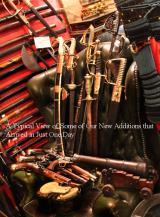
We Have New Fascinating Items Added To The Site Every Single Day.
Wonderful and intriguing pieces, such as a Renaissance period helmet and fusetto stiletto dagger, as used by a chief Cannoneer of the Papal Army in the 16th century, up to 500 years ago, commanded by Cesare Borgia, son of the Borgia Pope, and later in the 16th century, By Matteo Barbarini, brother to Pope Urban VIIIth.
Also, many military souvenirs of all kinds from WW1 and WW2, to, say, a Spanish Conquistador's helmet of the 16th century, to Ian Fleming’s James Bond, 1960's Ist Edition books, a Baker Rifle sword-bayonet, to original samurai swords hundreds of years old.
All are original, beautiful, historical and truly intriguing pieces.
This week we will be adding some superb and inexpensive Roman and Greek antiquities, plus medieval antiquities too. We are also sending our deliveries to our clients in the UK, Australia, America, & Canada, every working day, containing the rarest and finest pieces, from books, to helmets, swords and antiquities. read more
Price
on
Request

A, Good, Rare, Heavy Plate, Original Italian Vatican Infantry Army Helmet of Pope Urban VIIIth’s Armoury, a Cabasset Helmet 1500’s. As Used By The Cannoneers of the Papal Artillery. Originally Sourced From The Papal Armoury, in The Vatican
It’s companion Cabasset helmets are now in the Vatican Historical Museum in the Lateran Palace, Rome
The defensive helmet as used by the cannoneers of Pope Urban’s Papal Army artillery, and just as would be used by the chief cannoneer in battle, in the army commanded by Mateo Barbarini, Pope Urban’s brother. A helmet worn, while also armed with the chief Cannoneers fusetto
Used in artillery combat in Papal armies, such as were once commanded by the infamous Cesare Borgia, who was an Italian cardinal and condottiero, an illegitimate son of Pope Alexander VI and member of the Spanish-Aragonese House of Borgia.
His fight for power was a major inspiration for ‘The Prince’ by Niccolò Machiavelli. The Prince, one of Machiavelli's greatest works, as Machiavelli admired Borgia's undimmed ruthlessness, but mainly, because Borgia, for Machiavelli, exhibited a unity and coherence of purpose and intents that was good for the polity. {see Casare’s portrait in the gallery}
This is a Papal Army helmet from the collection of armour in the armoury of the Papal Army in Rome.
Good Heavy Italian Infantry Helmet Cabasset , hammered steel raised from a single plate, medial ridge with pear stalk finial stepped flared brim with turned over edge and in very good condition.
Provenance: From the Papal Armoury; and later acquired by London dealers Fenton & Sons Ltd. Fenton and Sons, Antique Arms and Armour, around 100 years ago. They traded in London from 1894-1927. and supplied, amongst others, the British Museum. An interesting point aside, we used to supply Fentons back in the 1920's ourselves. This and a few others were acquired by Fentons in 1919 and were listed in their catalogue. They were all from the Papal Armoury in Rome made for the Barberini family.
The Barberinis supplied the armour and cabassets for the papal army in the 16th century, a period fraught with anarchy and bandits and direct attacks on papal territories by Parma. The close association led to Maffeo Barberini becoming Pope Urban VIII. His brother Taddeo was made Supreme Commander of the Papal Army. The helmets, including this one, were from the papal armoury and served through the papal wars. It is estimated that about 4500 men served the papal army and most would have worn cabassets, making the original number of the group well over 4000. Others from the group are now in the Musio Storico Vaticano the Old Papal armoury now in the Vatican Historical Museum in the Lateran Palace, Rome.
The Papal Army was the loosely-construed army of volunteers and mercenaries in the service of the Italian Papal States, active from the 8th century until the capture of Rome by Italy in 1870. The Papal States maintained a sizeable military during the Middle Ages, using it to fight against the Holy Roman Empire and its Ghibelline allies. During the 1300s, the Papal States began to employ the services of condottieri, mercenaries who sold their services to the extremely wealthy Catholic Church. These forces would be instrumental to the defence of the Pope during the Italian Wars of the 15th and 16th centuries, with Cesare Borgia leading the Papal Army on a campaign of conquest that added several new city-states and regions to the Papal States' territories. Painting in the gallery of the Massacre of San Bartolome in the Catholic-Protestant Religious Wars, where the French crown aided by Queen Catherine de Medici, mother of the French King, with the Pope's blessing, fought ten of thousands of Huguenots what is considered the second deadliest religious war in European history (surpassed only by the Thirty Years' War, which took eight million European lives) The pope was so delighted with the battle he ordered a Te Deum to be sung as a special thanksgiving (a practice continued for many years after) and had a medal struck with the motto Ugonottorum strages, read more
1750.00 GBP
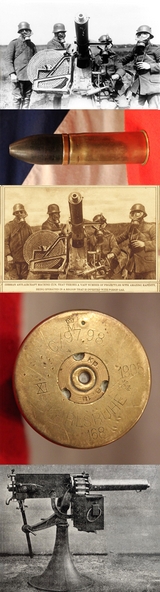
An Original, WW1, German Kaiserliche Marine Vickers-Maxim I Pounder Pom Pom Shell
Imperial Kaiserliche Marine Stamped. A superb fuzed shell head fully stamped and marked. With a 37mm calibre the water-cooled, belt-fed Maxim-Nordenfeldt (among others, with variants produced as Vickers-Maxim and Hotchkiss-Maxim) was the smallest item of artillery used during that war and boasted a firing rate of 60 rounds per minute, utilising a belt of 25 one-pound shells, each shell covering a distance ranging up to 3,000 yards. In World War I, it was used as an early anti-aircraft gun in the home defence of Britain. It was adapted as the Mk I*** and Mk II on high-angle pedestal mountings and deployed along London docks and on rooftops on key buildings in London, others on mobile motor lorries at key towns in the East and Southeast of England. 25 were employed in August 1914, and 50 in February 1916. A Mk II gun (now in the Imperial War Museum, London) on a Naval pedestal mounting was the first to open fire in defence of London during the war. However, the small shell was insufficient to damage the German Zeppelin airships sufficiently to bring them down. The Ministry of Munitions noted in 1922: "The pom-poms were of very little value. There was no shrapnel available for them, and the shell provided for them would not burst on aeroplane fabric but fell back to earth as solid projectiles were of no use except at a much lower elevation than a Zeppelin attacking London was likely to keep"
Nevertheless, Lieutenant O.F.J. Hogg of No. 2 AA Section in III Corps was the first anti-aircraft gunner to shoot down an aircraft, with 75 rounds on 23 September 1914 in France.
The gun was experimentally mounted on aircraft as the lighter 1-pounder Mk III, the cancelled Vickers E.F.B.7 having been specifically designed to carry it in its nose.
Hiram Maxim originally designed the Pom-Pom in the late 1880s as an enlarged version of the Maxim machine gun. Its longer range necessitated exploding projectiles to judge range, which in turn dictated a shell weight of at least 400 grams (0.88 lb), as that was the lightest exploding shell allowed under the St. Petersburg Declaration of 1868 and reaffirmed in the Hague Convention of 1899. Dated 1905. Not suitable for export, empty inert and safe. read more
95.00 GBP

A Superb, Original, Late Queen Elizabeth Ist to King James Ist Period Miniature Pistol. Late 1500's, To The Turn of The 17th Century, Functioning Miniature Pistol
A tiny pistol, made in bronze, many hundreds of years ago, to fire off, likely for the entertainment of the nobility and their children. Dark blue-black bronze age patination
An extraordinary little piece of rarely known history, from the earliest age of the black powder pistol. These intriguing miniature functioning pistols were called petronel, named after the original early name of matchlock and wheellock pistols, and very much of the period, from the Elizabethan to the Carolean age.
A petronel is a 16th and 17th century black powder muzzle-loading firearm, defined by Robert Barret (Theorike and Practike of Modern Warres, 1598) as a horsemans peece. It was the muzzle-loading firearm which developed on the one hand into the pistol and on the other into the carbine. The name (French petrinel or poitrinal) was given to the weapon either because it was fired with the butt resting against the chest (French poitrine, Latin pectus) or it was carried slung from a belt across the chest. Petronels are found with either matchlock or wheellock mechanisms.
The sclopus was the prototype of the petronel. The petronel is a compromise between the harquebus and the pistol. Early petronels date back to the end of the 14th century, with a crude buttstock. Generally the touch hole is on the right side, and fired by a separate slow match. Sometimes they had small hinged plate covers to protect the priming from moisture. By extension, the term petronel was also used to describe the type of light cavalry who employed the firearm. The petronel (cavalryman) was used to support the heavy cavalry such as demi-lancers and cuirassiers. The petronel was succeeded by a similarly armed cavalryman called the harquebusier.
Every single item from The Lanes Armoury is accompanied by our unique Certificate of Authenticity. Part of our continued dedication to maintain the standards forged by us over the past 100 years of our family’s trading read more
225.00 GBP

An 1801 Pattern Baker Rifle Sword {Bayonet}. Brass D Hilt & Single Edged Long Sword Blade
Traditional ribbed grip hilt, flattened section knucklebow, slightly bent quillon with long retaining spring, released by press catch. 23 inch steel flat sided single edged blade with return false edge. No maker markings remaining.
The sword that affixes to the end of a rifle as a bayonet. However, as all British Army riflemen know, the rifleman carries a sword, not a bayonet, despite it looking and acting as one. The rifle was used throughout the entire Peninsular Wars, the War of 1812 in America and Waterloo, by the world's greatest marksmen to fight for King and Country. This is not the denigrate our cousins, the American Riflemen of course, but they were not fighting for King and Country.
The British army had learned the value of rifles from their experience in the American rebellion in the 1770's. However, existing rifle designs were considered to be to cumbersome, slow-firing, fragile or expensive to be put to use on any scale beyond irregular companies. Rifles had been issued on a limited basis and consisted of parts made to no precise pattern, often brought in from Prussia. The war against Revolutionary France resulted in the employment of new tactics, and the British Army responded, albeit with some delay. Prior to the formation of an Experimental Rifle Corps in 1800, a trial was held at Woolwich by the British Board of Ordnance on 22 February 1800 in order to select a standard rifle pattern; the rifle designed by Ezekiel Baker was chosen.
Colonel Coote Manningham, responsible for establishing the Rifle Corps, influenced the initial designs of the Baker. The first model resembled the British Infantry Musket, but was rejected for being too heavy. Baker was provided with a German Jager rifle as an example of what was needed. The second model he made had a .75 calibre bore, the same calibre as the Infantry Musket. It had a 32-inch barrel, with eight rectangular rifling grooves; this model was accepted as the Infantry Rifle, but more changes were made until it was finally placed into production. The third and final model had the barrel shortened from 32 to 30 inches, and the calibre reduced to .653, which allowed the rifle to fire a .625 calibre carbine bullet, with a greased patch to grip the now-seven rectangular grooves in the barrel. The rifle had a simple folding backsight with the standard large lock mechanism (marked 'Tower' and 'G.R.' under a Crown, although later ones had 'Enfield,' but these only saw service after Waterloo), with a swan-neck cock as fitted to the 'Brown Bess.' Like the German Jager rifles, it had a scrolled brass trigger guard to help ensure a firm grip and a raised cheek piece on the left-hand side of the butt. Like many rifles, it had a 'butt-trap' or patchbox where greased linen patches and tools could be stored. The lid of the patchbox was brass, and hinged at the rear so it could be flipped up. The stocks were made of walnut and held the barrel with three flat captive wedges. The rifle also had a metal locking bar to accommodate up to a 23- inch sword bayonet, similar to that of the Jager rifle. The Baker was 45 inches from muzzle to butt, 12 inches shorter than the Infantry Musket, and weighed almost nine pounds. Gunpowder fouling in the grooves made the weapon much slower to load and affected its accuracy, so a cleaning kit was stored in the patch box of the Baker; the Infantry Muskets were not issued with cleaning kits. read more
885.00 GBP

A Superb Group of Four Medals WW1 Trio, and Third Afghan War, 1919 Afghanistan Bar, India General Service Medal
The North Staffordshire Regiment served with heroism and distinction in WW1, and the 2nd battalion served in Afghanistan after WW1 in 1919.
In May 1919, as the world recovered from the First World War, Afghanistan invaded British India. A daring move, the invasion took the British and Indian governments by surprise. To repel the Afghans, they launched a massive land and air campaign, mobilising a third of a million troops. Despite facing this military might, the Afghans - aided by the North-West Frontier tribes - almost won the war.
Frontier Assault tells the story of the Third Anglo-Afghan War through the eyes of the men who fought it. The North Staffordshire Regiment was one of the first units dispatched to halt the Afghan advance. They defeated the enemy vanguard in a tenacious mountain assault in the Khyber Pass. After, they led the British counter-attack into Afghanistan.
In WW1 the regiment were part of the Staffordshire Brigade,
Private Sidney Richards, who came from West Bromwich and had been employed as a clerk before the war, served with the Machine Gun Section of the. He recorded his experiences in his pocket diary:
2nd April Rifle inspection. Marched to trench at Messines. Took trenches over from 3rd Monmouths.
3rd April On look-out. Duty man in my trench had his brains blown out by a sniper. Raining very heavy.
4th April Raining heavy. Had no rations brought to us. Shortage of water. Up to our knees in mud.
5th April Simply awful. Raining all day and night. Shells bursting all over the shop. All I have to eat is 1 biscuit - would give a fortune for a dish of tea.
6th April More shells. Plenty of mud. Weather a little better. Relieved at 10 p.m. Got to camp 2 a.m. Wed.The threat posed by snipers was a constant feature of trench warfare. Initially at least, the units of the Brigade were woefully ill-equipped to conduct sniping from their own lines, as they had neither specialist rifles or telescopic sights. Several men had lucky escapes, such as Sergeant C. F. Rose, a soldier from Stone serving with the 1/5th North Staffords:
"I had a narrow shave of getting blinded in both eyes. I was looking at the German trenches through a periscope, when a German sniper hit the top glass with a bullet, and the glass falling in small pieces filled my eyes. I thought I had been shot, for it was sharp work for the eyes. I am getting on all right now, but have been pretty bad."
Captain William Millner of the 1/5th South Staffords also narrowly avoided being killed while sniping on 5th May. One of the best shots in the country at that time, Millner was an excellent candidate for the role. While observing German movements from the barn of one of the farms close to the front line, he too was wounded by an enemy sniper. The bullet hit the cap badge of his service dress cap and creased his skull. Luckily, his injury was not serious and after a brief period of recovery returned to his battalion.
German snipers were also quarry for the Staffords, patrols being sent out into "No-Man's Land" to hunt them down. Sergeant Sydney Norton, a member of "C" Company, 1/6th North Staffords, reported the results of one such patrol in a letter to his wife in Tamworth:
"...me and another Sergt. the day before found a sniper. We watched his antics for two hours and I placed the rifle at him, bowled him over the third shot and then got back to our trench. It's clinking sport like looking for game. They are very smart. We saw a dead cow in front of our trench. We fired a volley into it and the next day the Sergts. went out and found a dead sniper inside it, so you can tell the antics of war craft they get up to."
The last photo in the gallery is of Frontier Assault by James Green not included with group, just a suggestion. This might make a nice North Staffordshire Regt. Afghan War history book accompaniment for the medal read more