


A Very Rare Original Medeavil Book, Vitae Pontificum, Ist Edition, of 1479, By Bartolomaeus Platina, Vitae Pontificum (Lives of the Popes) and Personally Presented It To Pope Sixtus IV, From the Library of Abolishionist William Roscoe
Only the second example we have ever seen in almost 60 years.
Pope Sixtus IVth's Appointed Vatican Librarian. This remarkable tome an Incunabule is over 545 years old. When Bartolomeo Sacchi ('Platina', 1421-1481) wrote this Vitae pontificum (Lives of the Popes) and personally presented it to Pope Sixtus IV in 1475, he surely could not have imagined how influential it would become over the centuries. His was the first papal history, the lives of the popes from the time of Jesus Christ, to the reign of Sixtus IV, composed as a humanist Latin narrative and, as such, marked a distinct breakthrough in relation to the Liber pontificalis, the standard medieval chronicle of the papacy. Whatever Platina's intentions for the book that was published in 1479, it soon came to be regarded as the official history of the Roman pontiffs, an icon of the earliest printing. Formerly from the library of the renown Abolishionist William Roscoe, sold by him at auction in 1816 for £1.13/-, due to the financial difficulties of his banking house, and acquired by order of the Library Committee of the City of Bath Reference Library. This book was likely commissioned due to the influences of Pope Sixtus IV Francesco della Rovere upon his librarian, it's author, Bartolomaeus Platina. We show in the gallery a painting of Pope Sixtus appointing Platina as the official Vatican Librarian. An Incunable is a most rare book, pamphlet, or broadside (such as the Almanach cracoviense ad annum 1474) that was printed not handwritten before the year 1501 in Europe. They are the earliest form of printed books. Incunabula include the Gutenberg Bible of 1455, probably the most valuable book in the world. This is a First Edition of Bartholomaeus Platina's great history of the lives of the Popes, the first systematic papal history, not only to create the first detailed history of the Popes but also to villify his mortal enemy Pope Paul IInd Pietro Barbo. This book was created in the era of the great Rennaiscance, in the time of the notorious Borgias and in the year of the notorious Pazzi conspiracy, which was a plot by members of the Pazzi family and others to displace the de' Medici family as rulers of Renaissance Florence. It was printed at the time that Leonado De Vinci drew the hanging of a Pazzi conspiritor Bernardo di Bandino Baroncelli. On 26 April 1478 there was an attempt to assassinate Lorenzo de' Medici and his brother Giuliano de' Medici. Lorenzo was wounded but survived; Giuliano was killed. The failure of the plot served to strengthen the position of the de' Medici. The Pazzi were banished from Florence. During the time the Platina served as the first librarian at the Vatican under its modern founder, Sixtus IV. Platina started his career as a soldier employed by condottieri, before gaining long-term patronage from the Gonzagas, including the young cardinal Francesco, for whom he wrote a family history. He studied under the Byzantine humanist philosopher John Argyropulos in Florence, where he frequented other fellow humanists, as well as members of the ruling Medici family.
Around 1462 he moved with Francesco Gonzaga to Rome, where he purchased a post as a papal writer under the humanist Pius II (Enea Silvio Piccolomini) and became a member of the pagan-influenced Roman Academy founded by Pomponio Leto. Close acquaintance with the renowned chef Maestro Martino in Rome seems to have provided inspiration for a theoretical treatise on Italian gastronomy entitled De honesta voluptate et valetudine ("On honourable pleasure and health"), which achieved considerable popularity and has the distinction of being considered the first printed cookbook.
Platina's papal employment was abruptly curtailed on the arrival of an anti-humanist pope, Paul II (Pietro Barbo), who had the rebellious Platina locked up in Castel Sant'Angelo during the winter of 1464-65 as a punishment for his remonstrations. In 1468 he was again confined in Castel Sant'Angelo for a further year, where he was interrogated under torture, following accusations of an alleged pagan conspiracy by members of Pomponio's Roman academy involving plans to assassinate the pope.
Platina's fortunes were revived by the return to power of the strongly pro-humanist pope, Sixtus IV (Francesco della Rovere), who in 1475 made him Vatican librarian an appointment which was depicted in a famous fresco by Melozzo da Forli. He was granted the post after writing an innovative and influential history of the lives of the popes that gives ample space to Roman history and pagan themes, and concludes by vilifying Platina's nemesis, Paul Iia paragraph from Platina's Vitae Pontificum first gave rise to the legend of the excommunication of Halley's comet by Pope Callixtus III,
Vitae Pontificum ("Lives of the Popes", 1479) "Incunable" is the anglicised singular form of "incunabula", Latin for "swaddling clothes" or "cradle", which can refer to "the earliest stages or first traces in the development of anything." A former term for "incunable" is "fifteener", referring to the 15th century. Vitae pontificum, FIRST EDITION, 239 leaves (of 240, lacking first leaf), 39 lines, roman (and a little Greek) letter, capital spaces with guide letters, a few early marginal ink annotations, tears repaired to 2 leaves, small worm trace in upper margin of approximately 30 leaves (touching letters on approximately 20), inner margins of final leaves strengthened at gutter margins and a few other small paper repairs, gnawing to some fore-corners, blindstamp on approximately 6 leaves, late seventeenth/early eighteenth century red morocco gilt, sides panelled with corner, side and central decorations, spine gilt-tooled (including title and publication date) in 7 compartments within raised bands, rebacked preserving most of original spine. Venice, Johannes de Colonia and Johannes Manthen, 11 June 1479. William Roscoe's copy of the first editon of Platina's history of the Popes.
Provenance: William Roscoe (1753-1832), historian and author of Lorenzo de Medici (1796) and The Life of Pope Leo X (1805), with a 10-line pencil note in his hand, above which an ink note reads "Notes by Wm. Roscoe vide infra. Coll. By him". One of this books former owners was the renown William Roscoe (8 March 1753 , 30 June 1831). He was an English historian, leading abolitionist, art collector, M.P. Lawyer, banker, botanist and miscellaneous writer, perhaps best known today as an early abolitionist. 11.25 inches x 7.5inches x 2.25 inches. read more
4950.00 GBP
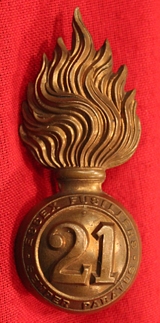
21st Regiment Essex Fusiliers Large Service Helmet Flaming Grenade Badge. Circa.1887
Canadian Militia busby helmet badge. 21st Regiment Essex Fusiliers Fur Busby grenade. Circa.1887 Brass grenade with two lugs to the reverse in excellent condition.
A military presence in Windsor and Essex County dates back as far as 1701, when all men in the community were essentially militia members, armed to combat a perceived 'Indian threat'. When Irish-American Nationalists invaded Canada in 1866, even stronger forces were established locally. By 1885, local militias had amalgamated into the 21st Essex Battalion of Infantry.
By the advent of the First World War, the 21st Battalion (now known as the 21st Regiment Essex Fusiliers) was placed on active service. Initially, they contributed to Canada's 1st Battalion, upon its formation in 1914, then later the 18th Battalion (consisting largely of Essex Fusilier soldiers. The 18th Battalion served in France and Flanders from 1915 until the Armistice.
The regiment perpetuated the 18th (Western Ontario) Battalion, 99th (Essex) Battalion and 241st (Canadian Scottish Borderers) Battalion of the Canadian Expeditionary Force and held its final Order of Precedence as 40. Battle honours for the regiment include: First World War: Ypres 1915 & 17, Festubert 1915, Mount Sorrel, Somme 1916 & 18, Flers-Courcelette, Thiepval, Ancre Heights, Arras 1917 & 18, Vimy 1917, Hill 70, Passchendaele, Amiens, Scarpe 1918, Hindenburg Line, Canal du Nord, Cambrai 1918, Pursuit to Mons, France & Flanders 1915-18 Second World War: Dieppe Raid (1942), Battle of Verrigres Ridge (1944), liberation of Dieppe (1944), Battle of the Scheldt (1944), The Rhine (1944-1945), Northwestern Europe
By 1926, an alliance was formed with the Essex Regiment of the British Army, and by 1927, the Essex Scottish had adopted the MacGregor tartan based on Scottish Highland tradition. That year an alliance was also established with the Queen’s Own Royal West Kent Regiment of the British Army.
The Regiment was the first unit of men in Western Ontario to be called up during World War II and one of the first Canadian units to see battle overseas. Their first fight was the tragic Dieppe raid on August 19th, 1942 where the Regiment was hit particularly hard during Operation Jubilee. When the smoke cleared, the Regiment had lost 121, and many of the survivors were either wounded or captured. With barely enough time to regroup, the regiment prepared itself for the invasion of France. On July 5th 1944, it participated in the bloody landing at Normandy, and then fought on through France, Holland and Germany until the war's end.
By then, the regiment had suffered 552 dead and had been inflicted with the highest number of casualties of any unit in the Canadian Army-a staggering 2,510. read more
245.00 GBP
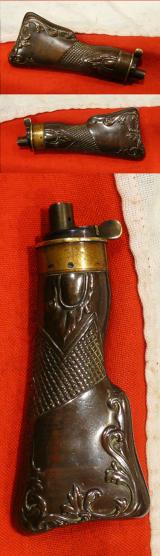
A Wonderful and Highly Desirable Original Antique Pistol Flask Shaped in the Form of a Rifle Butt
An absolute gem for even the most discerning of pistol flask collectors.
The 'butt stock' type are very rare indeed, and the smaller type, like this, are certainly the most desirable of all.
Overall in very nice condition indeed with very fine patination. This is one of the most desirable and highly sought types of pistol flask for casing with tools for rare Colt revolvers and fine British pistols.
This superb flask would compliment any fine cased pistol or pistols, from flintlocks to revolvers.
5 inches long 2.25 inches wide at widest. Small denting at the base and spout. read more
485.00 GBP
The Lanes Armoury's Specialist Museum Grade Restoration, Cleaning & Conservation
For generations we have prided ourselves on commissioning and providing the finest quality artisan restoration and conservation services available in the UK. Sadly, over the decades, many of these, and our, genius artisans have passed away, and there are so few that have today decided to follow in their esteemed footsteps, but we still have a few. Our late gunsmith, Dennis Ottery joined us as a gun restorer after his demobilisation from the British Army 'Green Jackets' Rifles Regt. in 1946, and he was our master gunsmith for more than 55 years, till the early 2000's.
Restoration is often a vital part to saving and preserving fine, rare or even regular pieces that have been neglected or damaged over the past decades or even hundreds of years, and by doing so we have had fantastic results that are incredibly satisfying and created a wonderful feeling of accomplishment. However, these specialist arts can progress slowly, and can be expensive, and are thus time-consuming but incredibly worth the wait and effort. Thus we do not actively undertake third-party restoration at all due to the often excessive costs and considerable time involved. It is not unknown for a specialist restoration and conservation project of a single piece to take several years
Another important factor though, is that bad and poorly executed restoration can be far worse than doing nothing at all.
Restoration is a magnificent art, and often well worthwhile for important pieces when successful, but it is not to be undertaken lightly without all due consideration.
It is important to understand all factors when considering such improvements to fine antique pieces.
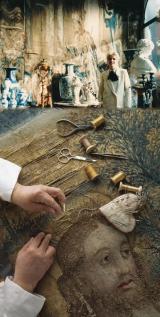
We were once advisers for the restoration of our magnificent 16th century 'Brussels' tapestry, that we sold to one of the great American collectors some decades ago.
You can see it in our photo gallery, photographed on display in our Prince Albert Street shop, with Judy Hawkins, Mark’s incredibly talented and beloved late wife, standing in the foreground. Another photograph is of a specialist lady restorer's hands, working upon the tapestry. The eventual restoration cost, in today’s terms, was over £600,000, and it took over 3 years to complete. A sobering sum, often outside of the deep pockets of national collections resources, but incredibly worthwhile none the less, as that tapestry would now likely be valued in the millions of pounds.
When we undertake restoration and conservation of our pieces, it will only be on items that we have decided would richly benefit from such attention, and we will also undertake this work often for posterity, in order to save, for future generations, pieces that may well might have been discarded in their poor, previously un-restored, neglected state.
We will often contribute towards, and therefore subsidise, these conservation costs ourselves, in order to save a piece of rarity, beauty, or historical significance, for this very reason. The improvement of 'value' alone is never, ever, our primary concern, and should, ideally never be the principle desire for collectors either. It should be for the preservation of fine past craftsmanship, and to restore fine cultural heirlooms for posterity, and for the benefit of all the generations to come.
If we restore an item that was acquired from us by a client, pre restoration, be they a museum, a private collector or specialist dealer, the results can be not only spectacular, but also incredibly satisfying to know that a fine piece has been saved for generations to come, and will be an ancestral heirloom for the future read more
Price
on
Request

A Rare and Very Fine WW1 German Sniper's Scharfschutzengewehr Optical Scope. Some Of The Best & Most Desirable Sniper Scopes Are 20th Century Fine German Examples Such As This
WW1 German Sniper Optical Scope, steel body scope with bracket fittings to the lower section. Top focusing mount is maker marked “Rudiger & Bischoff Braunschweig”. Remains of the blued finish. Optics remain clear. Photo in the gallery of German snipers in WW1 and a cabinet of original snipers kit, including the rifle and sniper site, in the Imperial War Museum. During World War I, snipers appeared as deadly sharpshooters in the trenches. At the start of the war, only Imperial Germany had troops that were issued scoped sniper rifles. Although sharpshooters existed on all sides, the Germans specially equipped some of their soldiers with scoped rifles that could pick off enemy soldiers showing their heads out of their trench. At first the French and British believed such hits to be coincidental hits, until the German scoped rifles were discovered. During World War I, the German army received a reputation for the deadliness and efficiency of its snipers, partly because of the high-quality lenses that German industry could manufacture.
During the First World War, the static movement of trench warfare and a need for protection from snipers created a requirement for loopholes both for discharging firearms and for observation. Often a steel plate was used with a "key hole", which had a rotating piece to cover the loophole when not in use.Imperial German Scharfschutzengewehr (Sharpshooters rifle in German) Model 1898 sniper rifle in 7.92x57 or more commonly known as 8mm Mauser. At the beginning of World War 1 no country had a "sniper program" as we know it today. Germany in 1915 outfitted the most experienced marksmen (typically pre-war game wardens and poachers) with specially selected factory rifles and equiped them with optical hunting sights. These early telescopic sights usually consisted of 2.5x, 3x and 4x power, produced by manufactures like Görtz, Gérard, Oige, Zeiss, Hensoldt, Voigtländer Rudiger & Bischoff and various civilian models from manufacturers like Bock, Busch and Füss. These rifles were standard 1898 Military Model which held exceptionaly high accuracy at the factory. They were fitted with a Model 1898AZ carbine bolt and optic and issued to an individual Soldier (Soldat) instead of a unit. Due to the very high usage of steel armor piercing ammunition the barrels were rapidly erroded and the life span for accuracy was between 1000-2500 rounds, often less, before having to be replaced. Soon the British army began to train their own snipers in specialized sniper schools. Major Hesketh Hesketh-Prichard was given formal permission to begin sniper training in 1915, and founded the First Army School of Sniping, Observation, and Scouting at Linghem in France in 1916. Starting with a first class of only six, in time he was able to lecture to large numbers of soldiers from different Allied nations, proudly proclaiming in a letter that his school was turning out snipers at three times the rate of any such other school in the world.
He also devised a metal-armoured double loophole that would protect the sniper observer from enemy fire. The front loophole was fixed, but the rear was housed in a metal shutter sliding in grooves. Only when the two loopholes were lined up—a one-to-twenty chance—could an enemy shoot between them. Another innovation was the use of a dummy head to find the location of an enemy sniper. The papier-mâché figures were painted to resemble soldiers to draw sniper fire. Some were equipped with rubber surgical tubing so the dummy could "smoke" a cigarette and thus appear realistic. Holes punched in the dummy by enemy sniper bullets then could be used for triangulation purposes to determine the position of the enemy sniper, who could then be attacked with artillery fire. He developed many of the modern techniques in sniping, including the use of spotting scopes and working in pairs, and using Kim's Game to train observational skills. An original complete Imperial German Scharfschutzengewehr (Sharpshooters rifle in German) Model 1898 GEW98 rifle, with its scope, just as this one, can now fetch over $11,000. read more
1195.00 GBP
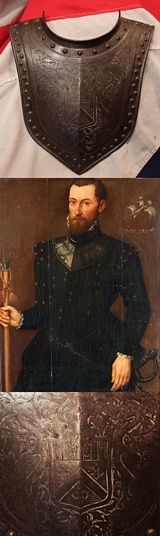
A Most Fine Tudor Heraldic Crested Steel Armour Gorget of a Duke
A most beautiful antique piece of armour, in the 16th century style, but likely made in the 18th to early 19th century. It bears a most fine etched heraldic ducal crest, composed of a pair of cranes bearing a five bar face guarded demi-profile dukes helmet, mounted above a shield with chevron below four ermine panels, with three, four lobed devices about the chevron on both sides. The entire rim bears brass headed steel rivets and two shoulder centred large brass rivets that once held leather straps. We show in the gallery several portraits of Elizabethan nobles all adorned in their armour gorget over fine tunics of velvet or leather. The gorget was the last remaining symbol of knightly armour universally worn either at court or in combat by nobles in the Elizabethan period Although other elements of armour could be worn, such as arm defences, in accompaniment as the wearer saw fit. In the High Middle Ages, when mail was the primary form of metal body armor used in Western Europe, the Mail coif protected the neck and lower face. During the 14th century as more plate armor appeared to supplement mail, the Bascinet helmet incorporated a mail curtain called the Aventail which protected the lower face, neck and shoulders. A separate mail collar called a "pisan" or "standard" was sometimes worn under the aventail as additional protection. Towards the end of the 14th century, threats including the increased penetrating power of the lance when paired with a lance rest on the breastplate made more rigid forms of neck protection desirable. One solution was a standing collar plate worn over the aventail and separate from the helmet, which was wide enough for the helmet to move around in so that the man-at-arms could turn his head. Through the early 15th century, gorget plates were integrated into the helmet itself to form the great bascinet. Other forms of helmet such as the sallet which did not protect the lower face and throat with plate were paired with a separate bevor, and the armet was often fitted with a wrapper that included gorget lames protecting the throat. During this time, the mail standard was still used.
At the beginning of the 16th century, the gorget became fully developed as a component of plate armor in its own right. Unlike previous gorget plates and bevors which sat over the breastplate and required a separate mail collar to fully protect the neck from gaps, the developed gorget was worn under the back and breastplate and was intended to cover a larger area of the neck, nape, shoulders, and upper chest, since the upper edges of the cuirass had become lower than before. The gorget served as an anchor point for the Pauldrons, which either had holes to slide over pins projecting from the gorget, or fastened to the gorget by straps and buckles. The neck was protected by a high collar of articulated lames, and the overall gorget consisted of front and back pieces which were hinged at the side so it could be put on and taken off. Some helmets had additional neck lames which overlapped the gorget, while others fitted tightly to the top of the gorget so that there would be no gap between them.
By the 17th century there appeared a form of gorget with a low, unarticulated collar and larger front and back plates which covered more of the upper chest and back. These were not worn with a breastplate as part of a full harness, but instead were worn over civilian clothing or a Buff coat. Some gorgets of this period were "parade" pieces that were beautifully etched, gilded, engraved, chased, embossed, or enamelled at great expense. Gradually the gorget became smaller and more symbolic, and became a single crescent shape worn on a chain, which suspended the gorget ever lower on the chest so that the gorget no longer protected the throat in normal wear. It is one of the more unusual elements of the arms and armour collecting field that 18th and 19th century fine etched armour, in the earlier styles of the 16th century, can be prized the same, or even more highly than the earlier originals that they were based upon. Companies such as Granger of Paris, that worked in the 1840's, created miniature suits of armour that can achieve tens of thousands of pounds, even approaching six figures today, that are no more than 50 cms high complete. Size 14 inches x 12 inches. read more
1450.00 GBP
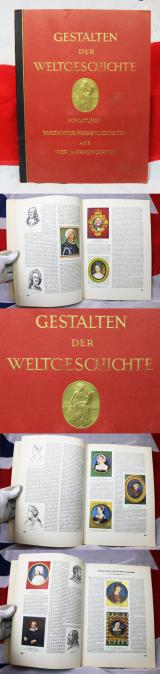
Gestalten Der Weltgeshichte Miniaturen. Shaping World History. Contemporary Miniatures of Famous Personalities from Four Centuries (Third Reich Publication1933)
A superb 1930's German album-book perfect for the collector of antique miniatures and famed personalities of history
Wiemann, Hermann (Text)
Gestalten der Weltgeschichte . Zeitgenössische Miniaturen berühmter Persönlichkeiten aus vier Jahrhunderten (1933)
Contemporary miniatures of famous personalities from four centuries, paperback with gold embossing, A4, Cigarettn-Bilderdienst, 1933, 111 pages, really good condition for its age,
Cardboard cover with gold embossing, 111 pages, approx. 31 x 23.5 cm, Humanism and Reformation in Germany / The Renaissance in Italy / England under the Tudors / The Renaissance in France / Spain and the Netherlands / Thirty Years' War / Absolutism in Prussia and Saxony / Absolutism in France / England under the Stuarts and the Revolution / England in the 18th century / France under Louis XV / Austria in the 18th century / Frederick the Great and his time / Russia / the time of Goethe / Louis XVI. and the French Revolution / Napoleon I and his time / Germany in the war of liberation / German Romanticism / The 19th century Shapes of world history Contemporary miniatures of famous personalities from four centuries Published by Cigaretten-Bilderdienst, Hamburg-Bahrenfeld, 1933 151.-180. read more
45.00 GBP
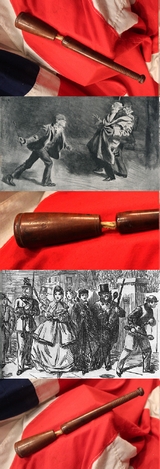
A Superb 19th Century Persuader Cosh. A Victorian, City Dwellers Version Of A Royal Navy 'Press-Gang' Cosh
Also a so called, 'life preserver', concealable flexible head cosh that would once have been well concealed about a gentleman's person, within an inside overcoat pocket, or tucked through a waist belt. Based on a press gang club from the Georgian era In the Victorian era, after dark, city thoroughfares abounded with ruffians neer'do wells and garrotters. Police forces, in those days, were in their infancy, and the respectable and well heeled inhabitants, when travelling the streets and lanes of most cities, were understandably paranoid for their safety, so most protection had to be provided for by oneself, and all due precautions and defensive measures explored. This is a wonderful example of a club, known at the time as a life preserverWe detail an article from Punch Magazine, August 18th 1866, regarding a trial of some violent street attackers?.. "No less than six roughs, two of them garrotters, convicted at Manchester Assizes, of robbery with violence, were sentenced the other day by Mr. Justice Lush, to be, in addition to penal servitude, flogged with the cat-o'-nine-tails. ? If there is in his the criminal's nature any degree of latent sympathy, inactive from want of imagination, it can be stimulated to due activity only be a whipping which will give him considerable pain. All that pain is economy of pain; of so much pain as it saves respectable people from suffering by brutal violence. ? Some of the six scoundrels whipped at Manchester, being pachydermatous, made a show of bravado. To preclude this in future, let all such offenders be sentenced to be flogged two or three times."
Punch, August 18, 1866. We show several original Victorian Punch magazine and journal illustrations of several persons being accosted in the city streets by thugs, and a group of ladies and gentlemen walking in the road armed with coshes and clubs for protection for information only. read more
395.00 GBP

A Most Rarely Seen, Antique Ceremonial, Head-Hunters Sword 'Pusaka Magic' Dohong, A Borneo, Dyak Shamen's, Kayanic Art Ritual Sword, With a Carved, Twin-Head Hilt
This is an amazing dohong, a Borneo kayanic art carved twin headed hilt sword, given to a previous owner, by a Dyak headhunter shamen, with a hardened skin scabbard, possibly goatskin. It’s condition is superb with stunning natural age patina to the carved wooden hilt. Kayanic art is most distinctive in the depiction of carved heads, with an owl-like style of heart shaped face carving
There are a lot of intriguing interest about this most rare form of shamen's dohong when they appear. They can come in either dagger or short sword form, and both are rare, but due to the fact it was likely used mostly for ceremonial "pusaka magic", many have never seen such a piece to survive. Few such ceremonies had ever been seen by Westerners, as very few outsiders visited the inner Dayak tribes during the 19th century. Of course ceremonial Dyak shamen magic was not always benign, as it could often include head-hunting, so the reticence of strangers to attempt to view such ceremonies was highly understandable
There is however, a somewhat similar carved wood hilted double headed kyanic art example in the National Museum Wereldkulturen in Rotterdam, and from all the ones we have seen, although very few in number of course, they have had all manner of bespoke differences. See photo 10 of that particular similar sword in the gallery
Dayaks are a collection ethic groups that have traditionally lived in the forests in both the Malaysian and Indonesian sides of Borneo. They are distinguished from the Malay population in that for the most part they are not Muslims and distinguished from the Penan in that have traditionally been settled while the Penan were nomadic.
The Dayaks are former head hunters and the original "wild men of Borneo." They continued to practice headhunting after it was outlawed by the Dutch in the 19th century. Up until World War II most of them were river-dwelling head hunters. Now many have been Christianized and forced into settlements. Even though they were the original inhabitants of Borneo they are now greatly outnumbered by Malays and Indonesians. It is believed that most Dayaks lived along the coast until they were driven inland after the arrival of the Malays.
Dayak "psycho-navigators” use visions and dreams to help them find their way in the forest. Dayak shaman practitioners of the "Old Snake religion” describe a hidden highland lake where enormous aging pythons enjoy dancing under the light of the full moon to honor the forest god Aping. Many Dayaks are Christians who have incorporated animists concepts onto their belief scheme. Missionaries went through the trouble of backpacking in paints and brushes to make hellfire scenes on the sides of longhouses. On the positive side missionaries have helped the Dayak clear landing strips which can be used for medical emergencies.
James Brooke wrote in his journal in “Expedition to Borneo of H.M.S. Dido for the Suppression of Piracy”: “The Kayans of the north-west coast of Borneo have one custom in common with the wild tribe of Minkoka in the Bay of Boni. Both the Kayans and Minkokas on the death of a relative seek for a head; and on the death of their chief many human heads must be procured: which practice is unknown to the Dyak. It may further be remarked, that their probable immigration from Celebes is supported by the statement of the Millanows, that the Murut and Dyak give place to the Kayan whenever they come in contact, and that the latter people have depopulated large tracts in the interior, which were once occupied by the former. Source: “The Expedition to Borneo of H.M.S. Dido For the Suppression of Piracy” by Henry Keppel and James Brooke (1847).
The Dayak perform elaborate death ceremonies in which the bones are disinterred for secondary reburial. The Ngaju Dayaks in the Mendawai area of Kalimantan keep alive their ancient burial rituals called Tiwah. Participants wear bizarre masks, with owl-like heart shaped faces, sing, and stage mock attacks. They exhume the bones of the dead, anoint and touch the bones and re-intern them in family “sandung”. (House-shaped boxes on stilts). In the old days headhunting was often include in the ritual.
Interestingly, despite returning from the darkest regions of the interior of Borneo, with this gifted sword, by the original vendors father, a former merchant ship captain, we were reminded, due to a mention from a regular viewer of our site, that we once had a somewhat similar style prestige sword from the Bamum or Tikar people of Cameroon. A tribe known for its similar highly talented artistry and carving. We couldn’t help wondering if there could once possibly have been a connection of some sort between these two native peoples due to the similarity of this wood-carvings artistry, despite around 7,000 mile distance between these peoples across the Indian Ocean. Could the Tikar peoples have made swords inspired by the Borneo version, or indeed could it be the other way around, and a Tikar sword found its way to Borneo. We may never know.
The captains son mentioned his father had a b&w photograph with the entire tribe’s elders after gifting him this sword. Apparently he became a most favoured ‘foreigner’ with the tribe due his supply of important necessities to them in ‘difficult times’. This may have been during the imminent Japanese invasions of that part of the world around the Indian Ocean in WW2.
The overall condition for age is excellent with just a small separation of the hide at the base of the scabbard. 28.5 inches long overall in scabbard, blade 16 inches long
Every single item from The Lanes Armoury is accompanied by our unique Certificate of Authenticity. Part of our continued dedication to maintain the standards forged by us over the past 100 years of our family’s trading read more
1200.00 GBP
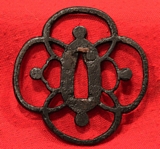
A Koto Period O-Sukashi Katana Tsuba
Circa 1550. Tsuba were made by whole dynasties of craftsmen whose only craft was making tsuba. They were usually lavishly decorated. In addition to being collectors items, they were often used as heirlooms, passed from one generation to the next. Japanese families with samurai roots sometimes have their family crest (mon) crafted onto a tsuba. Tsuba can be found in a variety of metals and alloys, including iron, steel, brass, copper and shakudo. In a duel, two participants may lock their katana together at the point of the tsuba and push, trying to gain a better position from which to strike the other down. This is known as tsubazeriai pushing tsuba against each other. read more
375.00 GBP