


A Fabulous, and Rare, 19th Century Imperial Russo-Prussian Grenadier's Mitre Cap
A most rarely surviving form of European service helmet. The highly distinctive mitre cap was in use by grenadier regiments of three principle nations [mostly British, Prussian and Russian] since the mid 18th century, they were used continually by the Russo-Prussians alone into the Napoleonic wars, in the early 19th century, right though in fact to the early 20th century, but they ceased to be used by the British in the end of the 18th century. The mitre cap is an extraordinary form of helmet that was both elaborate and decorative but also as a form of intimidation, to increase the perception of the height of a grenadier, yet still most functional for defence against sword cuts and slashes. Wih the helmets construction, a combination of cloth and pressed metal, creating a most effective ‘crumple zone’ against a slashing blade impact upon the soldiers head. The rarest of all the surviving mitre caps is beyond doubt the British, as they were in use for the shortest period of time and were entirely made of cloth, and that material survives poorly over 3 centuries. The Russian and Prussian examples had elements of metal within the helmets stamped crest frontispieces and frame, and, they were in use for longer, some into the WW1 period. However, all surviving examples are now very scarce indeed, and complete examples are most especially rare. The 18th and 19th century examples being the most rarest of all. The mitre cap, whether in stiffened cloth or metal, had become the distinguishing feature of the grenadier in the armies of Britain, Russia, Prussia and most German states during the late 17th and early 18th centuries. While Northern-European armies such as Britain, Russia, Sweden and various German states (perhaps most famously Prussia) wore the mitre cap, the southern countries, such as France, Spain, Austria, Portugal and various Italian states preferred the bearskin cap. By 1768 Britain too had adopted the bearskin. By the advent of the Napoleonic Wars, both mitres caps and fur caps had begun to fall out of use in favour of the shako. Two major exceptions were France's Grande Armee (although in 1812, regulations changed grenadier uniforms to those more similar to the ones of fusiliers, except in guard regiments) and the Austrian Army. After the Battle of Friedland in 1807, because of their distinguished performance, Russia's Pavlovsk Regiment were allowed to keep their mitre caps and were admitted to the Imperial Guard. In 1914 the Imperial German and Russian Armies still included a number of grenadier regiments. In the Russian Army these comprised the Grenadier Guards Regiment (L-G Grenadierski Polk) as well as the Grenadier Corps of sixteen regiments (plus an independent reinforced company of Palace Grenadiers, guarding the St. Petersburg Imperial residences). Five regiments of the Prussian Guard were designated as Garde-Grenadiers and there were an additional fourteen regiment of grenadiers amongst the line infantry of the German Empire. In both the Russian and German armies the grenadier regiments were considered a historic elite, distinguished by features such as plumed helmets in full dress, distinctive facings (yellow for all Russian grenadiers) or special braiding. A grenadier derived from the word grenade, and was originally a specialized soldier, first established as a distinct role in the mid-to-late 17th century, for the throwing of grenades and sometimes assault operations. At that time grenadiers were chosen from the strongest and largest soldiers. By the 18th century, dedicated grenade throwing of this sort was no longer relevant, but grenadiers were still chosen for being the most physically powerful soldiers and would lead assaults in the field of battle. Grenadiers would also often lead the storming of fortification breaches in siege warfare, although this role was more usually fulfilled by all-arm units of volunteers called forlorn hopes, and might also be fulfilled by sappers or pioneers. A very similar, near identical example appears illustrated and described in the The Lyle Official Arms and Armour Review 1983, page 261 read more
3950.00 GBP

A Supurb Trafalger Period Navy Rum, Stoneware Ceramic Rum Barrel, with King George IIIrd Royal Crest And Lions, & 'Fore and Aft' Barrel Tap Apertures
One imagine the Royal Naval officer's availing themselves daily of tots of rum. For meals, the officer's were supplied with decanted Port.
This is a simply superb navy rum barrel, stunningly impress decorated throughout the whole surface. with the Hanovarian royal crest of the Lion and Unicorn with lion surmounted crown, over the Hanovarian garter and shield. To the base of the crest are twin facing lions, in the same seated pose as can be seen at the base of Nelson's Column in Trafalgar Square.
Prior to 1655, a sailor's ration of alcoholic beverage was originally beer with a daily ration of one gallon (i.e. eight pints). This official allowance continued until after the Napoleonic Wars. When beer was not available, as it would often spoil easily, it could be substituted by a pint of wine or half a pint of spirits depending on what was locally available. In 1655, the difficulty in storing the large quantities of liquid required led to beer's complete replacement with spirits, with the political influence of the West Indian planters giving rum preference over arrack and other spirits. The half-pint of spirits was originally issued neat; it is said that sailors would "prove" its strength by checking that gunpowder doused with rum would still burn (thus verifying that rum was at least 57% ABV).
The practice of compulsorily diluting rum in the proportion of half a pint to one quart of water was first introduced in 1740 by Admiral Edward Vernon (known as Old Grog, because of his habitual grogram cloak). The ration was also split into two servings, one between 10 am and noon and the other between 4 and 6 pm. In 1795 Navy regulations required adding small quantities of lemon or lime juice to the ration, to prevent scurvy. The rum itself was often procured from distillers in Jamaica, Trinidad & Tobago and the British Virgin Islands. Rations were cut in half in 1823 and again in half, to the traditional amount, one-eighth of an imperial pint in 1850.
The abolition of the rum ration had been discussed in Parliament in 1850 and again in 1881 however nothing came of it. However, one dark day in 1970, Admiral Peter Hill-Norton abolished the rum ration as he felt it could have led to sailors failing a breathalyser test and being less capable to manage complex machinery.
This decision to end the rum ration was made after the Secretary of State for Defence had taken opinions from several ranks of the Navy. Ratings were instead allowed to purchase beer, and the amount allowed was determined, according to the MP David Owen, by the amount of space available for stowing the extra beer in ships. The last rum ration was on 31 July 1970 and became known as Black Tot Day as sailors were unhappy about the loss of the rum ration. There were reports that the day involved sailors throwing tots into the sea and the staging of a mock funeral in a training camp. In place of the rum ration, sailors were allowed to buy three one-half imperial pint cans of beer a day and improved recreational facilities. While the rum ration was abolished, the order to "splice the mainbrace", awarding sailors an extra tot of rum for good service, remained as a command which could only be given by the Monarch and is still used to recognise good service. Rum rations are also given on special occasions: in recent years, examples included the 100th anniversary of the Royal Canadian Navy in 2010 and after the Queen's Diamond Jubilee celebrations in 2012.
Heavy stoneware, around 8 kilos {guess} size, 17 inches high 13 inches across/ read more
495.00 GBP
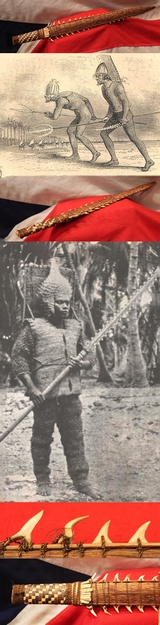
A Rare & Incredible Gilbert Islands Shark’s Tooth Kiribati Warriors Sword. In the Native Culture of The Islands It Is Called a Tebute.
A rarely seen {we have only had two in 15 years}, late 19th to early 20th century shark tooth sword, known as a tebute and was unique to the Gilbert Islands of Micronesia, the islands today are known as the nation of Kiribati.
The sword is made from seasoned wood of the coconut palm with cutting edges made from sharks teeth attached with fine fibrous cords. Most of these swords were destroyed by the maritime visitors to the islands. Kiribati has a history of contrived and ritualized duels. The armour was made of thickly woven sennit, a kind of coconut fibre. The duellists wore helmets made of blowfish remains. The helmets were resilient and, due to the structure of blowfish, covered with many points, which had the ability of damaging weapons. The weapons resembled broadswords with a serrated edge created with many shark teeth. The duels were performed mostly for the purpose of settling disputes and maintaining honour. The practicality of the duels is debatable. Due to the difficulty of moving in this armour, falling over and becoming unable to get back up was common enough that duel assistants were required. Kiribati has been known for its traditional martial arts which were kept within the secrets of several families for generations. The Kiribati arts of fighting as opposed to Asian martial arts are not often mentioned or even advertised to be known by the general public. Though, there may be some noticeable parallels in principle to that of Asian martial arts, they are merely really different. For instance, generally, there is no kicking as in Karate kicks or Kung Fu kicks, and speed is more important than power. A list of some of these traditional martial arts is as follows: Nabakai, Nakara, Ruabou, Tabiang, Taborara, Tebania, Temata-aua, Te Rawarawanimon, and Terotauea.
The essence of Kiribati traditional martial arts is the magical power of the spirits of the ancestral warriors. All these martial arts skills share one thing in common. That is, they came from an ancestral spirit.
"Nabakai" is a martial art from the island of Abaiang originated from the person named Nabakai. Nabakai was a member of the crab clan called "Tabukaokao". The three ancestral female spirits of this clan "Nei Tenaotarai", "Nei Temwanai" and "Nei Tereiatabuki" which usually believed to manifest themselves with a female crab came to him and taught him the fighting art. Overall 61 cm long. read more
1200.00 GBP

A Very Fine & Long 15th Century Katana, Around 600 Years Old, From An Historically Significant Great Samurai Clan, The Nabeshima Descendents of the Fujiwara, With Traditional Stone Polished Blade
The blade was sent to Japan some years ago for a fine stone traditional re polish. This superb ancient blade has a stunningly elegant curvature, and combined with a simply spectacular, vibrant and deep hamon, absolutely breathtaking, and very healthy for its age, and thus it makes this blade very special indeed, it is also very unusual for a blade of this age to survive its great length without alteration. The blade was fully traditionally stone polished. It has all its original Edo fittings, and its fine signed tsuba by Kinai of Echizen. It bears two mon, one in silver, 'Daki Myoga' mon of the great Nebeshima clan on the kashira, and the 'Sagarifuji' mon of the Fujiwara clan on the fuchi. The Nabeshima clan was a cadet branch of the Shoni clan and was descended from the Fujiwara clan. The Fujiwara became so powerful they had absolute control over the Imperial court. By the year 1000, Fujiwara no Michinaga was able to enthrone and dethrone emperors at will, effectively, "hereditary dictators". The Fujiwara controlled the throne until the reign of Emperor Go-Sanjō (1068–73), the first emperor not born of a Fujiwara mother since the ninth century. Emperor Go-Sanjō, determined to restore imperial control through strong personal rule, implemented reforms to curb Fujiwara influence. In the late 12th century, Fujiwara no Sukeyori, a descendant of Fujiwara no Hidesato in the 9th generation, received the title of Dazai Shoni (equivalent to that of vice-governor of the military government of Kyushu) from Shogun Minamoto no Yoritomo, and the title became the family name.
The clan played an important role in the region as early as the Muromachi period, when it helped suppress opposition to the Ashikaga shogunate's control of Kyushu. It did not take the name Nabeshima, however, until the late 15th century, when Shoni Shigenao established himself at Nabeshima in Hizen province (today part of Saga City, Saga prefecture). Later, in the Sengoku period (1467-1603), the Nabeshima were one of a number of clans which clashed over the island. The Nabeshima sided with the Ryuzoji clan against the Otomo clan, though this ultimately ended in failure and the death of Ryuzoji Takanobu at the 1584 battle of Okita Nawate. Several years later, however, the Nabeshima recovered power and prominence by aiding Toyotomi Hideyoshi in his 1587 invasion of Kyushu; Nabeshima Naoshige was granted the region of Saga as his fief, as a reward for his efforts. Naoshige also contributed to Hideyoshi's invasions of Korea in the 1590s.
The clan initially aided Ishida Mitsunari against Tokugawa Ieyasu in the Sekigahara Campaign in 1600. However, they switched sides to support the Tokugawa, who were ultimately victorious, before the campaign had ended, battling and occupying the forces of Tachibana Muneshige, who was thus prevented from contributing directly to the battle of Sekigahara. Though regarded as tozama daimyo ("outside" lords), and assigned particularly heavy corvee duties, the Nabeshima were allowed to keep their territory in Saga, and in fact had their kokudaka increased. The clan's forces served the new Tokugawa shogunate loyally in the years which followed; they remained in Kyushu during the 1615 Osaka Campaign as a check against a possible rebellion or uprising by the Shimazu clan, and aided in the suppression of the Shimabara Rebellion of 1637. In recognition of their service, members of the clan were granted the prestigious family name Matsudaira in 1648.
During the Edo period, the clan's Saga domain became quite famous. There is a stunning picture in our gallery of a painting in the British Museum, by an unknown artist, of Portrait of a Nabeshima lord, Fujiwara; Munemitsu of the Nabeshima clan wearing his tanto, with it's Nabeshima 'Daki Myoga' mon. The sukashi round tsuba is signed Echizen no Ju Kinai Saku, in the form of an aoi, or hollyhock plant, possibly by godai Ishikawa. Likely a branch of the Miōchin (Group IV), this family was founded by Ishikawa Kinai, who moved from Kiōto to Echizen province Japanese text and died in 1680. The succeeding masters, however, bore the surname of Takahashi. All sign only Kinai Japanese text, with differences in the characters used and in the manner of writing them.
The Kinai made guards only, of hard and well forged iron usually coated with the black magnetic oxide. They confined themselves to pierced relief showing extraordinary cleanness both of design and execution. Any considerable heightening of gold is found as a rule only in later work. Dragons in the round appear first in guards by the third master, fishes, birds, etc., in those of the fifth; while designs of autumn flowers and the like come still later. There are examples of Kinai tsuba in the Ashmolean and the British Museum. Very long 30.75 inch unsigned blade, measured tsuba to tip. read more
9850.00 GBP

Most Attractive, Antique, 19th Century Fire Bucket Decorated in Scarlet Red Livery, with Royal Crest. Such A Colour Is Synonymous With Britain. The Redcoats of the Royal Guard, The Red Pillar Boxes, Even Red Telephone Boxes & Once, The Entire British Army
It shows the same crest that one would find on fixtures and fittings within in a British royal residence. It’s condition for its purpose is very good, just natural aging and wear throughout.
Fire aboard a wooden ship or residence was a constant peril, from such as burning powder shot or cannon fire, or even from an enemy fire ship, and could be the destruction of a vessel and crew in a very short time, if not subdued as quickly as possible. Thus good and sturdy leather fire buckets were an essential piece of Royal Naval equipment aboard every vessel. We show in the gallery a row in an Earls stately home, and a row of Royal Naval issue fire buckets {reproductions} aboard Nelson's flagship, HMS Victory, now in permanent dock at Portsmouth.
It is still the flagship of the Royal Navy in honour of Nelsons famous victory at Trafalgar. Fire buckets have been popular with collectors and owners of period homes for a very long time, but especially the board of ordnance issue examples for naval warships. They represent a time long before most towns had established and well-equipped fire departments ready to respond at a moment’s notice to a house or shop fire, when people relied on their neighbours to come to their aid. The risk for catastrophe from fire was great. A single stand-alone house could be consumed in minutes. In towns, fire in densely populated neighbourhoods could quickly result in the destruction of dozens of buildings.
Between 1630 and 1700 Boston experienced at least six major fires that destroyed well over 200 buildings. Most fire buckets were likely purchased from merchant craftsmen who specialised in leather goods, or wholesalers who imported wares from England. The earliest reference for the sale of fire buckets in Boston comes from a 1743 newspaper where an advertisement from an unnamed merchant simply states, “A Parcel of Choice Fire Buckets to be sold.” it is very rare to find a mark or signature on a fire bucket that identifies its maker. read more
675.00 GBP

A Sublime Napoleonic Ist Empire French Superior Officer’s Blue & Gilt Officer’s Sword in the Mameluke Style, With Finest Deluxe Grade Chiselled Decor. We Always Try Our Utmost To Offer The Finest or Most Intriguing Pieces We Can From History
With copper mercurial gilt hilt and chequered polished horn grip original gilt scabbard with helmeted Minerva head mounts, twin ring belt fittings with its original, multi looped hanging belt chains, with spring catches.
Finely engraved blue and gilt blade.
Napoleon's Egypt Campaign, that ended in 1801, many Napoleonic officer's adopted the so-called oriental mounted swords, modelled on the Mameluke taken by him from Murad Bey, commander of the Mamelukes, which he holds in his Egypt portrait captured from the Egyptian Marmalukes {see gallery} that eventually became part of Napoleons Imperial Garde.
These swords, in their turn, were captured by the British and similarly adopted as a form of highly favoured officers sword. In fact the mamaluke sabre became the British General's pattern sword that is still in use today. Several of these specific swords were part of a Sotheby's Napoleonic Wars auction in Monaco in 1990, titled "Belles Armes Anciennes Casques et Objects Militaires". The last photo in the gallery is of Joachim Napoleon Murat, King of Naples, brother of Napoleon's Mameluke sword, somewhat similar to our sword, and all based on the sword of Napoleon from Murad Bey.
In May of 1804 Napoleon established the French Empire and with it he brought back the title of Marshal of France, also known as Marshal of the Empire at this time. Abolished by the National Convention in 1793, the title of Marshal of France was officially a civilian appointment but reserved for experienced generals. It was an honor to become a marshal and the marshals received higher pay and privileges. Napoleon wished to gain legitimacy in the eyes of Europe since other nations had the rank of field marshal, and he wished to reward and ensure the loyalty of the generals to his empire and thus they wore such swords of this quality and beauty.
One of his greatest marshals to wear such a sword was Marshal
Marshal of the Empire
Étienne Macdonald
duc de Tarente
Étienne Jacques-Joseph-Alexandre Macdonald. During the spring of 1810, Marshal Macdonald was sent to Spain to take command of the Army of Catalonia. While there he won at Ververa, but in 1811 he fell ill and returned to Paris again. In 1812 Macdonald was given command of the X Corps of the Grande Armée for the campaign against Russia. Macdonald's corps missed most of the fighting of 1812 due to being ordered to hold the left flank, but also due to his command being primarily composed of Prussian and German soldiers, with only his headquarters staff being French. Macdonald's corps laid siege to Riga in August, but they lifted the siege in December during the retreat, just in time for the majority of his force to defect away from the French side due to Prussian nationalism.
Napoleon needed experienced commanders for the campaigns of 1813, and in April of that year Macdonald was given command of the XI Corps. He won at Mersebourg and then commanded the right at the Battle of Lützen. Macdonald continued to lead his men into action, winning at Bischofswerda and then commanding the right at the Battle of Bautzen. That August he was placed in charge of multiple army corps but was then beaten by General Blucher at the Katzbach. Nevertheless, Macdonald continued to serve, and he fought at Leipzig , where after the bridge was blown early he had to swim the Elster River to escape capture. After surviving that escape unlike his fellow marshal Poniatowski, Macdonald resumed his command and then fought at Hanau.
Marshal Macdonald served during the defense of France of 1814, initially defending the Rhine but then being forced to fall back to Meaux. That February he fought at Mormant and Ferté-sur-Aube and then in March he fought at Provins and Saint-Dizier. By Napoleon's side, Macdonald along with Marshal Ney convinced Napoleon that he should give up the war and abdicate in favor of his son, Napoleon II. Macdonald, Ney, and Caulaincourt were then sent to negotiate with the Allies, but ultimately they were unable to secure the throne for Napoleon's son. When Macdonald returned to Napoleon to deliver the terms of surrender, Napoleon gave him the sword of Murad Bey, the Mameluke leader that he had defeated in Egypt.
Minerva, whose helmeted face is depicted and seen on the scabbard mounts, is the Roman goddess of wisdom, justice, law, victory, and the sponsor of arts, trade, and strategy. Minerva is not a patron of violence such as Mars, but of strategic warfare.
The blades scabbard has some inside denting at the base, and the blade has some natural age wear to the blue and gilt. Of course this sword’s original owner is now unknown, as none of its history was recorded or saved, however, once accurately known, a sword such as this could be valued anything from treble, to one hundred times its current price, simply depending on how famed he was then or now, or, how important he was to Napoleon and his campaigns. Marshal Nay’s sword for example could easily be valued from one to several million pounds. read more
5900.00 GBP

A Superb, Really Rare, French, Napoleonic Short Sea Service Boarding Pistol. The Pistolet De Bord Maritime, Modele 1786, Manufacture Nationale De Tulle Circa 1792
Used in the French navy during the Battles of the Nile and Trafalgar. Very good, tight and crisp action. Likely a war trophy of Trafalgar. French sea service pistols are far more rare than their British equivalents, due to the fact there were fewer French ships, and that so many French ships-of-the-line being captured or sunk by the British Royal Navy, between the 1790's to 1805 Such as when the French Fleet was soundly thrashed in the Egypt campaign at the Nile in 1798, and a little later the French and Spanish fleet, in 1805, were once again soundly thrashed and captured by Admiral Nelson at Cape Trafalgar.
The Battle of the Nile, was a battle that was one of the greatest victories of the British admiral Horatio Nelson. It was fought on August 1, 1798, between the British and French fleets in Abū Qīr Bay, near Alexandria, Egypt.
The French Revolutionary general Napoleon Bonaparte in 1798 made planned for an invasion of Egypt in order to constrict Britain’s trade routes and threaten its possession of India. The British government heard that a large French naval expedition was to sail from a French Mediterranean port under the command of Napoleon Bonaparte
Determined to find the French fleet, he sailed to Egypt once more, and on August 1 1798 he sighted the main French fleet of 13 ships of the line and 4 frigates under Admiral François-Paul Brueys d’Aigailliers at anchor in Abū Qīr Bay.
Although there were but a few hours left until nightfall and Brueys’s ships were in a strong defensive position, being securely ranged in a sandy bay that was flanked on one side by a shore battery on Abū Qīr Island, Nelson gave orders to attack at once. Several of the British warships were able to maneuver around the head of the French line of battle and thus got inside and behind their position. Fierce fighting ensued, during which Nelson himself was wounded in the head. The climax came at about 10:00 PM, when Brueys’s 120-gun flagship, L’Orient, which was by far the largest ship in the bay, blew up with most of the ship’s company, including the admiral. The fighting continued for the rest of the night; just two of Brueys’s ships of the line and a pair of French frigates escaped destruction or capture by the British. The British suffered about 900 casualties, the French about 9,000.
The Battle of the Nile had several important effects. It isolated Napoleon’s army in Egypt, thus ensuring its ultimate disintegration. It ensured that in due time Malta would be retaken from the French, and it both heightened British prestige and secured British control of the Mediterranean.
The Battle of Trafalgar, (October 21, 1805), was a naval engagement of the Napoleonic Wars, which established British naval supremacy for more than 100 years; it was fought west of Cape Trafalgar, Spain, between Cádiz and the Strait of Gibraltar. A fleet of 33 ships (18 French and 15 Spanish) under Admiral Pierre de Villeneuve fought a British fleet of 27 ships under Admiral Horatio Nelson.
Nelson was outnumbered, with 27 British ships of the line to 33 allied ships including the largest warship in either fleet, the Spanish Santísima Trinidad. To address this imbalance, Nelson sailed his fleet directly at the allied battle line's flank, hoping to break the line into pieces. Villeneuve had worried that Nelson might attempt this tactic but, for various reasons, had made no plans for this eventuality. The plan worked almost perfectly; Nelson's columns split the Franco-Spanish fleet in three, isolating the rear half from Villeneuve's flag aboard Bucentaure. The allied vanguard sailed off while it attempted to turn around, giving the British temporary superiority over the remainder of their fleet. In the ensuing fierce battle 20 allied ships were lost, while the British lost none.
Nelson's own HMS Victory led the front column and was almost knocked out of action. Nelson was shot by a French musketeer during the battle, and died shortly before it ended. Villeneuve was captured along with his flagship Bucentaure. He attended Nelson's funeral while a captive on parole in Britain. The senior Spanish fleet officer, Admiral Federico Gravina, escaped with the remnant of the Franco-Spanish fleet (a third of the original number of ships); he died five months later of wounds sustained during the battle.
The victory confirmed the naval supremacy Britain had established during the course of the eighteenth century, and was achieved in part through Nelson's departure from prevailing naval tactical orthodoxy. The belt hook was removed in its working life. Belt hook screw mount still remains in place read more
3995.00 GBP
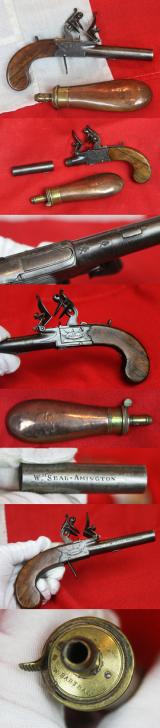
A Most Fine King George IIIrd Boxlock Flintlock By Bolton of London, Named for its Owner William Seal of Amington
effectively with built-in provenance. Made by John H Bolton, London and inscribed to its owner on the barrel. The pistol has excellent original finish and has just returned from a 'no expense spared' gunsmith service and the action is now as crisp as you could wish. Concealed trigger and sliding safety, Tower of London proved barrel, turn off barrel for breech loading. Super walnut grip. Unlike most firearms which have the hammer located off to the side of the pistol, a boxlock pistol had the hammer located directly on top of the pistol. They were called a boxlocks because all of the working mechanisms for the hammer and the trigger was located in a box or receiver directly below the top mounted hammer. While the hammer obstructed the aim of the user, this system had the advantage of making the gun more compact and concealable than other pistols. The first boxlock pistols were flintlock and where later made in percussion lock. Unlike modern firearms, these pistols were not mass produced, but were hand made in gunsmith's workshops. As with all our antique guns no license is required as they are all unrestricted antique collectables. Shown for illustration purposes only with a typical powder flask, as it would once have used read more
945.00 GBP

Roman 1st century, Large, Lead Sling Bullet, Acquired Near Camulodunum-Colchester-In the 1820's
From part four of our original ancient arrow heads, spears, lead sling bullets, antiquities and rings from an 1820 Grand Tour Collection. The Battle of Camulodunum, also known as the Massacre of the Ninth Legion, was the major military victory of the Iceni and their allies over an organised Roman army during the revolt of Boudica against the Roman occupation of Britain. A large vexillation of the Legio IX Hispana were destroyed by the rebels. While attempting to relieve the besieged colonia of Camulodunum (Colchester, Essex), legionaries of the Legio IX Hispana led by Quintus Petillius Cerialis, were attacked by a horde of British tribes, led by the Iceni. Possibly 80% of the Roman foot-soldiers were killed in the battle. The event is recorded by the historian Tacitus in his Annals. The Iberian auxiliaries or legionaries were the most famous of the Roman 'slingers' in the roman armies.In AD 60 or 61, the southeastern area of the island rose in revolt under Boudica, while the Roman governor, Gaius Suetonius Paulinus, was campaigning in Wales. The Iceni were joined by the Trinovantes, and their first target was Camulodunum, formerly the Trinovantian capital, now a colonia or settlement of discharged Roman soldiers. Tacitus reports it was poorly defended, and archaeology confirms its former military fortifications had been levelled by this time. The colonists appealed for aid to the procurator, Catus Decianus, who sent only two hundred auxiliaries. Camulodunum was burned, and the temple, where the last of the defenders took refuge, fell after a two-day siege. The defenders were massacred.
The Ninth Legion, commanded by Quintus Petillius Cerialis, attempted to relieve the siege. It is unlikely that the entire legionary strength of some 5,000 men was involved in the battle. Detachments of the legion were spread out across a network of small forts; on short notice, Cerialis was likely able to call on only the first cohort, possibly two others, auxiliary infantry, and a unit of some 500 cavalry - a total of perhaps 2,500 men. Cerialis set out from his base in Lindum Colonia (Lincoln). From Lindum, it was a distance of at least 110 miles. They may have taken the Roman road to Camulodunum from Durovigtum (Godmanchester, Cambridgeshire), a march of some 75 miles which would have taken three days.
However, they arrived too late to relieve the colonia. The British tribes had gathered a considerable force by the time Cerialis and the Ninth approached Camulodunum. They overwhelmed the detachment in the field and defeated it, routing the Romans. Tacitus says their entire infantry strength was wiped out, with only Cerialis and his cavalry able to retreat to their fortified camp. According to George Patrick Welch, "In the initial contact and later rear-guard actions he lost about 2,000 men, or one-third of his infantry strength."
Slingers wore three slings. A large one tightened to the waist (to be used in distances of more than 60 metres.), a small, one tightened around his forehead (range 20-25 metres.) and a medium size one always on the hand (with a range up to 60 mts.). They carried the bullets in a goat fur bag hanging from the shoulder. With the large one they could launch 500 grams stones (like a tennis ball) that were able to destroy shields and wood defences. With the small and medium size slings the lead bullets could perforate at short distances (up to 60 metres.) thin armours and helmets. The sling as a weapon was widely used not only by Balearic warriors but by other Iberian warriors and also by Roman auxiliary troops like Greeks, Sicilians, North Africans, but after the Roman conquest of the Balearic Islands elite slingers were always the Balearic that fought in the legions of Julius Caesar. Bullets are usually found on the known battle fields of the Roman conquest.
Every single item from The Lanes Armoury is accompanied by our unique Certificate of Authenticity. Part of our continued dedication to maintain the standards forged by us over the past 100 years of our family’s trading
This bullet weighs 62.5grams, and is 48mm long. read more
235.00 GBP

A Fabulous and Very Scarce, Mitsunaga Clan Antique Edo Period, High Rank Samurai Kunida-Gura Horse Pack-Saddle From The Clan Baggage Train, with Samurai Matsunaga Clan Kamon Crest Mounts
A stunning piece of Japanese decor, an original samurai horseman's mount for tanegashime {muskets} or even female attendants of the daimyo’s court.
This is probably only the second example of a kunida-gura of this type we have seen in 50 years outside of Japan, and even in Japan, and top quality examples are very scarce indeed.
Not only a functional piece of essential travel samurai equipment but a beautiful work of architectural art in itself.
The whole frame is beautifully decorated with crushed abilone shell and the arch mounts engraved with family clan crest or mon based on the Tsuta mon, Kamon with ivy, which has been used as a pattern since the earliest times in Japan, as a motif. Its elegant shape and the life force to survive by covering all things. The dominant clan with the tsuta mon were the Matsunaga clan ( Matsunaga-shi). It is a Japanese samurai clan who are descended from the Fujiwara clan.
The lineage of Matsunaga Danjo Hisahide strengthen the Matsunaga clan's claim to Fujiwara lineage through Hisahide's nephew, Tadatoshi Naito (also known as Naito Joan and Fujiwara John). Tadatoshi Naito's mother was Naito Sadafusa who was from the Naito clan. The Naito clan are descended from Fujiwara no Hidesato (Hokke (Fujiwara)). Tadatoshi Naito would serve as lord of Yagi castle.
Hisahide's granddaughter, Matsunaga Teitoku also strengthened the Matsunaga clan's link to the Fujiwara clan. Her mother was the older sister of Fujiwara Seika. Teitoku's cousin was Tadatoshi Naito.
Other sources suggest that the Matsunaga clan may have descended from the Minamoto clan and may be the descendants of Takenouchi no Sukune. Such a piece as this to be of such high quality lacquer, finely embelished with abilone, and bearing the clan mon, shows that this is a high ranking piece, for the transport of weapons, armour boxes, and women of the daimyo's court, within the baggage train of a Daimyo. This is a spectacular piece and they are very rarely seen, and the few that have survived over the centuries are more usually the fairly crude utility examples, completely undecorated and very plain. Over the decades we have had early Japanese woodblock prints showing a procession of horses, in a Daimyo's or Shogun's entourage, some occasionally show a pack saddle exactly such as this, with it's distinctive high crested top. They were usually racked with tanegashima arquebuss guns or even polearms. Also, in one early print three women are seated on one example. They may have been attendant's for a Daimyo's consort. We show in the gallery an original Meiji Period photograph of two ladies seated on the same type of saddle, on a ni-uma or konida uma, but a simple plain example of a much lower status. read more
2750.00 GBP