

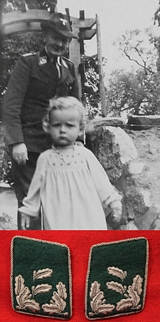
Set of German WW2 Revierforster Rank Collar Tabs
This is a set of third reich period German Revierforster rank shoulder boards in the Forestry Service, a favourite of Reich Marshal Goring. The tabs are constructed forest-green woolen backer. The obverse of the tabs are ordained with extremely fine, high quality, silver aluminum twisted wire in the shape of two vertically positioned oak leaves in the centre of the tab, with a twig of three leafs in the bottom left and right corners. Both tabs are edged on all four sides with fine quality twisted wire fastened to the sides using invisible green threads. read more
100.00 GBP

A ERII Royal Naval Officers Sword & Scabbard. Queen Elizabeth Cypher Blade & Traditional Queen's Crown Fouled Anchor Naval Pattern Hilt
Beatifully etched mirror bright with counter frosted design of ERII cypher, Royal naval devices design of oak leaf with acorn and rope design, fouled anchor. Traditional triple wire bound faux shagreen grip, brass mounted leather scabbard.
Overall in excellent condition. Ideal for a current or future serving Royal naval officer.
The two most frequently encountered designs within the hilt are the St Edward’s Crown and the Tudor Crown. In the former of these, the arches supporting the orb and Cross are depressed towards the centre. This design, often termed a Queen’s Crown by collector, has been used as the regal crown by Queen Elizabeth II, Queen Victoria and the monarchs preceding her. The arches of the Tudor Crown rise towards the centre to support the orb and crown. This design was used by Edward VII, George V, Edward VIII and George VI. Collectors often refer to this as a King’s Crown. The Sovereign chooses the regal crown pattern as it was chosen by Prince Charles on his accession to king.
The sword was possibly retailed by Crisp and Son before their closure around 7 years past read more
475.00 GBP

A Shinto Aikuchi Tanto, Unokubi-Zukuri With Hi Blade & Stunning Bi-Colour Shakudo Fittings Katakiri-bori Carving, on Migaki-ji of Insects, a Cricket a Hornet and a Praying Mantis
Circa 1700. A very attractive Samurai tanto that has lain untouched for likely 140 odd years or more. All matching and most attractive Edo period bi-colour hand carved shakudo fittings katakiri-bori carving, on migaki-ji including a kozuka, engraved with a preying mantis, a wasp on the kashira and a grasshopper on the sayajiri. The menuki are of fine gold overlay of dragon, and the tsuka has imperial off-white silk binding. The blade is in a unokubi-zukuri form similar to naga nata in stunning polish. The original Edo lacquer saya is uniformly ribbed along it's length with age cracking below the kozuka pocket, and small bruises at the base. Very fine hammered silver foil covered habaki.
The tanto is commonly referred to as a knife or dagger. The blade can be single or double edged with a length between 15 and 30 cm (6-12 inches, in Japanese 1 shaku).
The tanto was designed primarily as a stabbing weapon, but the edge can be used for slashing as well. Tanto are generally forged in hira-zukuri style (without ridgeline), meaning that their sides have no ridge line and are nearly flat, unlike the shinogi-zukuri structure of a katana.
Some tanto have particularly thick cross-sections for armour-piercing duty, and are called yoroi toshi. read more
3650.00 GBP

A Stunning, Fearsome Yet Beautiful, Edo Period Shirohige Ressei-Menpo "Mask With Fierce Expression" Samurai Face Armour,, Probably Myochin School, 18th century
Men-yoroi (面鎧), also called menpō (面頬) or mengu (面具), are various types of facial armour that were worn by the samurai class and their retainers in feudal Japan. These include the sōmen, menpō, hanbō or hanpō, and happuri.
A resseimon cheek is a form of cheek below the eyes, and is a mask with a very fierce, angry, and threatening expression. He is characterized by wrinkles on his nose and cheeks, wide open mouth, moustache and gold teeth. This work is a typical ressei mask made of iron and covered with black lacquer over the entire surface, and is attached with a collar called a kuruwa, which was commonly used in the Edo period.
This is a wonderful piece of Japanese Samurai 'art' made for warfare, which features a kuchi hige (mustache), shiwa (facial wrinkles). Extremely collectable art that is most desirable in its own right, often stunningly used for interior decoration as an individual work of samurai art in its own right. A very good urushi lacqured embossed iron mask of 'Me no Shita Men' (half face) type. Mid Edo period 18th century. Typical Myochin school craftmanship with very sharp embossing. A multi coloured silk bound yodarekake, neck defence with hooked standing cord pegs for attaching with cords to the samurai. A doeskin top to the neck defences decorated in a black inked pattern of Shishi lion dogs on a leaf pattern background. The inner face is decorated with vermillion lacquer, and the neck lames are covered in black urushi lacquer under the cords. Face armour, menpo, is samurai armour, and this is called 'with a fierce expression' masks They were worn with the Samurai's armours to serve as a protection for the head and the face from sword cuts. Even if the mask in unsigned, the type, and its the features suggest this fabulous face armour menpo was made by a smith from the Myochin school.
There are 4 types of mask designs that came into general use in Japan: happuri (which covers the forehead and cheeks), hanbō (covers the lower face, from below the nose all the way to the chin), sōmen (covers the entire face) and the me-no-shita-men (covers the face from nose to chin). We can also classify those mask depending on their facial expressions, most of which derive from the theatre masks. It has an asenagashino ana a hole under the chin to drain off perspiration and orikugi two projecting studs above the chin to provide a secure fastening to the wearer. In the 16th century Japan began trading with Europe during what would become known as the Nanban trade. Samurai acquired European armour including the cuirass and comb morion which they modified and combined with domestic armour as it provided better protection from the newly introduced matchlock muskets known as Tanegashima. The introduction of the tanegashima by the Portuguese in 1543 changed the nature of warfare in Japan causing the Japanese armour makers to change the design of their armours from the centuries old lamellar armours to plate armour constructed from iron and steel plates which was called tosei gusoku (new armours). Bullet resistant armours were developed called tameshi gusoku or (bullet tested) allowing samurai to continue wearing their armour despite the use of firearms.
The era of warfare called the Sengoku period ended around 1600, Japan was united and entered a relatively peaceful Edo period. However, the Shoguns of the Tokugawa period were most adept at encouraging clan rivalries and conflicts and battles were engaged throughout the empire. This of course suited the Shogun very well, while all his subordinate daimyo fought each other they were unlikely to conspire against him. Samurai use continued to use both plate and lamellar armour as a symbol of their status but traditional armours were no longer necessary for war, but still for battle. The most important branch of the Myochin school is probably that of the Ki region. Founded by Kunimichi, it became popular between 17th and 18th century for the works of Munesuke, who had the technical ability and the artistic capacity to create samurai armour of great beauty, In fact, this is the period when Japanese armor makers became aware that they were living in a peaceful time and their works begun looking back at the mediaval samurai armour as an inspiration: kabuto started again to be of circular shape and decorations became again large and rich, as in the old o-yoroi armor.
The best ability of Munesuke was the hammering technique (uchidashi): his menpo look almost exagerated in their shapes, with a very long chin, sharp and deep wrinkles on the cheeks and theatrical mouth. Moustaches are often inlaid in silver or gold, instead of being in fur as on Nara style menpo.
But the armor maker who really brough the uchidashi technique to the highest level is Muneakira, pupil and adopted son of Munesuke, which we can consider the best maker for samurai armour of modern times: his hammeried works are extraordinary, with precise and sharp lines of a quality that nobody else achieved.
The men-yoroi, which covered all or part of the face, provided a way to secure the top-heavy kabuto (helmet). The Shinobi-no-o (chin cord) of the kabuto would be tied under the chin. Small hooks called ori-kugi or posts called odome located on various places would help secure the chin cord. The men-yoroi was constructed from iron, leather, or a combination of both. It had a lacquered or rusted type of finish and included a variety of facial details, such as a moustache, fierce teeth and a detachable nose. With the exception of the happuri, a men-yoroi had a small hole underneath the chin for sweat drainage.
Face armour in Japan begins with the happuri, which is depicted in Heian- and Kamakura-era yamato-e paintings and is thought to have appeared during the 10th or 11th centuries. It is depicted as being worn with or without a helmet by both mounted warriors and foot retainers. By the 14th century, the hōate appears, and according to Tom Conlan, this development is behind decreased facial wound statistics. However, others, such as Yamagishi Sumio, believe that the hōate was not widespread at that time, as it—and the later menpō—restricted the vision of the wearer. Hōate are also portrayed in art and literature of the period, most notably the Aki no yo no Nagamonogatari scroll and Taiheiki. The menpō (half-mask with detachable nosepiece) and the sōmen (full face mask) are believed to have been introduced around the mid to late 15th century, and the hanbō (chin guard) in the second half of the 16th century
. read more
3750.00 GBP

Very Fine & Beautiful, Victorian, ‘Scottish’ Officer's Sword of Presentation Grade, 29th Lanarkshire Regt. Volunteers. Presented By His Company to Captain Hincksman in 1875.Identical to The Sword Used by Lt Bromhead at Rorke's Drift
The 29th Lanarkshire Rifle Volunteers were created in February 1860 in Coatbridge. The corps absorbed several other Lanarkshire Rifle Volunteer companies before becoming the 7th Lanarkshire Rifle Volunteer Corps in June 1880. The following year this became part of the Cameronian (Scottish Rifles) as part of the army reforms of that year.
Just returned from over 20 hours of expert hand polishing and conservation in the workshop to return it to as close to how it was when presented to Capt. Hincksman in 1875. It now look breathtaking. It also still has its original patent leather inner half basket lining, This was stitched in but had to be removed to enable conservation and photographed seperate. It has now been re-stitched back in place, and we have photographed it accordingly. It’s finest grade mercurial gilt finish hilt has over 95% of all of it original mint bright gilt finish remaining.
An absolute beauty of an original historical sword. Overall in superb condition. A sword that would compliment any form of background decor. Exactly the form of sword used by Lt Bromhead in the Zulu war, as was portrayed and carried in the film 'Zulu' by Sir Michael Caine. One may find it impossible indeed to see another as fine and beautiful and as original as this sword. With its original, mirror bright polished and counter-frosted ground, bespoke fully etched blade, bearing the cypher and crest of H.M. Queen Victoria, and named and dated presentation panels.
Gothic pieced half basket hilt, combined, combat-dress scabbard, fine wire bound sharkskin grip.
Photo in the gallery from the film "Zulu" and Michael Caine as Bromhead with his sword for information only not included.
The 1822/45 pattern of sword has a Gothic hilt and Queen Victoria's cypher within the pierced oval centre. This sabre would have seen service by an officer at the very cusp of England's Glory of Empire. A sabre fit to represent the age and used throughout the Zulu War and numerous other great and famous conflicts of the Victorian era. The 1822 pattern infantry with it's elegant pierced Gothic style hilt, and the graceful monogram of Queen Victoria make it one of the most attractive patterns of sword ever used by British Army officers, and it was a pattern that saw service for almost 80 years. The blade is by Henry Wilkinson, who developed in 1845 pattern blade. Many swords of British officers were continually used for many decades, until the 1890's in fact, as swords were quite often passed on from father to son, down the generations, in many military families. During the period of this sword's use, two of most famous pair of engagements in the British army's history, during the last quarter of the 19th century, happened over two consecutive days. Curiously, it is fair to say that these two engagements, by the 24th Foot, against the mighty Zulu Impi, are iconic examples of how successful or unsuccessful leadership can result, in either the very best conclusion, or the very worst. And amazingly, within only one day of each other. The 1879 Zulu War, for the 24th Foot, will, for many, only mean two significant events, Isandlhwana and Rorke's Drift. This is the brief story of the 24th Foot in South Africa; In 1875 the 1st Battalion arrived in Southern Africa and subsequently saw service, along with the 2nd Battalion, in the 9th Xhosa War in 1878. In 1879 both battalions took part in the Zulu War, begun after a British invasion of Zululand, ruled by Cetshwayo. The 24th Foot took part in the crossing of the Buffalo River on 11 January, entering Zululand. The first engagement (and the most disastrous for the British) came at Isandhlwana. The British had pitched camp at Isandhlwana and not established any fortifications due to the sheer size of the force, the hard ground and a shortage of entrenching tools. The 24th Foot provided most of the British force and when the overall commander, Lord Chelmsford, split his forces on 22 January to search for the Zulus, the 1st Battalion (5 companies) and a company of the 2nd Battalion were left behind to guard the camp, under the command of Lieutenant-Colonel Henry Pulleine (CO of the 1/24th Foot).
The Zulus, 22,000 strong, attacked the camp and their sheer numbers overwhelmed the British. As the officers paced their men far too far apart to face the coming onslaught. During the battle Lieutenant-Colonel Pulleine ordered Lieutenants Coghill and Melvill to save the Queen's Colour—the Regimental Colour was located at Helpmakaar with G Company. The two Lieutenants attempted to escape by crossing the Buffalo River where the Colour fell and was lost downstream, later being recovered. Both officers were killed. At this time the Victoria Cross (VC) was not awarded posthumously. This changed in the early 1900s when both Lieutenants were awarded posthumous Victoria Crosses for their bravery. The 2nd Battalion lost both its Colours at Isandhlwana though parts of the Colours—the crown, the pike and a colour case—were retrieved and trooped when the battalion was presented with new Colours in 1880.
The 24th had performed with distinction during the battle. The last survivors made their way to the foot of a mountain where they fought until they expended all their ammunition and were killed. The 24th Foot suffered 540 dead, including the 1st Battalion's commanding officer.
After the battle, some 4,000 to 5,000 Zulus headed for Rorke's Drift, a small missionary post garrisoned by a company of the 2/24th Foot, native levies and others under the command of Lieutenant Chard, Royal Engineers, the most senior officer of the 24th present being Lieutenant Gonville Bromhead. Two Boer cavalry officers, Lieutenants Adendorff and Vane, arrived to inform the garrison of the defeat at Isandhlwana. The Acting Assistant Commissary James Langley Dalton persuaded Bromhead and Chard to stay and the small garrison frantically prepared rudimentary fortifications.
The Zulus first attacked at 4:30 pm. Throughout the day the garrison was attacked from all sides, including rifle fire from the heights above the garrison, and bitter hand-to-hand fighting often ensued. At one point the Zulus entered the hospital, which was stoutly defended by the wounded inside until it was set alight and eventually burnt down. The battle raged on into the early hours of 23 January but by dawn the Zulu Army had withdrawn. Lord Chelmsford and a column of British troops arrived soon afterwards. The garrison had suffered 15 killed during the battle (two died later) and 11 defenders were awarded the Victoria Cross for their distinguished defense of the post, 7 going to soldiers of the 24th Foot.
The stand at Rorke's Drift was immortalised in the 1964 movie 'Zulu', and Sir Michael Caine is carrying this very same pattern of sword.
Overall in excellent plus condition. Very nice and snug fit to the very brightly polished scabbard, with all its original wood liner present. The combat scabbard its the only part of the sword that bears any natural age wear with traces of old light surface pitting {now hand polished out} read more
1395.00 GBP

And Now, For Something Completely Different! ***Congratulations to Our Former 'Lanes Armoury' World Wide 'Meet and Greet" Representative, Holly Hawkins-Smith's All New On-line Fashion Project & Shop, Kaija Swim
Our former and remarkably talented worldwide 'meet and greet' representative, {who is also our partner's granddaughter and great niece} has just revamped part of her successful fashion line, that she started from her bedroom as a 16 year old young school girl during the UK Covid lockdown,
kaijaswim.com
https://www.instagram.com/hollyhawkinssmith/?hl=en-gb
Congratulations from us all here, we are so, so proud of you, and your mum for all her help, advice and guidance.
Maybe some of our tens of thousands of daily viewers might know ladies that need a very special gift!!
Since then, over just the past few years, she has traveled the world sourcing sustainable materials and manufacturers from, such as, Brazil, Italy to Bali. She has arranged models and photoshoots around the globe, in the Maldives, Italy, Dubai etc. All in the past three years since she turned 18. And, as our American cousins might say, 'all on her own dime', most admirably, without a single penny of assistance from her family or banking finance.
Naluda Magazine interview with Stunning Model & Entrepreneur Holly Hawkins-Smith in 2023
Check out our interview with stunning British Model and Entrepreneur Holly Hawkins-Smith. Holly was born and raised in Brighton, England and was scouted at age 9 by a child model agency and has been working in the industry ever since. She recently signed with top London Model Agency FOMO Models and has worked with some of the most influential fashion brands in the industry including Valentino Beauty, SKIMS by Kim Kardashian, Oh Polly, Lounge, Pretty Little Thing, Boohoo and is an Ambassador for American Fashion Brand, Fashion Nova to name a few.
Besides modelling Holly also has her own successful business Kamiraa and is currently working on her first sustainable swimwear line to be launched this Summer!
“As a popular model and influencer you are followed by so many people. How do you feel about that pressure of doing always the right thing, and encourage people to follow their dreams”
"I will always encourage people to follow their dreams, I’m living proof of that! Ever since I was a little girl I knew I wanted to model, travel and be successful. I had extremely bad skin when I turned 15 and I didn’t believe in myself if I’m totally honest! I lacked confidence, but my parents made me realize that nothing good comes easily and I will face much harder times in the future and to never ever give up! I want to show my followers that nobody is perfect and there is always ups and down along the way.
When it comes to doing the right thing, I do feel greatly that I have a responsibility to my followers to help make changes for the better. My new business Kamiraa’s {now re-named Kaija} main ethos is sustainability. Our fashion brand pieces are made from re-cycled plastic bottles and netting from the ocean, but manufactured, using ground breaking technology, to create a luxurious range of materials that have a natural feel, combined with sublime comfort. It was incredibly important to me, that if I was going to start something it had to be ethical and I’m really proud of it! Our first bikini launches in the Summer."
{It has actually taken a year longer, due to assuring herself of the very best production quality and designs possible}.
https://www.naludamagazine.com/interview-with-stunning-model-entrepreneur-holly-hawkins-smith/ read more
Price
on
Request

A Superb Late 19th To WW2 British Tropical Helmet, Wolseley Pattern Used From The Boer War to WW1 and WW2 By Tress and Co. With Interior Makers Stamp. With War Dept. Stamped Storage and Transit Cover
The Wolseley pattern helmet is a distinctive British design developed and popularised in the late 19th and early 20th century. It was the official designation for the universal sun helmet worn by the British Army from 1899 to 1948 and described in the 1900 Dress Regulations as "the Wolseley pattern cork helmet". It is named after Field Marshal The 1st Viscount Wolseley. With its swept-back brim, it provided greater protection from the sun than the old Colonial pattern helmet. Its use was soon widespread among British personnel serving overseas and some Canadian units.
The British Empire won the Second Boer War, which took place from 1899 to 1902. The war was fought against the two Boer republics, the South African Republic (Transvaal) and the Orange Free State. Despite initial setbacks and a prolonged guerrilla phase, the British ultimately prevailed and annexed both republics. The war concluded with the Treaty of Vereeniging, which formally integrated the Boer republics into the British Empire
The desert campaigns in World War I primarily involved fighting in the Sinai and Palestine, as well as the Western Desert of Egypt, between the British Empire and the Ottoman Empire. These campaigns were characterized by harsh desert conditions, with troops facing extreme heat, water shortages, and challenging terrain. The campaigns included actions like the Suez offensive, the Senussi revolt, and operations in Sinai and Palestine.
The North African campaign of World War II took place in North Africa from 10 June 1940 to 13 May 1943, fought between the Allies and the Axis Powers. It included campaigns in the Libyan and Egyptian deserts (Western Desert campaign, Desert War), in Morocco and Algeria (Operation Torch), and in Tunisia (Tunisia campaign). The Allied war effort was dominated by the British Commonwealth and exiles from German-occupied Europe. The United States entered the war in December 1941 and began direct military assistance in North Africa on 11 May 1942.
Fighting in North Africa started with the Italian declaration of war on 10 June 1940. On 14 June, the British 11th Hussars and part of the 1st Royal Tank Regiment, (1st RTR) crossed the border from Egypt into Libya and captured Fort Capuzzo. This was followed by an Italian counter-offensive into Egypt and the capture of Sidi Barrani in September. The British recaptured Sidi Barrani in December during Operation Compass. The Italian 10th Army was destroyed and the German Afrika Korps was dispatched to North Africa in February 1941 in Operation Sonnenblume to reinforce the Italians and prevent an Axis defeat.
Battles for control of Libya and Egypt followed, with advances and retreats until the Second Battle of El Alamein in October 1942 when the Eighth Army (Lieutenant-General Bernard Montgomery) defeated the German–Italian Panzerarmee Afrika and forced its remnants into Tunisia. After Operation Torch, the Anglo-American landings in North-West Africa in November 1942 and fighting against Vichy France forces (which then changed sides), the Allies trapped about 250,000 German and Italian personnel in northern Tunisia, forcing their surrender in May 1943.
Information gleaned via British Ultra code-breaking was important in the Allied victory in North Africa. The Italian campaign followed, culminating in the downfall of the Fascist government in Italy and the elimination of Germany's main European ally. German and Italian forces committed atrocities against prisoners of war and Maghrebi Jews, Berbers and Arabs. read more
350.00 GBP

A Superb, Ancient Koto Long Katana, Circa 1390 to1420 With a Very Fine Suite of Jakushi Iron & Gold Koshirae, A Signed Tsuba, and Matching Jukushi Fuchi-Kashira. The Stunning Black Saya Has Four Aoi Mon in Hiramaki-e Gold Lacquer of The Tokugawa
A 600 to 630 year old, long and mighty blade, of 29 inches, measured from the tsuba to tip in beautiful condition, with a fabulous hamon. This is a most impressive ancient sword from the great warring period of Japan Samurai endured for almost 700 years, from 1185 to 1867. Samurai families were considered the elite. They made up only about six percent of the population and included daimyo and the loyal soldiers who fought under them. Samurai means one who serves."
The late saya bears 4 deep relief gold aoi gold mon hiramaki-e low relief lacquer, the triple hollyhock leaf, of the Tokugawa, on a fine black lacquer ground. The tsuka has just been re bound in stunning black silk ito.
The theme of the koshirae is influenced by the Province of Hizen (肥前國). Forged iron (tetsu 鉄) hand guard (tsuba 鐔) is a work of the Jakushi (杓子) School based in the port city of Nagasaki (長崎) in Hizen Province, and inlaid with small silver and gold detailing. The artistic scene on both sides of the tsuba is that of a Chinese style painting made popular during the Ming Dynasty that was exported to southern Japan during the beginning of the Edo Period with the collapse of the Ming Dynasty (1644 CE). The fuchi-gashira (縁頭) is made of forged iron. The tsuba is signed by Jakushi (杓子) on its obverse face. The signature style is consistent with what the Jakushi School used during the Edo Period.
When this sword was first made it would have been the period of the end of the Nanboku-chō period, when a form of civil war was fought between the Northern Japanese Emperor and the Southern Japanese Emperor. Go-Kameyama acceded to the throne during the turbulent Nanboku-chō period during which rival claimants to the Chrysanthemum Throne gathered supporters around them in what were known as the Northern court and the Southern Court. Go-Kameyama became Emperor in what was called the Southern court when Emperor Chōkei abdicated in 1383. On October 15, 1392, at the insistence of the peace faction amongst his own courtiers, he applied to Ashikaga Yoshimitsu for peace; and he subsequently returned to the capital where he did hand over the Sacred Treasures to his Northern Court rival. In doing so, Go-Kameyama was understood to have abdicated.
From then it was in the era of use in the
1419 Ōei Invasion to Wokou bases on Tsushima Island
1428 Cholera epidemic and extreme impoverishment in now Shiga Prefecture have resulted in the Shocho uprising.
1438 Flare-up of Eikyō disturbance in the Kantō region after 22 years of confrontation between local lords and shogunate
1443 The Treaty of Gyehae was signed, resulting in Wokou pirates becoming increasingly non-Japanese.
1454 The Kyōtoku Incident starts the 32 years of instability and bloodshed in the semi-independent Kantō region.
1457 Takeda Nobuhiro emerged victorious after repelling an Ainu assault on Kaminokuni, Hokkaido, marking the beginning of Japanese conquest of Hokkaido.
Edo Castle, a nucleus of modern Tokyo, was built.
1459 Bad handling of the Kanshō famine in the aftermath of flood and plague in Kyoto has resulted in increasing divisions of society, which led to the Sengoku period
The Sengoku period Sengoku Jidai, "Warring States period" is a period in Japanese history of near-constant civil war, social upheaval, and intrigue from 1467 to 1615.
The Sengoku period was initiated by the Onin War in 1467 which collapsed the feudal system of Japan under the Ashikaga Shogunate. Various samurai warlords and clans fought for control over Japan in the power vacuum, while the Ikkō-ikki emerged to fight against samurai rule. The arrival of Europeans in 1543 introduced the arquebus into Japanese warfare, and Japan ended its status as a tributary state of China in 1549. Oda Nobunaga dissolved the Ashikaga Shogunate in 1573 and launched a war of political unification by force, including the Ishiyama Hongan-ji War, until his death in the Honnō-ji Incident in 1582. Nobunaga's successor Toyotomi Hideyoshi completed his campaign to unify Japan and consolidated his rule with numerous influential reforms. Hideyoshi launched the Japanese invasions of Korea in 1592, but their eventual failure damaged his prestige before his death in 1598. Tokugawa Ieyasu displaced Hideyoshi's young son and successor Toyotomi Hideyori at the Battle of Sekigahara in 1600 and re-established the feudal system under the Tokugawa Shogunate. The Sengoku period ended when Toyotomi loyalists were defeated at the siege of Osaka in 1615.
The Sengoku period was named by Japanese historians after the similar but otherwise unrelated Warring States period of China. read more
7950.00 GBP

A Beautiful Edo Period Original Samurai Armour, Gosuko Likely 17th Century and Used Into The 18th Century With 12 Plate Goshozan Suji Bachi Kabuto Helmet And A Super Ressai Fierce Full Face Armour Menpo And Clan Mon Tassets of The Honda Tadakatsu Clan
A superb early to mid Edo samurai yoroi, with the symbol in gold of deer antlers emblazoned on both haidate thigh protectors tassets, which would indicate a samurai of the clan of the great Honda Tadakatsu, a 17th century general and later daimyo serving under Tokugawa Iayesu, whose symbol was his famous deer antlers worn upon his kabuto helmet.
Deer antlers were seen as symbols of the messengers of the gods.
Honda Tadakatsu (本多 忠勝, March 17, 1548 – December 3, 1610), also called Honda Heihachirō (本多 平八郎) was a Japanese samurai, general, and daimyo of the late Sengoku through early Edo periods, who served Tokugawa Ieyasu. Honda Tadakatsu was one of the Tokugawa Four Heavenly Kings (Shitennō) along with Ii Naomasa, Sakakibara Yasumasa, and Sakai Tadatsugu.
It has a fine helmet kabuto of 12 plates, a 12 plate goshozan suji bachi kabuto. A helmet which is a multiple-plate type of Japanese helmet bowl with raised ridges or ribs showing where the 12 tate hagi-no-ita ( helmet plates) come together at the five-stage tehen kanamono finial, with the fukurin metal edges on each of the standing plates. The mabisashi peak lacquered and it has a four-tier lacquered iron hineno-jikoro neck-guard laced with dark blue. The interior shows four very ancient helmet plates rivetted together to form the interior support basis of the 12 plate skull. Unlined. With full face ressai menpo {the grimacing expression face armour} sets it off superbly with a most intimidating presence. When this was worn by its fierce-some armoured samurai, he must have looked spectacularly impressive. Dou or do, a chest armour made up of iron plates of various sizes and shapes with pendents
kusazuri made from iron or leather plates hanging from the front and back of the dou to protect the lower body and upper leg.
Sode, large modern rectangular shoulder protection made from iron and or leather plates.
Kote, armoured glove like sleeves which extended to the shoulder or han kote (kote gauntlets) which covered the forearms. Kote made from cloth covered with iron plates of various size and shape, connected by chain armor (kusari). Haidate, thigh guards which tied around the waist and covered the thighs. These were made from cloth with small iron and or leather plates of various size and shape, connected to each other by chain armour (kusari) and sewn to the cloth.
Suneate, shin guards made from iron splints connected together by chain armour (kusari) and sewn to cloth and tied around the calf.
The “deer-horn helmet” and deer horns, came henceforth, to be known as his symbol.
Tadakatsu’s helmet “Kazuno Wakidate Kabuto,” or Japanese armour (yoroi/kabuto), was a simple black helmet. His helmet is famous for its deer horn flanks. There are various theories as to why deer horns were used as the side of the helmet. When Yoshimoto Imagawa was shot in the Battle of Okehazama and Ieyasu’s army had to immediately return to Okazaki Castle, Tadakatsu found that the river was swollen, and he could not cross. At that moment, a deer appeared, and when he was watching the deer also trying to cross to the opposite bank, he found shallow water at a certain point and crossed the river. Thanks to this, the deer was able to return safely to Mikawa. Since then, Tadakatsu made up his mind to “protect Ieyasu-dono for the rest of his life like the deer did that one time,” and made a helmet out of the deer’s horns. Deers have also been cherished as messengers of the gods since ancient times. There are various theories as to why deers were regarded as messengers of the gods, but in mountainous Japan, the deer’s ability to run through steep mountains may have portrayed them as animals with mystical powers. In addition to his military prowess, Honda Tadakatsu was also attractive because of his large figure as a man, which is probably the reason why he is still popular today as a military commander who attracts many people
In the 16th century Japan began trading with Europe during what would become known as the Nanban trade. Samurai acquired European armour including the cuirass and comb morion which they modified and combined with domestic armour as it provided better protection from the newly introduced matchlock muskets known as Tanegashima. The introduction of the tanegashima by the Portuguese in 1543 changed the nature of warfare in Japan causing the Japanese armour makers to change the design of their armours from the centuries-old lamellar armours to plate armour constructed from iron and steel plates which was called tosei gusoku.
Bullet resistant armours were developed called tameshi gusoku or (bullet tested) allowing samurai to continue wearing their armour despite the use of firearms. This armour has areas of worn and naturally aged lacquer and areas of cloth/material that are perished due to it's great age and just as would be expected.
Complete with storage box unlidded read more
9950.00 GBP

A Very Good Shinto Period, Circa Later 1600's, Samurai Spear, A Ryo-Shinogi Yari Pole Arm. Signed Hisatoshi, & Magari-Yari Saya
The magari-yari saya would indicate it would be used on a triple bladed magari-yari pole arm.
An Edo Period Samurai Horseman Ryo-Shinogi Yari Polearm on original haft, circa 1670. For use on or off horseback.
Beautiful bright polish with suguha straight hamon to both edges.
With original pole and iron foot mount ishizuki. Four sided double edged head. The mochi-yari, or "held spear", is a rather generic term for the shorter Japanese spear. It was especially useful to mounted Samurai. In mounted use, the spear was generally held with the right hand and the spear was pointed across the saddle to the soldiers left front corner.
The warrior's saddle was often specially designed with a hinged spear rest (yari-hasami) to help steady and control the spear's motion.
The mochi-yari could also easily be used on foot and is known to have been used in castle defense. The martial art of wielding the yari is called sojutsu. A yari on it's pole can range in length from one metre to upwards of six metres (3.3 to 20 feet). The longer hafted versions were called omi no yari while shorter ones were known as mochi yari or tae yari. The longest hafted versions were carried by foot troops (ashigaru), while samurai usually carried a shorter hafted yari.
Ryō-shinogi yari, a blade with a diamond shaped cross section
Honda Tadakatsu was famous as a master of one of The Three Great Spears of Japan, the Tonbokiri (蜻蛉切). One of The Three Great Spears of Japan, the Nihongō (ja:日本号) was treasured as a gift, and its ownership changed to Emperor Ogimachi, Shogun Ashikaga Yoshiaki, Oda Nobunaga, Toyotomi Hideyoshi, Fukushima Masanori, and so on, and has been handed down to the present day.
Yari are believed to have been derived from Chinese spears, and while they were present in early Japan's history they did not become popular until the thirteenth century.The original warfare of the bushi was not a thing for "commoners"; it was a ritualized combat usually between two warriors who may challenge each other via horseback archery and sword duels. However, the attempted Mongol invasions of Japan in 1274 and 1281 changed Japanese weaponry and warfare. The Mongol-employed Chinese and Korean footmen wielded long pikes, fought in tight formation, and moved in large units to stave off cavalry. Polearms (including naginata and yari) were of much greater military use than swords, due to their much greater range, their lesser weight per unit length (though overall a polearm would be fairly hefty), and their great piercing ability. Swords in a full battle situation were therefore relegated to emergency sidearm status from the Heian through the Muromachi periods.
The shaft (nagaye or ebu) came in many different lengths, widths, and shapes; made of hardwood and covered in lacquered bamboo strips, these came in oval, round, or polygonal cross section. These in turn were often wrapped in metal rings or wire (dogane), and affixed with a metal pommel (ishizuki; 石突) on the butt end. Yari shafts were often decorated with inlays of metal or semiprecious materials such as brass pins, lacquer, or flakes of pearl. A sheath (saya; 鞘) was also part of a complete yari.
The Three Great Spears of Japan are three individual spears (yari) that were made and crafted by the greatest historical blacksmiths of Japan:1
Tonbokiri (蜻蛉切): This spear once wielded by Honda Tadakatsu, one of the great generals of Tokugawa Ieyasu. It was forged by Masazane, a disciple of Muramasa. It is now owned by a private individual and lent to the Sano Art Museum for its collection. The type of blade shape is sasaho yari.2
Nihongo, or Nippongo (日本号): A famous spear that was once used in the Imperial Palace. Nihongo later found its way into the possession of Fukushima Masanori, and then Tahei Mori. It is now at Fukuoka City Museum. The type of blade shape is omi yari.2
Otegine (御手杵): It was a spear that Yuki Harutomo, a daimyo, ordered Shimada Gisuke, a swordsmith, to make. It was lost in the Bombing of Tokyo in 1945. The type of blade shape was omi yari.
this yari's blade is 17.5 inches including tang, blade 5 inches long, overall in pole 78 inches {not including saya} read more
1695.00 GBP