
Japanese


A Beautiful and Most Impressive Nanban-Nari Kabuto High Conical Samurai Helmet. Likely of A Christian Samurai, Known As Krishitan, Momoyama to Edo Period. With Menpo Face Armour
A Nanban-nari, Christian decorated high conical helmet, with a koshi-no-ita base plate encircles the lower section of the skull, decorated around the border and across the apex with European form strap work with applied rivetted Catholic fleur-de-lys decor, a visor, or tousei mabisashi, is fitted to the front. Three-tiered black lacquer shikoro neck guard with sugake odoshi spaced lacing in very dark red braid. A tatsu tsunomoto holder for the maedate helmet crest, and a maedate in very decoratively pierced sinchu, brass alloy resembling gold. The maedate is of the form with slots that can have optional wakedate flat horns fitted.
The helmets fully embellished fleur-de-lys decor is a symbol of the 16th century Catholic Church, specifically Mary the Virgin. From antiquity it has been the symbol of purity and was readily adopted by the Roman Catholic church to associate the sanctity of Mary with events of special significance. The lily was said to have sprung from the tears shed by Eve as she left Eden. Thus, when Pope Leo III in 800 crowned Charlemagne as emperor, he is reported to have presented him with a blue banner covered (semé) with golden fleurs-de-lis.
The kabuto has a matching form Menpō face armour, that covered the face from the top of the nose down to the chin, with four rows of yodare-kake, throat guard armour. An early syle affixed and none removable nasal cover. All the main helmet and menpo surfaces, {except the shikoro} are in Higo russetted form.
Every year oir so we are delighted to acquired samurai swords with hidden Christian {Kakure Kirishitan} symbology, such as tsuba with pierced crucifix within in their designs, but we cannot recall ever seeing a Krishitan symbolised kabuto over these past 50 years. Only in Japanese museums, and very few of these.
The Nanban-nari Kabuto was introduced from the West during the Warring States period. Because it imitates the shape of a hat, it was called a “Nanban hat helmet”. Only the helmets bowl (Hachi ) was Nanban, other parts like Shikoro and Mabisashi were made and designed domestic style. This brand new kind of helmet was very popular at the time of introduction.
Nanban, In Japanese literally means “southern Barbarians”, actually refers to Europeans, because they came from the south of Japan. The helmets of the Europeans, Spanish and Portuguese, were of the morion or cabassat form. These new ‘barbarians’ not only brought Catholic monks to convert the samurai and their vassal peasants to Christianity, but their muskets, cannon, armour, leather, and clothing became de-riguer to influence everything from decor fashion armour and clothing. Especially amongst the converted daimyo lords, his family, and his samurai.
Face armour in Japan begins with the happuri, which is depicted in Heian- and Kamakura-era yamato-e paintings, and is thought to have appeared during the 10th or 11th centuries.It is depicted as being worn with or without a helmet by both mounted warriors and foot retainers. By the 14th century, the hōate appears, and according to Tom Conlan, this development is behind decreased facial wound statistics. However, others, such as Yamagishi Sumio, believe that the hōate was not widespread at that time, as it—and the later menpō—restricted the vision of the wearer. Hōate are also portrayed in art and literature of the period, most notably the Aki no yo no Nagamonogatari scroll and Taiheiki. The menpō (half-mask with detachable nosepiece) and the sōmen (full face mask) are believed to have been introduced around the mid to late 15th century, and the hanbō (chin guard) in the second half of the 16th century.
The current FX series 'Shogun' by Robert Clavell is based on the true story of William Adams and the Shogun Tokugawa Ieyesu, and apart from being one of the very best film series yet made, it shows superbly and relatively accurately the machinations of the Catholic Jesuits to manipulate the Japanese Regents and their Christian convert samurai Lords.
Oda Nobunaga (1534–82) had taken his first step toward uniting Japan as the first missionaries landed, and as his power increased he encouraged the growing Kirishitan movement as a means of subverting the great political strength of Buddhism. Oppressed peasants welcomed the gospel of salvation, but merchants and trade-conscious daimyos saw Christianity as an important link with valuable European trade. Oda’s successor, Toyotomi Hideyoshi (1537–98), was much cooler toward the alien religion. The Japanese were becoming aware of competition between the Jesuits and the Franciscans and between Spanish and Portuguese trading interests. Toyotomi questioned the reliability of subjects with some allegiance to the foreign power at the Vatican. In 1587 he ordered all foreign missionaries to leave Japan but did not enforce the edict harshly until a decade later, when nine missionaries and 17 native Kirishitan were martyred.
After Toyotomi’s death and the brief regency of his adopted child, the pressures relaxed. However, Tokugawa Ieyasu, who founded the great Tokugawa shogunate (1603–1867), gradually came to see the foreign missionaries as a threat to political stability. By 1614, through his son and successor, Tokugawa Hidetada, he banned Kirishitan and ordered the missionaries expelled. Severe persecution continued for a generation under his son and grandson. Kirishitan were required to renounce their faith on pain of exile or torture. Every family was required to belong to a Buddhist temple, and periodic reports on them were expected from the temple priests.
By 1650 all known Kirishitan had been exiled or executed. Undetected survivors were driven underground into a secret movement that came to be known as Kakure Kirishitan (“Hidden Christians”), existing mainly in western Kyushu island around Nagasaki and Shimabara. To avoid detection they were obliged to practice deceptions such as using images of the Virgin Mary disguised as the popular and merciful Bōsatsu (bodhisattva) Kannon, whose gender is ambiguous and whom carvers often render as female.
The populace at large remained unaware that the Kakure Kirishitan managed to survive for two centuries, and when the prohibition against Roman Catholics began to ease again in the mid-19th century, arriving European priests were told there were no Japanese Christians left. A Roman Catholic church set up in Nagasaki in 1865 was dedicated to the 26 martyrs of 1597, and within the year 20,000 Kakure Kirishitan dropped their disguise and openly professed their Christian faith. They faced some repression during the waning years of the Tokugawa shogunate, but early in the reforms of the emperor Meiji (reigned 1867–1912) the Kirishitan won the right to declare their faith and worship publicly.
The interior lining and cords of this kabuto have been replaced in the past 100 years read more
7450.00 GBP

A Very Fine & Long 15th Century Katana, Around 600 Years Old, From An Historically Significant Great Samurai Clan, The Nabeshima Descendents of the Fujiwara, With Traditional Stone Polished Blade
The blade was sent to Japan some years ago for a fine stone traditional re polish. This superb ancient blade has a stunningly elegant curvature, and combined with a simply spectacular, vibrant and deep hamon, absolutely breathtaking, and very healthy for its age, and thus it makes this blade very special indeed, it is also very unusual for a blade of this age to survive its great length without alteration. The blade was fully traditionally stone polished. It has all its original Edo fittings, and its fine signed tsuba by Kinai of Echizen. It bears two mon, one in silver, 'Daki Myoga' mon of the great Nebeshima clan on the kashira, and the 'Sagarifuji' mon of the Fujiwara clan on the fuchi. The Nabeshima clan was a cadet branch of the Shoni clan and was descended from the Fujiwara clan. The Fujiwara became so powerful they had absolute control over the Imperial court. By the year 1000, Fujiwara no Michinaga was able to enthrone and dethrone emperors at will, effectively, "hereditary dictators". The Fujiwara controlled the throne until the reign of Emperor Go-Sanjō (1068–73), the first emperor not born of a Fujiwara mother since the ninth century. Emperor Go-Sanjō, determined to restore imperial control through strong personal rule, implemented reforms to curb Fujiwara influence. In the late 12th century, Fujiwara no Sukeyori, a descendant of Fujiwara no Hidesato in the 9th generation, received the title of Dazai Shoni (equivalent to that of vice-governor of the military government of Kyushu) from Shogun Minamoto no Yoritomo, and the title became the family name.
The clan played an important role in the region as early as the Muromachi period, when it helped suppress opposition to the Ashikaga shogunate's control of Kyushu. It did not take the name Nabeshima, however, until the late 15th century, when Shoni Shigenao established himself at Nabeshima in Hizen province (today part of Saga City, Saga prefecture). Later, in the Sengoku period (1467-1603), the Nabeshima were one of a number of clans which clashed over the island. The Nabeshima sided with the Ryuzoji clan against the Otomo clan, though this ultimately ended in failure and the death of Ryuzoji Takanobu at the 1584 battle of Okita Nawate. Several years later, however, the Nabeshima recovered power and prominence by aiding Toyotomi Hideyoshi in his 1587 invasion of Kyushu; Nabeshima Naoshige was granted the region of Saga as his fief, as a reward for his efforts. Naoshige also contributed to Hideyoshi's invasions of Korea in the 1590s.
The clan initially aided Ishida Mitsunari against Tokugawa Ieyasu in the Sekigahara Campaign in 1600. However, they switched sides to support the Tokugawa, who were ultimately victorious, before the campaign had ended, battling and occupying the forces of Tachibana Muneshige, who was thus prevented from contributing directly to the battle of Sekigahara. Though regarded as tozama daimyo ("outside" lords), and assigned particularly heavy corvee duties, the Nabeshima were allowed to keep their territory in Saga, and in fact had their kokudaka increased. The clan's forces served the new Tokugawa shogunate loyally in the years which followed; they remained in Kyushu during the 1615 Osaka Campaign as a check against a possible rebellion or uprising by the Shimazu clan, and aided in the suppression of the Shimabara Rebellion of 1637. In recognition of their service, members of the clan were granted the prestigious family name Matsudaira in 1648.
During the Edo period, the clan's Saga domain became quite famous. There is a stunning picture in our gallery of a painting in the British Museum, by an unknown artist, of Portrait of a Nabeshima lord, Fujiwara; Munemitsu of the Nabeshima clan wearing his tanto, with it's Nabeshima 'Daki Myoga' mon. The sukashi round tsuba is signed Echizen no Ju Kinai Saku, in the form of an aoi, or hollyhock plant, possibly by godai Ishikawa. Likely a branch of the Miōchin (Group IV), this family was founded by Ishikawa Kinai, who moved from Kiōto to Echizen province Japanese text and died in 1680. The succeeding masters, however, bore the surname of Takahashi. All sign only Kinai Japanese text, with differences in the characters used and in the manner of writing them.
The Kinai made guards only, of hard and well forged iron usually coated with the black magnetic oxide. They confined themselves to pierced relief showing extraordinary cleanness both of design and execution. Any considerable heightening of gold is found as a rule only in later work. Dragons in the round appear first in guards by the third master, fishes, birds, etc., in those of the fifth; while designs of autumn flowers and the like come still later. There are examples of Kinai tsuba in the Ashmolean and the British Museum. Very long 30.75 inch unsigned blade, measured tsuba to tip. read more
9850.00 GBP

A Fabulous and Very Scarce, Mitsunaga Clan Antique Edo Period, High Rank Samurai Kunida-Gura Horse Pack-Saddle From The Clan Baggage Train, with Samurai Matsunaga Clan Kamon Crest Mounts
A stunning piece of Japanese decor, an original samurai horseman's mount for tanegashime {muskets} or even female attendants of the daimyo’s court.
This is probably only the second example of a kunida-gura of this type we have seen in 50 years outside of Japan, and even in Japan, and top quality examples are very scarce indeed.
Not only a functional piece of essential travel samurai equipment but a beautiful work of architectural art in itself.
The whole frame is beautifully decorated with crushed abilone shell and the arch mounts engraved with family clan crest or mon based on the Tsuta mon, Kamon with ivy, which has been used as a pattern since the earliest times in Japan, as a motif. Its elegant shape and the life force to survive by covering all things. The dominant clan with the tsuta mon were the Matsunaga clan ( Matsunaga-shi). It is a Japanese samurai clan who are descended from the Fujiwara clan.
The lineage of Matsunaga Danjo Hisahide strengthen the Matsunaga clan's claim to Fujiwara lineage through Hisahide's nephew, Tadatoshi Naito (also known as Naito Joan and Fujiwara John). Tadatoshi Naito's mother was Naito Sadafusa who was from the Naito clan. The Naito clan are descended from Fujiwara no Hidesato (Hokke (Fujiwara)). Tadatoshi Naito would serve as lord of Yagi castle.
Hisahide's granddaughter, Matsunaga Teitoku also strengthened the Matsunaga clan's link to the Fujiwara clan. Her mother was the older sister of Fujiwara Seika. Teitoku's cousin was Tadatoshi Naito.
Other sources suggest that the Matsunaga clan may have descended from the Minamoto clan and may be the descendants of Takenouchi no Sukune. Such a piece as this to be of such high quality lacquer, finely embelished with abilone, and bearing the clan mon, shows that this is a high ranking piece, for the transport of weapons, armour boxes, and women of the daimyo's court, within the baggage train of a Daimyo. This is a spectacular piece and they are very rarely seen, and the few that have survived over the centuries are more usually the fairly crude utility examples, completely undecorated and very plain. Over the decades we have had early Japanese woodblock prints showing a procession of horses, in a Daimyo's or Shogun's entourage, some occasionally show a pack saddle exactly such as this, with it's distinctive high crested top. They were usually racked with tanegashima arquebuss guns or even polearms. Also, in one early print three women are seated on one example. They may have been attendant's for a Daimyo's consort. We show in the gallery an original Meiji Period photograph of two ladies seated on the same type of saddle, on a ni-uma or konida uma, but a simple plain example of a much lower status. read more
2750.00 GBP
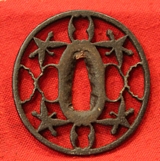
A Good Koto Period O Sukashi Tsuba
Cirtca 1550. Probably Owari school. The OWARI school should be divided into three periods. The first period comprises those pieces made in the Muromachi age. The earliest tsuba of the first period are a little younger than the earliest Kanayama tsuba. The second period is the work of the Momoyama age. The third period is from the early Edo age to the Genroku era (1688-1703). A few facts may be stated based on examination of the work of this school. They are always of positive silhouette design. The subjects of the designs vary greatly but they always have in common a strong masculine feeling. They are a noble tsuba whose influence may be seen in many contemporary schools.
Yamasaka Kichibei was the name of the first tsuba artist of this family. Later members of this school shortened the name to Yamakichibei, still later onwe see the name Yamakichi. The working period of the first Yamasaka Kichibei is from Tensho to Keicho eras (1575-1615), about contemporary with the second Nobuiye. The first generations lived in the Kiyosu area, but the later generations lived at Nagoya in Owari Province. Tsuba were made by whole dynasties of craftsmen whose only craft was making tsuba. They were usually lavishly decorated. In addition to being collectors items, they were often used as heirlooms, passed from one generation to the next. Japanese families with samurai roots sometimes have their family crest (mon) crafted onto a tsuba. Tsuba can be found in a variety of metals and alloys, including iron, steel, brass, copper and shakudo. In a duel, two participants may lock their katana together at the point of the tsuba and push, trying to gain a better position from which to strike the other down. This is known as tsubazeriai pushing tsuba against each other. read more
495.00 GBP

A Very Good Shinto Samurai Combat Ryo-Shinogi yari. A Samurai's Polearm Circa 1650
Very nice blade in polish showing a good hamon temper line. Double edged four sided. A thick stout blade that would have been enormously effective in trained hands. A Samurai ryo-shinogi yari polearm. Shinto period in nice order overall. Yari is the Japanese term for spear, or more specifically, the straight-headed spear. The martial art of wielding the yari is called sojutsu. A yari can range in length from one meter to upwards of six metres (3.3 to 20 feet). The longer versions were called omi no yari while shorter ones were known as mochi yari or tae yari. The longest versions were carried by foot troops (ashigaru), while samurai usually carried a shorter yari such as this example. Yari are believed to have been derived from Chinese spears, and while they were present in early Japan's history they did not become popular until the thirteenth century.The original warfare of the bushi was not a thing for "commoners"; it was a ritualized combat usually between two warriors who may challenge each other via horseback archery and sword duels. However, the attempted Mongol invasions of Japan in 1274 and 1281 changed Japanese weaponry and warfare. The Mongol-employed Chinese and Korean footmen wielded long pikes, fought in tight formation, and moved in large units to stave off cavalry. Polearms (including naginata and yari) were of much greater military use than swords, due to their much greater range, their lesser weight per unit length (though overall a polearm would be fairly hefty), and their great piercing ability. Swords in a full battle situation were therefore relegated to emergency sidearm status from the Heian through the Muromachi periods. Around later half of sixteenth century, ashigaru holding pikes (naga yari) with length of 4.5 to 6.5 m (15 to 22 feet) or sometimes 10 m became main forces in armies. They formed lines, combined with harquebusiers and short spearmen. Pikemen formed two or three row of line, and were forced to move up and down their pikes in unison under the command.Yari overtook the popularity of the daikyu for the samurai, and foot troops (ashigaru) used them extensively as well
Various types of yari points or blades existed. The most common blade was a straight, flat, design that resembles a straight-bladed double edged dagger. This type of blade could cut as well as stab and was sharpened like a razor edge. Though yari is a catchall for spear, it is usually distinguished between kama yari, which have additional horizontal blades, and simple su yari (choku-so) or straight spears. Yari can also be distinguished by the types of blade cross section: the triangular sections were called sankaku yari and the diamond sections were called ryo-shinogi yari. 16.5 inch blade including tang, 7inch blade length, overall yari length 75 inches. read more
1495.00 GBP

A Most Beautiful Fine Quality Shinto Wakizashi With All Original Edo Period Fittings and Silver Mounts. Circa 1650
Japanese Wakizashi, with a signed Shinto, very good shinogi zukuri blade in fabulous polish, with a fine suguha hamon, and wazamono sharp.
The sword has a tsuka with gold ito bound over a pair of superb shakudo shishi lion dogs on samegawa, a shakudo kashira with nanako ground and decorated with takebori sage wearing a court cap, with gold highlights, and a plain silver fuchi and shakudo nanako tsuba decorated with plants.
It is in its original Edo period stunning saya, decorated with pine needle and abilone shell lacquer, an inlaid silver kojiri of elaborate scrolls, and a plain silver koi guchi that matches the silver fuchi, and a kozuka pocket for an optional kozuka to be housed.
Kanzan Sato, in his book titled "The Japanese Sword", notes that the wakizashi may have become more popular than the tanto due to the wakizashi being more suited for indoor fighting. He mentions the custom of leaving the katana at the door of a castle or palace when entering while continuing to wear the wakizashi inside. Wakizashi were worn on the left side, secured to the obi waist sash. Although they appear to be likely a relative expensive luxury compared to other antique swords from other nations, they are in fact incredible value for money, for example a newly made bespoke samurai style sword blade from Japan will cost, today, in excess of £11,000, take up to two years to complete, will come with no fittings at all, and will be modern naturally with no historical context or connection to the ancient samurai past in any way at all. Our fabulous original swords can be many, many, hundreds of years old, stunningly mounted as fabulous quality works of art, and may have been owned and used by up to 30 samurai in their working lifetime. Plus, due to their status in Japanese society, look almost as good today as the did possibly up to 400 years ago, or even more. Every katana, tachi, or wakazashi buyer will receive A complimentary sword stand, plus a silk bag, white handling gloves and a white cleaning cloth.
Excellent condition overall, superb polished blade showing a fine suguha hamon, a crisp, razor sharp cutting edge without blemish. read more
4250.00 GBP
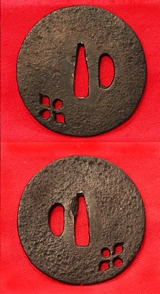
Ko Tosho School Swordsmith Made Koto Katana Tsuba Circa 1400
The strong, softly lustrous metal and very well cut, the large Hitsu-ana, and the antique chisel marks around the Hitsu-ana are all characteristic indications of early-Muromachi period works. Carved openwork clan mon. The Hitsu-ana, made when the guard was first produced, suggests that it is a work of the time of Yoshimitsu. A well worked and hammered plate. According to tradition, it says each time a Tosho made a to-ken, he made a habaki with his own hands, and at the same time he also added a single tsuba such as this.
The earliest Tosho tsuba are referred to in Japanese as Ko-Tosho old sword smith and date from the Genpei War (1180-1185) to middle Muromachi Period (1400-1500).
During the late Kamakura Period large Ko-Tosho tsuba were developed and were used mostly as field mounts for odachi by high-ranking Samurai during and after the Mongol invasion of Japan in Genko Jidai (1274-1281 ) in the Muromachi Period (1336-1573) the Ko-Tosho tsuba became even more common with the development and popularization of the onehanded sword uchigatana as the only sword of Ashigaru.
The most common design characteristic, next to the plain flat plate, for Ko-Tosho tsuba is kosukashi the simplistic use of small negative silhouetted openwork. The most common openwork designs are of mon (family crest), sun, moon, tools, plants, Buddhist, Shinto and sometimes Christian religious symbols. The plates iron is characteristically of a good temper, having good hardness and elasticity. The plate is made of local iron forged by the swordsmith or apprentice, the same as for Japanese sword blades. 74mm read more
750.00 GBP
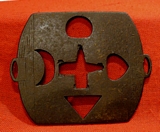
A Most Unusual & Rare Edo Period Katana Tsuba, With Rotational Fitting. This is An Incdibly Rare Form of Tsuba in that it Has Two Methods To Mount It On Katana. Vertical or Horizontal
An iron sukashi tsuba, cut with four different shaped symbols as kozuka-ana and kogai-ana, and two, North and South, or East and West facing blade apertures, to enable the rotation of the tsuba when mounting it onto the blade. Thus altering the profile of the tsuka from wide to narrow.
The tsuba is always usually a round, ovoid or occasionally squarish guard at the end of the tsuka of bladed Japanese weapons but always usually designed to be worn one way upon the sword, either the katana and its various declinations, tachi, wakizashi, tanto, and polearms that have a tsuba, such as naginata etc.
They contribute to the balance of the weapon and to the protection of the hand. The tsuba was mostly meant to be used to prevent the hand from sliding onto the blade during thrusts as opposed to protecting from an opponent's blade. The chudan no kamae guard is determined by the tsuba and the curvature of the blade. The diameter of the average katana tsuba is 7.58 centimetres (3.0-3.1 in), wakizashi tsuba is (2.4-2.6 in), and tanto tsuba is 4.5-6 cm (1.8-2.4 in).
During the Muromachi period (1333-1573) and the Momoyama period (1573-1603) Tsuba were more for functionality than for decoration, being made of stronger metals and designs. During the Edo period (1603-1868) tsuba became more ornamental and made of less practical metals such as gold.
Tsuba are usually finely decorated, and are highly desirable collectors' items in their own right. Tsuba were made by whole dynasties of craftsmen whose only craft was making tsuba. They were usually lavishly decorated. In addition to being collectors items, they were often used as heirlooms, passed from one generation to the next. Japanese families with samurai roots sometimes have their family crest (mon) crafted onto a tsuba. Tsuba can be found in a variety of metals and alloys, including iron, steel, brass, copper and shakudo. In a duel, two participants may lock their katana together at the point of the tsuba and push, trying to gain a better position from which to strike the other down. This is known as tsubazeriai pushing tsuba against each other. read more
585.00 GBP
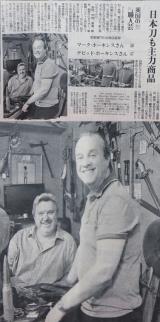
A Most Pleasant Reminder of An Interview We Gave With The Japanese Press
We received a most pleasant surprise from a Japanese friend who works in the Japanese Consulate in Piccadilly, London.
It was his copy of a most informal interview that we gave during our stock listing, it was a boiling hot summers day, and our air con was struggling.
It was with a most polite and courteous journalist {they all are in fact} from a Japanese newspaper a little while ago. read more
Price
on
Request

Superb Early to Mid Edo,Museum Quality Signed Samurai War Helmet Kabuto, by Nobutada, of 21 'Helmet Skull' or 'Bowl Plates', with a Leaping Animal, Carved Wooden and Gold Maedate & Clan Mon of the Sakai Clan, & “Fierce Face” Ressai, Face Armour
A truly fabulous, original, Edo samurai's antique kabuto, war helmet, worthy of a museum display, the best samurai or Japanese art collections, or as a single 'statement' piece for any home. This is, without doubt, one of the most beautiful and fine original antique samurai war helmets, kabuto, we have seen for a jolly long time. Helmets of such beauty and quality as this can be prized and valued as much as a complete original samurai armour.
The imposing beauty of the helmet is entrancing, and the menpo {the moustached, grimacing expression face armour} sets it off superbly with a most intimidating presence. When this was worn by its fierce-some armoured samurai he must have looked spectacularly impressive.
A 21 plate goshozan sujibachi kabuto, with ressei {fierce face } mempo face armour, that has just returned from having the mempo's moustache expertly conserved, and it looks as good as new.
Probably a 17th-18th century, 21 ken plate, Sujibachi, which is a multiple-plate type of Japanese helmet skull bowl with raised ridges or ribs showing where the 21 tate hagi-no-ita (helmet plates) come together creating the main skull bowl bachi, and culminating at the multi stage tehen kanamono finial, with the fukurin metal edges on each of the standing plates.
The mabisashi peak is lacquered and it has a four-tier lacquered iron hineno-jikoro neck-guard laced with gold, and the skull is surmounted by a gilt-lacquered wood leaping animal, the maedate (forecrest), possibly a rabbit or deer, the Fukigaeshi small front wings shows the mon crest symbol of a plain form katabami mon {the wood sorrel flower}.
It's one of popular kamon that is a design of the flower of oxalis corniculata.
The founder of the clan that chose this flower as their mon had wished that their descendants would flourish well. Because oxalis corniculata is renown, and fertile plant.
the mon form as used by clans such as the Sakai, including daimyo lord Sakai Tadayo
One of the great Sakai clan lords was Sakai Tadayo (酒井 忠世, July 14, 1572 – April 24, 1636). He was a Japanese daimyō of the Sengoku period, and high-ranking government advisor, holding the title of Rōjū, and later Tairō. You can see his image in the gallery wearing the very same form of war helmet kabuto.
The son of Sakai Shigetada, Tadayo was born in Nishio, Mikawa Province; his childhood name was Manchiyo. He became a trusted elder (rōjū) in Toyotomi Hideyoshi's government, alongside Tokugawa Ieyasu. Under Hideyoshi, he was made lord of Kawagoe Castle (in Musashi Province, today Saitama Prefecture) and later of Nagoya Castle in Kyūshū's Hizen Province. In 1600, in the lead-up to the decisive Sekigahara campaign, he fought against the Tokugawa at Aizu, and submitted to them at the siege of Ueda. Thus, having joined the Tokugawa prior to the battle of Sekigahara itself, Sakai was made a fudai daimyō, and counted among the Tokugawa's more trusted retainers. He served under Ieyasu for a time, and under the second shōgun, Tokugawa Hidetada, as a hatamoto.
The lacquered iron menpo (face mask) with four-lame yodarekake face armour. The kabuto is signed on the interior Nobutada saku Nobutada made this
After the introduction of firearms, smoke blanketed many battlefields, causing confusion for the troops. So they could be more readily identified, samurai began to wear helmets with elaborate ornaments at the front, back, or sides, often featuring an intricate crest (maedate).
In their quest for unique and meaningful armour, samurai turned to nature, folklore, or religion for inspiration. Whatever the source, they selected designs for their armor that would set them apart and communicate their personality and beliefs, whether whimsical, frightening, or spiritual.
An antique woodblock print in the gallery, likely of Sakai Tadayo, showing his same form of war helmet kabuto, decorated with his same Sakai clan mon of the katabami, and he also has a leaping animal, gold covered carved wood, as his maedate helmet crest as has ours. And he has the same 'fierce face' mempo face armour with the very same style of elaborate, pronounced moustache.
The Fukigaeshi on the left facing side of the helmet shows the mon crest symbol of a plain katabami mon but small surface lacquer area partly missing. There are very small age nicks to the helmet lacquer. It has its original helmet lining but most removed back to reveal the signature
Every single item from The Lanes Armoury is accompanied by our unique Certificate of Authenticity. Part of our continued dedication to maintain the standards forged by us over the past 100 years of our family’s trading, as Britain’s oldest established, and favourite, armoury and gallery read more
7950.00 GBP