
Antique Arms & Militaria


A 13th Century Iron Head, Crusader Knight's Battle Mace, 800 Years Old, Mounted Upon A Later Museum's Display Haft
Pineapple shaped lobes on circular head with large mounting hole through which the haft slots. it was fitted to a plain wood haft for a museum display, as its original rotted away centuries ago as usual, in order to show how it looked and was used 800 years ago.
This type of mace head were also used as a Flail Mace, by filling out the hollow iron head with lead and a chain mounted hook placed within it, a chain would then be added to the end of a similar but shorter wooden haft. This subsequent mace head weapon could thus then became a flail, often called a scorpion at the time.
This very fine and rare iron mace head has flattened pyramidal protuberances, and is possibly English. Made for a mounted Knight to use as an armour and helmet crusher in hand to hand mortal combat upon his war horse, or then for use dismounted.
It would have been used for several hundred years, up to the 15th to 16th century.
Used as a flail it had the sobriquet of a Scorpion in England or France, or sometimes a Battle-Whip. It was also wryly known as a 'Holy Water Sprinkler'.
King John The Ist of Bohemia used exactly such a weapon, as he was blind, and the act of 'Flailing the Mace' meant lack of site was no huge disadvantage in close combat. Although blind he was a valiant and the bravest of the Warrior Kings, who perished at the Battle of Crecy against the English in 1346. On the day he was slain he instructed his Knights both friends and companions to lead him to the very centre of battle, so he may strike at least one blow against his enemies. His Knights tied their horses to his, so the King would not be separated from them in the press, and they rode together into the thick of battle, where King John managed to strike not one but at least four noble blows. The following day of the battle, the horses and the fallen knights were found all about the body of their most noble King, all still tied to his steed. In fact so noble were his actions regarded, it is said his banner of three erect and standing feathers became the symbol of the then Prince of Wales, Edward, the Black Prince, and as such, is still used by the current Prince of Wales today.
During the Middle Ages metal armour such as mail protected against the blows of edged weapons. Solid metal maces and war hammers proved able to inflict damage on well armoured knights, as the force of a blow from a mace is great enough to cause damage without penetrating the armour. Though iron became increasingly common, copper and bronze were also used, especially in iron-deficient areas.
It is popularly believed that maces were employed by the clergy in warfare to avoid shedding blood (sine effusione sanguinis). The evidence for this is sparse and appears to derive almost entirely from the depiction of Bishop Odo of Bayeux wielding a club-like mace at the Battle of Hastings in the Bayeux Tapestry, the idea being that he did so to avoid either shedding blood or bearing the arms of war. One of the Crusades this type of mace may have been used was the Crusade of 1239, which was in territorial terms the most successful crusade since the First. Called by Pope Gregory IX, the Barons' Crusade broadly spanned from 1234-1241 and embodied the highest point of papal endeavour "to make crusading a universal Christian undertaking." Gregory called for a crusade in France, England, and Hungary with different degrees of success. Although the crusaders did not achieve any glorious military victories, they used diplomacy to successfully play the two warring factions of the Muslim Ayyubid dynasty (As-Salih Ismail in Damascus and As-Salih Ayyub in Egypt) against one another for even more concessions than Frederick II gained during the more well-known Sixth Crusade. For a few years, the Barons' Crusade returned the Kingdom of Jerusalem to its largest size since 1187.
This crusade to the Holy Land is sometimes discussed as two separate crusades: that of King Theobald I of Navarre, which began in 1239; and, the separate host of crusaders under the leadership of Richard of Cornwall, which arrived after Theobald departed in 1240. Additionally, the Barons' Crusade is often described in tandem with Baldwin of Courtenay's concurrent trip to Constantinople and capture of Tzurulum with a separate, smaller force of crusaders. This is because Gregory IX briefly attempted to redirect the target his new crusade from liberating the Holy Land from Muslims to protecting the Latin Empire of Constantinople from heretical Christians.
Despite relatively plentiful primary sources, scholarship until recently has been limited, due at least in part to the lack of major military engagements. Although Gregory IX went further than any other pope to create an ideal of Christian unity in the process of organizing the crusade, in practice the crusade's divided leadership did not reveal a unified Christian action or identity in response to taking a cross. Approx. 2.5 inch wide lobed iron head.
Painting in the gallery by Julian Russel Story of the Black Prince at the battle of Crecy. At his feet lies the body of the dead King John of Bohemia painted in 1888. read more
1250.00 GBP

A Superb 19th Century French Chassepot M1866 Sword Bayonet, Franco Prussian War Issue, Manufactured at the Armoury of StEtienne 1870
Stunning example, with very good steel and brass,
Its inventor was, Antoine Alphonse Chassepot, and it became the French service weapon in 1866. It was first used at the battlefield at Mentana, November 1867, where it inflicted severe losses on Garibaldi's troops. The event was reported at the French Parliament: "Les Chassepots ont fait merveille!", {The Chassepots did marvelous execution !} In the Franco-Prussian War (1870-1871) it proved greatly superior to the German Dreyse needle gun, outranging it by 2 to 1. Although it was a smaller caliber but the chassepot ammunition had more gunpowder and thus faster muzzle velocity. The Chassepots were responsible for most of the Prussian and other German casualties during the conflict. This is the most widely copied of all the sword bayonets. Many countries - including the United States, Egypt, Belgium, and Argentina - have manufactured or used very similar bayonets. The French model was designed to fit on the French Model 1866 Chassepot Rifled Infantry Musket (the musket was revolutionary in itself). It was manufactured from 1866 to about 1874 and was replaced by the French Model 1874 "Gras" Bayonet.
The bayonets are brass-hilted The crossguard is iron (steel) and has a screw-type tightening arrangement on the muzzle-ring. The lower quillon is a hooked "blade-breaker" type.
The blade is steel, single-edged, fullered (both sides), with a re-curved or "yataghan-shape." The blades marked on the back-edge (opposite the cutting edge) with the arsenal, month, and year of manufacture; this is done in engraved cursive fashion
Arsenals encountered may be such as Chatellerault, Mutzig, St. Etienne, Paris-Oudry, Tulle, and perhaps Steyr (not confirmed on the 1866). The French wars during the life-span of this bayonet were: French Intervention in Mexico (1861-1867);
Franco-Prussian War (July 19, 1870 - May 10, 1871)
French Indo-China (1873-1874, 1882-1883);
Sino-French War (1883-1885);
Madagascar Wars (1883-1885, 1895);
1st Mandingo-French War (1883-1886);
1st Dahomeyan-French War (1889-1990);
2nd Dahomeyan-French War (1892-1894);
Franco-Siamese War of (1893)
2nd Mandingo-French War (1894-1895);
Conquest of Chad (1897-1914);
3rd Mandingo-French War (1898);
Moroccan War (1907-1912);
The Wadai War (1909-1911);
World War I (early).
These bayonets were widely copied and used by many countries - including the United States, Belgium, and Germany. Many of the actual French-marked bayonets can be found with German manufactured blades. It is believed some of these were used during the American Civil War when many European arsenals were emptied of their surplus arms.
These bayonets are the French Model 1866 "Chassepot" Bayonet.
The crossguard are iron (steel) and with a "cock's comb" muzzle-ring finial. The lower quillon is a hooked "blade-breaker" type.
The blade is steel, single-edged, fullered (both sides), with a re-curved or "yataghan-shape." One blade is marked on the back-edge (opposite the cutting edge) with the arsenal, month, and year of manufacture; this is done in engraved cursive fashion. read more
175.00 GBP
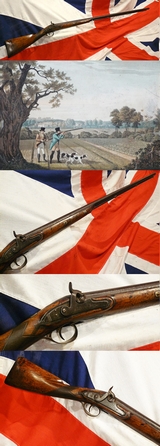
A Most Attractive Late King George IIIrd English Long Barrel Fowling Piece
Very long barrel, and good walnut stock. Percussion action. The earliest smoothbore firearms loaded with shot were the fowling pieces that appeared in 16th-century Europe. In the early 17th century, the barrels were made as long as 6 feet in an attempt to gain maximum accuracy. Hunting has been practised in Britain since prehistoric times; it was a crucial activity of hunter-gatherer societies before the domestication of animals and the dawn of agriculture.
In Britain, hunting with hounds was popular in Celtic Britain before the Romans arrived, using the Agassaei breed. The Romans brought their Castorian and Fulpine hound breeds to England, along with importing the brown hare (the mountain hare is native) and fallow deer as quarry. Wild boar was also hunted.
The earliest known attempt to specifically hunt a fox with hounds was in Norfolk, in the East of England, in 1534, where farmers began chasing down foxes with their dogs as a form of pest control. Packs of hounds were first trained specifically to hunt foxes in the late 17th century, with the oldest such fox hunt likely to be the Bilsdale in Yorkshire. By the end of the 17th century, many organised packs were hunting both hare and fox.
Shotguns were improved during the 18th and 19th centuries and game shooting became more popular. To protect the pheasants for the shooters, gamekeepers culled vermin such as foxes, magpies and birds of prey almost to extirpation in popular areas, and landowners improved their coverts and other habitats for game. Game Laws were relaxed in 1831 which meant anyone could obtain a permit to shoot rabbits, hares, and gamebirds, although shooting and taking away any birds or animals on someone else's land without their permission continued to be the crime of poaching, as it still is.
Hunting was formerly a royal sport, and to an extent shooting still is, with many Kings and Queens being involved in hunting and shooting, including King Edward VII, King George V (who on 18 December 1913 shot over a thousand pheasants out of a total bag of 3937), King George VI and the present day Prince Philip, although Queen Elizabeth II does not shoot. Shooting on the large estates of Scotland has always been a fashionable country sport. This trend is generally attributed to the Victorians, who were inspired by the romantic imagery of the Scottish Highlands.
The modern shotgun evolved principally from a series of 19th-century improvements in gunpowder, cartridges, and guns. The barrel was shortened and lightened, making possible the double-barreled gun, in which two barrels shoot to the same point of aim at normal ranges. The choke bore was introduced to limit the spread of the shot and increase range and accuracy. As with all our antique guns, no license is required as they are all unrestricted antique collectables
Barrel 50.5 inches long, overall 67 inches long read more
750.00 GBP

We Just Signed Up To Instagram This Week. Another Way to Connect To our Webstore & Our Daily Updates
We signed up on Thursday to Instagram, thanks to the suggestions and guidance of our tech savvy Victoria, and our eldest granddaughter / great neice, Holly {who has her own 500k instagram followers}
copy and paste.
https://www.instagram.com/lanesarmoury
We only have a few pictures to view there at present, and it will take us a while to add our other 20k+ photographs, but we will get it done eventually.
If you use Instagram... why not 'follow' us and enjoy read more
Price
on
Request
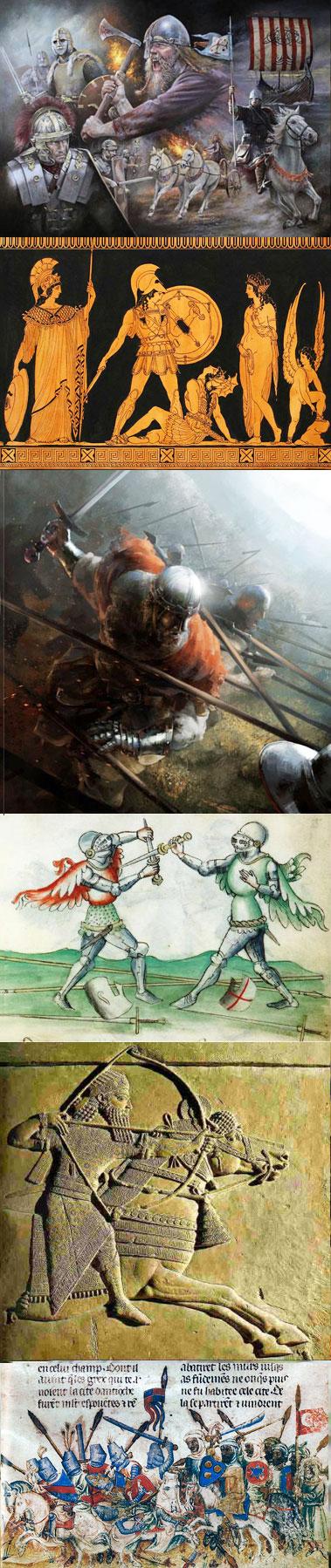
The Lanes Armoury..Everything You Can Imagine, and a Lot, Lot More!
Original pieces from the great ancient civilisations, Ancient Egyptian, Greek, Scythian, Persian, Roman, Celtic, Anglo-Saxon, Viking, Norman, Japanese, Chinese, Indian, British, and beyond, in fact more antiquities, armoury antiques, militaria, that you can imagine, plus leaves from illuminated manuscripts, rare and historical books, incunabula and Ist editions
We may not quite have everything that everyone might be seeking, but you can trust that we have spent over 100 years trying, and every day we do our utmost to scour the collecting world to find yet more, unique ancient or antique pieces. We put in all the hard work, effort and expertise, so that you don't have to!, and remember, every purchase is accompanied with our Certificate of Authenticity, as our unique, lifetime guarantee, backed up by over 100 years of long established experience.
We are asked almost every day by many of our amazed and curious visitors about famous celebrities that have been customers past and present, so here goes, but just a snippet of a few mixed up names including those that Mark has personally assisted since 1970, and David since 1980, but of course there are many here below that our younger viewers will very likely have never even heard of!;
Elizabeth Taylor and Richard Burton, actors
Charlton 'Chuck' Heston, actor
Edward G. Robinson, actor,
HRH Princess Margaret, late sister of Her Late Majesty Queen Elizabeth
'Fat Boy' Slim, aka Norman Cook, songwriter +
Ronald Reagan, Potus
John Osborne, author
Lord Olivier, a most well beloved Brighton resident, and actor director..
Barry Humphries, genius writer actor of limitless talent
Max Millar, comedian
Harold, Viscount Watkinson, Winston Churchill's Minister of Defence 1959/62
Garfield [Garry] Weston, proprietor of Fortnum and Mason, chairman Associated British Foods and of the Garfield Weston Foundation
John Montgomery, author
Johnny Rotten, singer and armed forces supporter
The Lord St John of Fawsley
The Tower Armouries, museum
The Higgins Museum, USA
Octav Botnar Chairman, &. Late Owner Nissan UK, formerly Datsun UK
The Metropolitan, New York
The Smithsonian, Washington D.C.
Lord Hailsham
Katy Melua, singer songwriter
Will Young, singer
Douglas Bader, RAF
Mark Williams, character actor par excellence
Sir Ralph Richardson, actor
Jim Davidson major armed services charities benefactor and comedian
Warner Bros. UK,
Sir Henry Cecil One of the world's greatest horse trainers
Macy’s, New York Department Store
St Albans Museum + Gallery, providing their new centrepiece exhibit for their new ‘War of the Roses’ Battle of St. Albans gallery.
Rebekkah Brooks & Ross Kemp in their past to-gether days, journalist and actor
The Horniman Museum, UK.
Major General Lord Fitzalen Howard Life Guards GCVO, CB, CBE, MC.
Howard Blackmore Deputy Master of The Tower of London Armouries, Founder and President The Arms and Armour Society
Steven Berkoff, actor, playwright, theatre director
Kaufhof GmbH German department store chain
Galeria D'Arte Adriana Papiri-Brignoni foremost gallery proprietor of Lugano Switzerland [with her husband Gigi] & Her friends, residents of Lugano;
Gina Lollobrigida, actress
Valentino, fashion designer
Eugene Faberge, in the 1950’s, the eldest son Carl Faberge of Moscow.
Dzigar Kongtrul Rinpoche (Jigme Namgyel), renown Buddhist and author.....
Plus, many thousands more... read more
Price
on
Request

A 19th Century, Highly Attractive, Antique Stilletto Bladed So-Called Courtesan's Protective Dagger
Spiral carved bone hilt, powerful quatrefoil 'armour piercing' blade, steel teardrop quillon crossguard, nickle scabbard. A so called coutesan's dagger, also often regarded as the gambler's boot dagger when found in North America
A coutesan's dagger was so called due to their attractiveness and useful size for concealment by unaccompanied ladies travelling abroad after dark.
Of course they would never have been sold as such by retailers, and the term has entered the vernacular of collectors probably even after the time they were actually made, however, like the term 'mortuary hilted swords' that bore the engraved visage of the king in the hilt from the English Civil War, they were never actually called that until almost 200 years later.
They are attractively designed elegant daggers, just such as this one, with a powerful and most efficient blade. 'Ladies of the night' became a major concern and a focal point for social reformers in the 19th century. Concerns were seen everywhere including the literature of notables such as Charles Dickens. He created characters (some of which may have had real life versions) like Nancy in Oliver Twist, and Martha Endell in David Copperfield.
No one knows for certain, but there were somewhere between 8,000 and 80,000 ladies of the trade in London during the Victorian Age. It is generally accepted that most of these women found themselves in prostitution due to economic necessity and desperate want.
There were three attitudes towards those in the profession – condemnation, regulation, and reformation. Dickens adopted the last and was intimately involved in a house of reform called Urania Cottage.
The carved handle has some feint natural line age markings read more
675.00 GBP

A Stunning Solid Silver Napoleonic Cavalry Officer's Sabre 1796.-1803. It Is Exceptionally Rare To Ever See a Solid Silver Hilted Version of the Napoleonic Wars Period Light Dragoon Officer’s Sabre
It is possible there may not even be another similar example like it in the National Army Museum Collection, one of Englands finest military museums, located next to the world renown Chelsea Hospital, home to the most highly regarded military veterans in the world, the Chelsea Pensioners.
The sabre has a traditional version of the 1803 type Lion's head pommel, spiral turned ebony grip, with silver triple wire binding and two silver rivets. Slotted hilt, 1803 style, with fretted, open diamond form insert. Long, curved, traditional 1796 pattern light dragoon blade but with a rare clipped-back tip. In overall superb condition. A most rare example of a sword used by an officer serving under Wellington in the great light cavalry regiments, but as this sword bears a solid silver hilt this would suggest it was an officer of considerable status and rank, or, it was a presentation sword of highest quality. A deluxe bespoke sword, designed as a cross between the British 1796 Light Dragoon pattern sword and the British 1803 pattern sword with lion's head pommel and slotted hilt. Until just after the close of the war with Napoleon all British officers were allowed to wear a sword pattern of their choice, and this example is a most rare and beautiful example of such a hand made sword from the late 18th to earliest 19th century. Used by a British officer, as his finest top quality grade combat sword, during the Napoleonic Wars.
The mounted swordsmanship training of the British emphasised the cut, at the face for maiming or killing, or at the arms to disable. This left masses of mutilated or disabled troops; the French, in contrast, favoured the thrust, which gave cleaner kills. A cut with the 1796 LC sabre was, however, perfectly capable of killing outright, as was recorded by George Farmer of the 11th Regiment of Light Dragoons, who was involved in a skirmish on the Guadiana River in 1811, during the Peninsular War:
"Just then a French officer stooping over the body of one of his countrymen, who dropped the instant on his horse's neck, delivered a thrust at poor Harry Wilson's body; and delivered it effectually. I firmly believe that Wilson died on the instant yet, though he felt the sword in its progress, he, with characteristic self-command, kept his eye on the enemy in his front; and, raising himself in his stirrups, let fall upon the Frenchman's head such a blow, that brass and skull parted before it, and the man's head was cloven asunder to the chin. It was the most tremendous blow I ever beheld struck; and both he who gave, and his opponent who received it, dropped dead together. The brass helmet was afterwards examined by order of a French officer, who, as well as myself, was astonished at the exploit; and the cut was found to be as clean as if the sword had gone through a turnip, not so much as a dint being left on either side of it" The blade is remembered today as one of the best of its time and has been described as the finest cutting sword ever manufactured in quantity read more
2675.00 GBP

An Original Ancient Egyptian Shabti, An Afterlife Tomb Figure Servant of An Egyptian Mummy, Pale Blue-Glazed Faience 664 to 332 BC
A stunning Grand Tour artefact.
Much of our Grand Tour historic artefacts were originally acquired by a noble Scottish family in the 1820's while on a Grand Tour of the Middle East and the Holy Land, plus Anglo French battle sites within Northern & Western France from Azincourt, in the Pas-de-Calais, to Poitiers in Aquitaine. And the great classical battle sites of Ancient Rome and Greece.
We also had {now sold} the swordstick of the Scottish 10th Duke of Hamilton, the world renown Grand Tour collector, especially of ancient Egyptian pieces. He was the Ambassador to Catherine the Great as well as being Lord High Steward to both King William IV and Queen Victoria. He was so enamoured with his devotion to his collection of antiquities, he was mummified after his death, and buried in an ancient Egyptian sarcophagus within his family tomb.
From the 25th dynasty to the Late Period. One of a group of fine small tomb pieces we acquired. A shabti (also known as shawabti or ushabti) is a generally mummiform small figurine found in many ancient Egyptian tombs. They are commonly made of blue or green glazed Egyptian faience, but can also consist of stone, wood, clay, metal, and glass. The meaning of the Egyptian term is still debated, however one possible translation is ‘answerer’, as they were believed to answer their master’s call to work in the afterlife. Since the Fourth Dynasty (2613–2494 BC), for instance, the deceased were buried with servant statuettes like bakers and butchers, providing their owners with eternal sustenance. after the death of Cleopatra in around 37 b.c. and the close of the Ptolomeic Dynasty, no shabti were produced for service in Egyptian mummy's tombs. A spell was oft written on the shabti so that it would awaken as planned, this is the 'shabti spell' from chapter six of the Book of the Dead and reads as follows:
"O shawabti, if name of deceased is called upon,
If he is appointed to do any work which is done on the necropolis,
Even as the man is bounden, namely to cultivate the fields,
To flood the river-banks or to carry the sand of the East to the West,
And back again, then 'Here am I!' you shall say"
The “Shabti Spell” from Chapter 6 of the Book of the Dead. This spell gives the ushabti the power to complete tasks (farming, manual labour, etc) for the deceased in the Field of Reeds . People of rank could be buried with at least 365 ushabti figures – one for each day of the year
Piye established the Twenty-fifth Dynasty and appointed the defeated rulers as his provincial governors. He was succeeded first by his brother, Shabaka, and then by his two sons Shebitku and Taharqa. The reunited Nile valley empire of the 25th Dynasty was as large as it had been since the New Kingdom. Pharaohs of the dynasty, among them Taharqa, built or restored temples and monuments throughout the Nile valley, including at Memphis, Karnak, Kawa, and Jebel Barkal. The 25th Dynasty ended with its rulers retreating to their spiritual homeland at Napata. It was there (at El-Kurru and Nuri) that all 25th Dynasty pharaohs were buried under the first pyramids to be constructed in the Nile valley in hundreds of years
The Late Dynasty Period era;
The Twenty-Eighth Dynasty consisted of a single king, Amyrtaeus, prince of Sais, who successfully rebelled against the Persians, inaugurating Egypt's last significant phase of independence under native sovereigns. He left no monuments with his name. This dynasty reigned for six years, from 404 BC–398 BC.
The Twenty-Ninth Dynasty ruled from Mendes, for the period from 398 to 380 BC. King Hakor of this dynasty was able to defeat a Persian invasion during his reign.
The Thirtieth Dynasty took their art style from the Twenty-Sixth Dynasty. A series of three pharaohs ruled from 380 to 343 BC. The first king of the dynasty, Nectanebo I, defeated a Persian invasion in 373 BC. His successor Teos subsequently led an expedition against the Achaemenid Empire in the Near East. The expedition was beginning to meet with some success. unfortunately for Teos, his brother Tjahapimu was plotting against him. Tjahapimu convinced his son Nectanebo II to rebel against Teos and to make himself pharaoh. The plan was successful and the betrayed Teos had no alternative but to flee and the expedition disintegrated. The final ruler of this dynasty, and the final native ruler of Egypt, was Nectanebo II who was defeated in battle leading to the re-annexation by the Achaemenid Empire.
31st Dynasty
Main article: Thirty-first Dynasty of Egypt
The Second Achaemenid Period saw the re-inclusion of Egypt as a satrapy of the Persian Empire under the rule of the Thirty-First Dynasty, (343–332 BC) which consisted of three Persian emperors who ruled as Pharaoh - Artaxerxes III (343–338 BC), Artaxerxes IV (338–336 BC), and Darius III (336–332 BC) - interrupted by the revolt of the non-Achaemenid Khababash (338–335 BC). Persian rule in Egypt ended with the defeat of the Achaemenid Empire by Alexander the Great, who accepted the surrender of the Persian satrap of Egypt Mazaces in 332BC, and marking the beginning of Hellenistic rule in Egypt, which stabilized after Alexander's death into the Ptolemaic Kingdom.
Photo in the gallery of an ushabti of Khabekhnet and its box in the Metropolitan Museum of Art in America read more
275.00 GBP
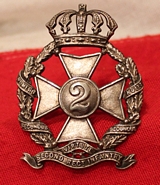
A Rare Victorian 2nd Regiment NSW Volunteer Infantry Helmet Badge Circa
Circa 1878. Silvered brass hat badge with centrally mounted Maltese cross featuring a number '2' within a circle in the centre. The cross is surmounted by a large Kings Crown and surrounded by a wreath of waratahs with intertwined scrolls. The scroll on the left reads 'NUMERO SECUNDUS' and the right scroll reads 'NULLI SECUNDUS'. Beneath the cross on a central scroll is 'VIRTUTE' and 'SECOND REGT INFANTRY'. The back of the badge has three lugs for attaching it to the hat. They have a near identical example in the Australian War Memorial Collection that may be associated with the Ferguson family from Goulburn as it was found in the personal affects of 9146 Gunner Leopold Ferguson who was killed on 9 June 1917 while serving with the Australian Imperial Force. read more
295.00 GBP
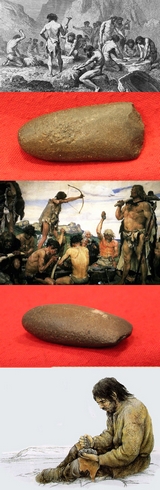
Around 6000 Year Old, A Fabulous Neolithic Period Stone-Age Polished Hand Axe
Some of the most fascinating, interesting and intriguing hand made tools and weapons come from a time so far distant to us, it was thousands of years before history was ever recorded, yet they can be extraordinarily affordable. So beautiful and tactile, in fact as much an object d’art as an implement.
To hold within ones hands an implement that was last used by a person up to 4000 years before Julius Caesar even set foot upon this land with his cohorts of Roman Legionaries is simply awe inspiring. It is extraordinary that we have a remarkable knowledge about how they lived, farmed and thrived upon the earth, but not the remotest clue about how they spoke, what form of language they used, and even remotely how it might have sounded. Yet here one can be, holding a piece of amazing hand crafted Neolithica, a tool and vital artefact of person who had hopes, dreams, desires, fears, wants and needs just as we do, but not having the faintest clue how they thought, or communicated them, or even expressed them vocally to others. Ironically from a period around 4600 before the era known to the British as the Dark Ages, due to so precious little is known about British history between when the Roman’s left our shores and the Anglo Saxons ruled this land.
Mankind has effectively long past created a time machine, it is, simply, language, but only when combined with the ability to set it down, to be visually communicated from one to another, albeit on rock or stone, slate tablets, scrolls, parchment vellum or paper. That way once it can be understood, translated if you like, can we communicate with the past by knowing what they had recorded about their time. This is why the printed word, and not electronic data, is so absolutely vital to the continuation of humanity. Imagine, just, say 50 years into the future, it is possible that by then all recorded information around the world will be by electronic data alone, then imagine the simplest possibility of all electronic data being lost or inaccessible, by say an electro magnetic pulse. If that occurred 200 years in the future, without those 150 years being saved in print, we would have a new Dark Age, simply by not having any form of a hand held viewable and readable record.
Around 4,000-2,500BC, In the later Neolithic period, (known as the later stone age) people started to settle down and start farming. At places such as Springfield Lyons, these early settlements have been identified. It was also at this time when stone tools, which up until this point had been purely functional, started to take on a more symbolic meaning. Polished stone axes and other tools that were never used have been found across the county, showing changes in social hierarchy and possibly even the development of religion. The Neolithic also known as the "New Stone Age", the final division of the Stone Age, began about 12,000 years ago when the first development of farming appeared in the Epipalaeolithic Near East, and later in other parts of the world. The division lasted until the transitional period of the Chalcolithic from about 6,500 years ago (4500 BC), marked by the development of metallurgy, leading up to the Bronze Age and Iron Age. In Northern Europe, the Neolithic lasted until about 1700 BC, while in China it extended until 1200 BC. Other parts of the world (the New World) remained in the Neolithic stage of development until European contact.
The Neolithic comprises a progression of behavioral and cultural characteristics and changes, including the use of wild and domestic crops and of domesticated animals.
The term Neolithic derives from the Greek neos and lithos "New Stone Age". The term was coined by Sir John Lubbock in 1865 as a refinement of the three-age system2.5 inches long As with all our items it comes complete with our certificate of authenticity. read more
295.00 GBP