
Antique Arms & Militaria


A Yemeni Jambiya A Stunning WW1 Yemeni 'Lawrence of Arabia's' Favoured Pattern of Jambiya
Just returned from over 30 hours of specialist hand conservation to clean and conserve the whole dagger, and a remarkable result has been achieved, but it was simply a labour of love, as it's stored condition was most sad indeed. Likely this intriguing piece was acquired from a souk in Arabia sometime after the war.
Very similar to Lawrence of Arabia's jambiya when he was serving in WW1 in the Turkish Campaign in Arabia. The word jambiya actually means “something worn at one’s right side” (from the triliteral root j-n-b). Lawrence of Arabia had several very similar ones presented to him, they were his favourite dagger, and he was frequently photographed wearing them. One picture is a portrait of Lawrence with his Jambiya, most similar to this example. photo for historical context information only and not included It is made from silver metal, but usually, more often than not, coin silver, certainly not English hallmarked silver. The jambia, a curved Islamic dagger, is the main customary accessory to the clothing worn by Arabian men. For centuries the people of South Arabia have inherited the their jambiahs from generation to generation. There are several theories about the origin of the Jambia. There are historical facts, concerning the existence of the Jambia revealing that it used to be worn at Sheban times, in the Himiarite kingdom. They take the statue of the Sheban king (Madi Karb 500 bc ) as proof. This statue, which was discovered by an American mission in Marib in the 1950s, was found to be wearing a Jambia.
Reference; a Lanes Armoury *Special Conservation* Item, restored and conserved in our workshop, see info page for details on our conservation principles. read more
895.00 GBP
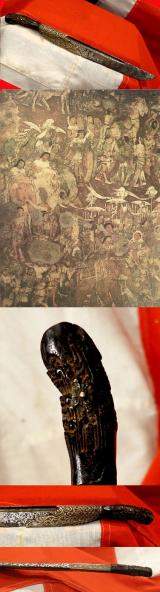
A Beautiful Noble's Early Antique Sinhalese Ceylonese Piha Kaetta Knife Dagger
A most engaging ornate pihas and likely made exclusively by the Pattal Hattara (The Four Workshops). They were employed directly by the Kings of Kandy. Kandy, the independent kingdom, was first established by King Wickramabahu (1357-1374 AD). The last Kandyan king was in the early 1800's, and the workshops are no longer in existence today.The simplest are of plain steel, but very graceful form, with wooden or horn handles, and carried in the belt, to lop off inconvenient branches as one passes through the jungle, or, to open coconuts, or cut jungle ropes. From these knives there are all transitions to the finest versions of nobles and princes, the most elaborate and costly of silver or gold inlaid and overlaid knives worn by the greatest chiefs as a part of their formal dress, and possibly never intended for regular use. The workmanship of many of these is most exquisite but this fine work is done rather by the higher craftsmen, the silversmiths and ivory carvers, than by the mere blacksmith. Many of the best knives were doubtless made in the Four Workshops, such as is this example, the blades being supplied to the silversmith by the blacksmiths.
"The best of the higher craftsmen (gold and silversmiths, painters, and ivory carvers, etc.) working immediately for the king formed a close, largely hereditary, corporation of craftsmen called the Pattal-hatara (Four Workshops). They were named as follows; The Ran Kadu [Golden Arms], the Abarana [Regalia], the Sinhasana [Lion Throne], and the Otunu [Crown] these men worked only for the King, unless by his express permission (though, of course, their sons or pupils might do otherwise); they were liable to be continually engaged in Kandy, while the Kottal-badda men were divided into relays, serving by turns in Kandy for periods of two months. The Kottal-badda men in each district were under a foreman (mul-acariya) belonging to the Pattal-hatara. Four other foremen, one from each pattala, were in constant attendance at the palace.This beautiful noble's dagger is stunningly decorated with veka deka liya vela [double curve vine motif] and the flower motif sina mal, and a bold vine in damascene silver. The blade is traditonal iron and the hilt beautifully carved black coral read more
695.00 GBP
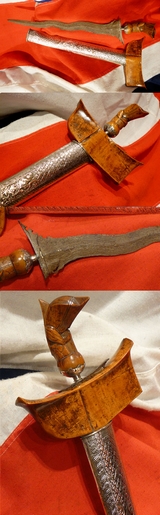
A Stunning Antique 18th Century Indonesian Silver Mounted Kris
Keris Melayu Semenanjong with a serpentine blade with 7 Luk [seven curves or waves]. A very good and rare example of a keris from the southern Malaysian peninsular region of Johor or Selangor. Handle in the jawa demam form. This form of hilt is common in central or southern Sumatra, as well as the Malay peninsular regions. The Minang variant is usually more upright with a more flaring top.
The top sheath in the typical Malay tebeng form, are made from very well selected kemuning woods with flashing grains. Bottom stem is likely made from well selected angsana woods with tiger?s stripe grains. It has a beautifully tooled silver sheath and a plain silver pendoko or ferrule completes the wonderful fittings.
Pamor patterns are arranged in the mlumah technique of the wos utah or scattered rice variations which is said to enhance the owner?s material well being. Traditionally the pamor material for the kris smiths connected with the courts of Yogyakarta and Surakarta originates from an iron meteorite that fell to earth at the end of 18th century in the neighborhood of the Prambanan temple complex. The meteorite was excavated and transported to the keraton of Surakarta; from that time on the smiths of Vorstenlanden (the Royal territories) used small pieces of meteoric iron to produce pamor patterns in their kris, pikes, and other status weapons. After etching the blade with acidic substances, it is the small percentage of nickel present in meteoric iron that creates the distinctive silvery patterns that faintly light up against the dark background of iron or steel that become darkened by the effect of the acids. read more
495.00 GBP

A Fabulous Javanese Kris With Pure Gold Snake God Symbol Onlaid on to The Fabulous Pamor Serpentine Blade
Probably 19th to early 20th century. In an esteemed London auction house, a most similar quality gold inlaid example, of the same age, sold three Decembers ago for just over £5,400 [inc commission]. This is simply one of the most beautiful we have seen on the market in over 20 years. A sarpa lumarka wavy blade with a gold naga [snake] in sangkelat [13 waves, or lok]. Ladrang form of wrangka hilt crosspiece [boat form] of a simply stunningly grained wood, which may well be Javan pelet, with a fine gilt metal sleeve covering the haft, with a most intricate and detailed pieced design on the obverse side. In Java, the metal sleeve is called pendokbunton, which is a full metal sleeve. The keris is considered a magical weapon, filled with great spiritual power. In Javanese there is a term "Tosan Aji" or "Magic Metal" used to describe the keris. The keris is replete with the totems of Malay-Indonesian culture of hindu and islam. The blade is a mixture of meteoric steel and nickel According to traditional Javanese kejawen, kris contain all the intrinsic elements of nature: tirta (water), bayu (wind), agni (fire), bantolo (earth, but also interpreted as metal or wood which both come from the earth), and aku (lit: "I" or "me", meaning that the kris has a spirit or soul). All these elements are present during the forging of kris. Earth is metal forged by fire being blown by pumped wind, and water to cool down the metal. In Bali, the kris is associated with the naga or dragon, which also symbolizes irrigation canals, rivers, springs, wells, spouts, waterfalls and rainbows; thus, the wavy blade symbolizes the movement of the serpent. Some kris have a naga or serpent head carved near the base with the body and tail following the curves of the blade to the tip. A wavy kris is thus a naga in motion, aggressive and alive; a straight blade is one at rest, its power dormant but ready to come into action.
In former times, kris blades were said to be infused with poison during their forging, ensuring that any injury was fatal. The process of doing so was kept secret among smiths. Different types of whetstones, acidic juice of citrus fruits and poisonous arsenic bring out the contrast between the dark black iron and the light coloured silvery nickel layers which together form pamor, damascene patterns on the blade. The distinctive pamor patterns have specific meanings and names which indicate the special magical properties they are believed to impart read more
3750.00 GBP
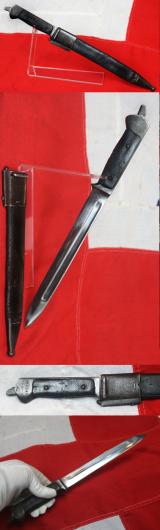
A Quite Rare Danish M1889 Krag-Jorgensen Knife Bayonet, Early Model by Weyersberg
Single-fullered spear point blade, forged together with the entire hilt as one piece of steel. Chequered black leather grips secured by two steel rivets. Black leather scabbard with steel mounts at the throat and chape. Unique locking mechanism, consisting of an integral locking catch on the scabbard, and sprung release lever on the hilt.
The ricasso of the blade is stamped with a ‘king’s head’ and ‘knight’s helm’ marks, over ‘W. K & C’, which stands for the maker Weyersberg, Kirschbaum & Co. of Solingen, Germany. Below this on the rim of the grip is stamped a crown over ‘91’, which means this bayonet was produced in 1891.
The pommel is stamped on one side with a unit mark ‘. to the th Battalion, over a cancelled unit mark ‘B ’ to the th Battalion, and on the other side with the item number ‘’. The chape finial of the scabbard is stamped ‘B’ to the rd Battalion and on the other side with ‘’.
The leather grips mark this out as the early version of this bayonet, which was made in Germany. The later and more common version was introduced in 1892: made in Denmark, it had wooden grips, which held up better to heavy use and wet conditions. Those bayonets of the early model whose grips wore out also received wooden replacements. The Danes were the first nation to adopt the Norwegian-designed Krag-Jorgensen rifle, followed by the United States and Norway. The blade is superbly bright The hilt and pommel have light, even patination. The leather grips have some light handling wear to the chequering. overall in great condition for age. read more

19th Century, Antique, Mandingo Mandinka Chief's Slave and Gold Trader's Sword With Tattooed-Leather Covered Wooden Scabbard
A most scarce and original African slave and gold trader chieftain's sword
The Manding (Mandingo) are West African people. Their traditional slaver's sword comprises a sabre like blade, a guardless leather grip and wide expanded scabbard with exquisite tattooed leather work.
This example is a fine example of very nice quality and most finely tattooed.
It has a 16 inches long curved blade, leather grip and leather scabbard with leaf shaped widening tip, entirely tooled tattooed and decorated. Of special interest is the finely bound and decorated leather work. These weapons are well known for their rare leather-work and the tattooing applied to the leather of the scabbards. The iron work skills are of black-smith quality.
Slave raiding, capture and trading in the Mandinka regions existed in significant numbers long before the European colonial era, as is evidenced in the memoirs of the 14th century Moroccan traveller and Islamic historian Ibn Battuta. Slaves were part of the socially stratified Mandinka people, and several Mandinka language words, such as Jong or Jongo refer to slaves. There were fourteen Mandinke kingdoms along the Gambia River in the Senegambia region during the early 19th century, for example, where slaves were a part of the social strata in all these kingdoms.
Scholars have offered several theories on the source of the transatlantic slave trade of Mandinka people. According to Boubacar Barry, a professor of History and African Studies, chronic violence between ethnic groups such as Mandinka people and their neighbours, combined with weapons sold by slave traders and lucrative income from slave ships to the slave sellers, fed the practice of captives, raiding, manhunts, and slaves. The victimised ethnic group felt justified in retaliating. Slavery was already an accepted practice before the 15th century. As the demand grew, states Barry, Futa Jallon led by an Islamic military theocracy became one of the centres of this slavery-perpetuating violence, while Farim of Kaabu (the commander of Mandinka people in Kaabu) energetically hunted slaves on a large scale. Martin Klein (a professor of African Studies) states that Kaabu was one of the early suppliers of African slaves to European merchants
Many blades were taken by the Mandingo and fitted from European weapons, such as sabres and short cutlasses. .
In general, these remain primarily considered Mandingo weapons, and from regions in Mali. These were of course invariably mounted with European sabre blades. Mandingo Tribe (also known as the Mandinka, Mande, or the Malinke Tribes) were the traders of the African West Coast, trading primarily in gold and slaves.
In 1324, Mansa Musa who ruled Mali, went on Hajj pilgrimage to Mecca with a caravan carrying gold. Shihab al-Umari, the Arabic historian, described his visit and stated that Musa built mosques in his kingdom, established Islamic prayers and took back Maliki school of Sunni jurists with him. According to Richard Turner – a professor of African American Religious History, Musa was highly influential in attracting North African and Middle Eastern Muslims to West Africa
Picture in the gallery of a Mandingo Slave Trader Chieftain, standing next to his boy sword bearer, carrying his very same form of 'tattooed' sword. One, from an original collection of weapons we recently acquired.
Overall the leather on this sword in in exceptional condition and beautifully decorated.
Early medeavil painting in the gallery of Mansa Musa's visit to Mecca in 1324 CE with large amounts of gold, that not unsurprisingly attracted many Middle Eastern Muslims and Europeans to Mali. read more
455.00 GBP
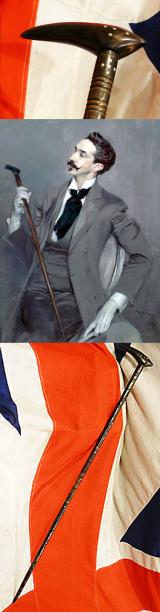
A Stunning Antique, 19th Century, Colonial Walking Stick of Carved and Turned Horn, Inlaid With Circular Pattern Design
A heavy quality stick of most attractive form and fine quality. Every other portrait of a Georgian, Victorian, or Edwardian gentleman, shows some nattily dressed fellow with a walking stick pegged jauntily into the ground or a slim baton negligently tucked under the elbow. The dress cane was the quintessential mark of the dandy for three centuries, part fashion accessory, part aid to communication, part weapon, and of course, a walking aid. A dandy, historically, is a man who places particular importance upon physical appearance, refined language, and leisurely hobbies, pursued with the appearance of nonchalance in a cult of self. A dandy could be a self-made man who strove to imitate an aristocratic lifestyle despite coming from a middle-class background, especially in late 18th- and early 19th-century Britain.
Previous manifestations of the petit-maitre (French for "small master") and the Muscadin have been noted by John C. Prevost, but the modern practice of dandyism first appeared in the revolutionary 1790s, both in London and in Paris. The dandy cultivated cynical reserve, yet to such extremes that novelist George Meredith, himself no dandy, once defined cynicism as "intellectual dandyism". Some took a more benign view; Thomas Carlyle wrote in Sartor Resartus that a dandy was no more than "a clothes-wearing man". Honore De Balzac introduced the perfectly worldly and unmoved Henri de Marsay in La fille aux yeux d'or (1835), a part of La Comedie Humaine, who fulfils at first the model of a perfect dandy, until an obsessive love-pursuit unravels him in passionate and murderous jealousy.
Charles Baudelaire defined the dandy, in the later "metaphysical" phase of dandyism, as one who elevates esthetics to a living religion, that the dandy's mere existence reproaches the responsible citizen of the middle class: "Dandyism in certain respects comes close to spirituality and to stoicism" and "These beings have no other status, but that of cultivating the idea of beauty in their own persons, of satisfying their passions, of feeling and thinking Dandyism is a form of Romanticism. Contrary to what many thoughtless people seem to believe, dandyism is not even an excessive delight in clothes and material elegance. For the perfect dandy, these things are no more than the symbol of the aristocratic superiority of mind."
The linkage of clothing with political protest had become a particularly English characteristic during the 18th century. Given these connotations, dandyism can be seen as a political protest against the levelling effect of egalitarian principles, often including nostalgic adherence to feudal or pre-industrial values, such as the ideals of "the perfect gentleman" or "the autonomous aristocrat". Paradoxically, the dandy required an audience, as Susann Schmid observed in examining the "successfully marketed lives" of Oscar Wilde and Lord Byron, who exemplify the dandy's roles in the public sphere, both as writers and as personae providing sources of gossip and scandal. Nigel Rodgers in The Dandy: Peacock or Enigma? Questions Wilde's status as a genuine dandy, seeing him as someone who only assumed a dandified stance in passing, not a man dedicated to the exacting ideals of dandyism.
36.5 inches read more
265.00 GBP
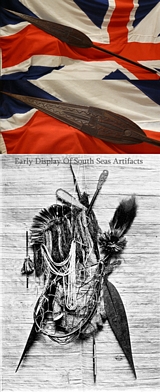
A Beautiful Antique African Tribal Carved Paddle-Spear Possibly of the Itsekiri People Or Even Benin
One of a matched pair we acquired but we are selling separately. In carved native wood with geometric carving covering one paddle side, the other side is different . This is a dance paddle of the kind used in ceremonies by the Itsekiri people of the Niger delta. The river was at the centre of tribal society and economy – it provided food and transport for the communities who lived in the area. Canoes were an extremely important part of traditional society and so the paddle was an important symbol for prosperity. Local people relied on the river for their quality of life and believed in water spirits. This paddle is decorated with intricate carving and may have been used in ceremonial dances. Alternatively, it may have been made for trading with Europeans as ethnic objects became fashionable possessions. Although African, like Oceanic art it is often infused with ancestral spirits, as well as spirits of water, air and land. These spirits are contacted in ceremonies to ensure fertility, or invoke protection from famine, disease or enemies.
Sometimes these invocations serve extremely practical purposes. There was a ceremony in Papua New Guinea where ancestral spirits were activated in a carved wooden crocodile. Men carrying the crocodile were then led, like people holding a divining rod are led, to the home of a local murderer.
African and Oceanic art is not only made for decoration. It is made to be used as a tool in the culture. Cubist painters, and especially Surrealists, were moved by the power of Oceanic abstractions, as they were by traditional African art . This wonderful piece would make a stunning additional display of object d’art in any setting, albeit traditional or contemporary read more
495.00 GBP
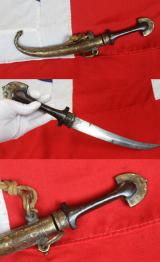
A Good 19th Century, Heavy Grade, Antique 'Berber's' Jambiya or Koummya
Two ring mounting with beautiful and finely scroll engraved panelled front decoration The koummya is the characteristic traditional dagger of the Berber and Arabic peoples of Morocco. Stone classifies these as being one localised variant of the Arabic jambiya, and the contoured handles, curved double-edged blades and exaggeratedly upturned scabbard tips are all features consistent with such an interpretation. In the context of the traditional regional manner of dress, the koummya is worn visibly at the left side, generally about at the level of the waist and is suspended vertically, with the scabbard tip forward, by a long woolen baldric, attached at either end to one of the two scabbard rings, and worn crossing in front and back of the torso and over the right shoulder. A much greater diversity in forms and decoration exists than is represented by the examples presented here and presumably such features could be used to place particular examples geographically and temporarily.
Koummya blades are curved and double edged with the portion nearer the hilt remaining relatively straight while the curvature becomes pronounced in the half towards the tip. The length of the blade which is bevelled and sharpened is longer along the concave side than along the opposite convex side. Blade thickness tapers from the base of the blade, where it is thickest, to the tip. While the edge bevels may give the blade a flattened diamond or lenticular cross-section towards the tip, the cross-section is rectangular at the forte. These blades are characteristically relatively thin and utilitarian and the presence of fullers or ridges is not typical. read more
275.00 GBP
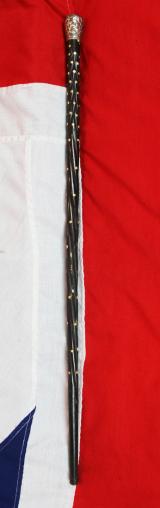
A Most Interesting & Beautiful Quality Victorian Walking Cane. With a Florid Repousse Silver Top, Carved Spiral Haft With Carved Bullet Inlays
Carved spiral twist body with a cross-hatched top section. The dress cane was the quintessential mark of the dandy for three centuries, part fashion accessory, part aid to communication, part weapon, and of course, a walking aid. A dandy, historically, is a man who places particular importance upon physical appearance, refined language, and leisurely hobbies, pursued with the appearance of nonchalance in a cult of self. A dandy could be a self-made man who strove to imitate an aristocratic lifestyle despite coming from a middle-class background, especially in late 18th- and early 19th-century Britain.
Previous manifestations of the petit-maitre (French for "small master") and the Muscadin have been noted by John C. Prevost, but the modern practice of dandyism first appeared in the revolutionary 1790s, both in London and in Paris. The dandy cultivated cynical reserve, yet to such extremes that novelist George Meredith, himself no dandy, once defined cynicism as "intellectual dandyism". Some took a more benign view; Thomas Carlyle wrote in Sartor Resartus that a dandy was no more than "a clothes-wearing man". Honore De Balzac introduced the perfectly worldly and unmoved Henri de Marsay in La fille aux yeux d'or (1835), a part of La Comedie Humaine, who fulfils at first the model of a perfect dandy, until an obsessive love-pursuit unravels him in passionate and murderous jealousy.
Charles Baudelaire defined the dandy, in the later "metaphysical" phase of dandyism, as one who elevates esthetics to a living religion, that the dandy's mere existence reproaches the responsible citizen of the middle class: "Dandyism in certain respects comes close to spirituality and to stoicism" and "These beings have no other status, but that of cultivating the idea of beauty in their own persons, of satisfying their passions, of feeling and thinking Dandyism is a form of Romanticism. Contrary to what many thoughtless people seem to believe, dandyism is not even an excessive delight in clothes and material elegance. For the perfect dandy, these things are no more than the symbol of the aristocratic superiority of mind."
The linkage of clothing with political protest had become a particularly English characteristic during the 18th century. Given these connotations, dandyism can be seen as a political protest against the levelling effect of egalitarian principles, often including nostalgic adherence to feudal or pre-industrial values, such as the ideals of "the perfect gentleman" or "the autonomous aristocrat". Paradoxically, the dandy required an audience, as Susann Schmid observed in examining the "successfully marketed lives" of Oscar Wilde and Lord Byron, who exemplify the dandy's roles in the public sphere, both as writers and as personae providing sources of gossip and scandal. Nigel Rodgers in The Dandy: Peacock or Enigma? Questions Wilde's status as a genuine dandy, seeing him as someone who only assumed a dandified stance in passing, not a man dedicated to the exacting ideals of dandyism. 31.5 inches long read more
325.00 GBP