
Antique Arms & Militaria

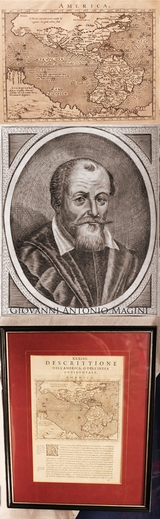
A Wonderful Original 16th Century Map of America By Giovanni Antonio Magini
A fabulous original historical artifact ideal for the collector with an interest in early maps and the earliest period of modern America. Magini (Giovanni Antonio), Plate XXXIIII, Descrittione Dell'America, O Dell'India Occidentale, no date [ printed in 1598], engraved map of America [North and South] with Italian text below, map plate 140mm x 180mm, uncoloured, mounted, framed and glazed. Giovanni Antonio Magini (in Latin, Maginus) (13 June 1555 11 February 1617) was an Italian astronomer, astrologer, cartographer, and mathematician. He was born in Padua, and completed studies in philosophy in Bologna in 1579. His father was Pasquale Magini, a citizen of Padua. Dedicating himself to astronomy, in 1582 he wrote Ephemerides coelestium motuum, translated into Italian the following year.
In 1588 he was chosen over Galileo Galilei to occupy the chair of mathematics at the University of Bologna after the death of Egnatio Danti. He died in Bologna. Magini supported a geocentric system of the world, in preference to Copernicus's heliocentric system. Magini devised his own planetary theory, in preference to other existing ones. The Maginian System consisted of eleven rotating spheres, which he described in his Novo colestium orbium theoric congruentes cum observationibus N. Copernici (Venice, 1589).
In his De Planis Triangulis (1592), he described the use of quadrants in surveying and astronomy. In 1592 Magini published Tabula tetragonica, and in 1606 devised extremely accurate trigonometric tables. He also worked on the geometry of the sphere and applications of trigonometry, for which he invented calculating devices. He also worked on the problem of mirrors and published on the theory of concave spherical mirrors. Framed 38cm x 30.5cm read more
935.00 GBP

A Beautiful & Superb Quality, Antique, Late Victorian, Finely Engraved Silver & Mother O'Pearl Handled Sword-Cane. A Most Elegant & Sophisticated Work of Art In Near Mint Condition.
Long silver and mother o'pearl handle. A long bamboo haft with superb patination and a quatrefoil four sided edged blade. Overall in stunning condition for age, as much a work of art as a former functional walking cane sword.
Lord Byron's was a most exponent of the use and carrying of the gentleman’s sword stick. His was exhibited in King's College London, bearing a mercurial gilt collar bearing his name, coronet and adopted surname Noel. Upon the death of Byron's mother-in-law Judith Noel, the Hon. Lady Milbanke, in 1822, her will required that he change his surname to "Noel" so as to inherit
An interesting 19th century conversation and collector's piece, and one can ponder over of the kind of gentleman who would have sought and required such a piece of personal defence paraphernalia. Although one likes to think that jolly old England had a London full of cheerful cockneys and laddish chimney sweeps, it was also plagued with political intrigue, nefarious characters and caddish swine prowling the endless foggy thoroughfares and dimly lit passageways. The swordstick was a popular fashion accessory for the wealthy during the 18th and 19th centuries. While the weapon's origins are unknown, it is apparent that the cane-sword's popularity peaked when decorative swords were steadily being replaced by canes as a result of the rising popularity of firearms, and the lessening influence of swords and other small arms.
The first sword canes were made for nobility by leading sword cutlers. Sixteenth century sword canes were often bequeathed in wills. Sword canes became more popular as the streets became less safe. Society dictated it mandatory that gentlemen of the 18th and especially 19th centuries would wear a cane when out and about, and it was common for the well-dressed gentleman to own and sport canes in a variety of styles, including a good and sound sword cane. Although Byron was proficient in the use of pistols, his lameness and his need to defend himself in some potentially dangerous situations made a swordstick doubly useful to him. He received lessons in London from the fencing master Henry Angelo and owned a number of swordsticks, some of which were supplied by his boxing instructor Gentleman John Jackson.
On Byron’s sword cane was the name NOEL BYRON, upon the ferrule of his one indicated that it was used after 1822, when Byron added the surname Noel after the death of his mother-in-law.
There are several references to sword sticks in the correspondence of Byron and his circle. Byron wrote to Hobhouse from Switzerland on 23 June 1816 asking him to Bring with you also for me some bottles of Calcined Magnesia a new Sword cane procured by Jackson he alone knows the sort (my last tumbled into this lake ) some of Waite's red tooth-powder & tooth-brushes a Taylor's Pawrsanias Pausanias and I forget the other things. Hobhouse responded on 9 July: Your commissions shall be punctually fulfilled whether as to muniments for the mind or body pistol brushes, cundums, potash Prafsanias Pausanias tooth powder and sword stick.
In the entry for 22 September 1816 in Byron's Alpine Journal he describes how, at the foot of the Jungfrau,
"Storm came on , thunder, lightning, hail, all in perfection and beautiful, I was on horseback the Guide wanted to carry my cane I was going to give it him when I recollected it was a Sword stick and I thought that the lightning might be attracted towards him kept it myself a good deal encumbered with it & my cloak as it was too heavy for a whip and the horse was stupid & stood still every other peal."
In a letter to Maria Gisborne of 6-10 April 1822, Mary Shelley described the "Pisan affray" of 24 March, in which Sergeant-Major Masi was pitch-forked by one of Byron's servants. She recounted how Byron rode to his own house, and got a sword stick from one of his servants.
Sword sticks came in all qualities, and for numerous purposes, from the simplest bamboo sword cane personal defender to stout customs officer’s ‘prod’, to offensive close quarter stiletto dagger canes and even to the other side of the world in the form of Japanese samurai’s shikome-sue, hidden swords.
We show two famous sword sticks in the gallery, one that belonged to Lord Byron, and another in a Presidential Centre Library collection, a historic sword stick is part of the Rutherford B. Hayes Presidential Centre Library collection in Fremont, Ohio from the Waggoner family, the sword-cane was said to have been presented to Mr Waggoner by General George Washington in honour of Waggoner's service in Washington's Life Guard during the American Revolutionary War.
But it was Louis XIII who brought the cane to importance as a royal accessory. The king, as his portraits depict, supposedly always held one in his hands. He also gave them – along with valuable snuffboxes – as gifts of honour. Accordingly, gentlemen who wanted to be fashionable never went without this accessory from that time on. At the time, these were sort of ornate rods without a curved handle that were held in the hand or carried under the arm.
The 19th century and the beginning of the 20th century became the age of the cane. The tremendous popularity then created the desire to be seen with a cane. And so a wealth of unique
pieces with practical and strange handles and a mysterious inner life were created. The painter
Henri de Toulouse-Lautrec, for example, owned a cane containing a bottle that held a pint of absinthe.
In the mid-18th century Saxony's prime minister, Heinrich Graf von Brühl, possessed 300 sticks to go with 300 suits, together with just as many snuffboxes which he weared in turn. King Friedrich II, too, had a huge collection of luxurious walking sticks and snuffboxes. After the Seven-Years War one particular type of sticks with a handle formed like a rope, which was King Friedrich’s constant companion, became so popular, that it was dubbed the "Fritz crutch".
Overall 39 inches long, blade 25.75 inches long, silver & mother o'pearl handle, 12.5 inches long. read more
1250.00 GBP

A Most Elegant Equestrian Walking Stick Cum Dandy Cane
Finely carved handle of a horses hoof and fetlock. The stick is a superb close grain hardwood. Overall in super condition. Every other portrait of a Georgian, Victorian, or Edwardian gentleman, shows some nattily dressed fellow with a walking stick pegged jauntily into the ground or a slim baton negligently tucked under the elbow. The dress cane was the quintessential mark of the dandy for three centuries, part fashion accessory, part aid to communication, part weapon, and of course, a walking aid. A dandy, historically, is a man who places particular importance upon physical appearance, refined language, and leisurely hobbies, pursued with the appearance of nonchalance in a cult of self. A dandy could be a self-made man who strove to imitate an aristocratic lifestyle despite coming from a middle-class background, especially in late 18th- and early 19th-century Britain.
Previous manifestations of the petit-maitre (French for "small master") and the Muscadin have been noted by John C. Prevost, but the modern practice of dandyism first appeared in the revolutionary 1790s, both in London and in Paris. The dandy cultivated cynical reserve, yet to such extremes that novelist George Meredith, himself no dandy, once defined cynicism as "intellectual dandyism". Some took a more benign view; Thomas Carlyle wrote in Sartor Resartus that a dandy was no more than "a clothes-wearing man". Honore De Balzac introduced the perfectly worldly and unmoved Henri de Marsay in La fille aux yeux d'or (1835), a part of La Comedie Humaine, who fulfils at first the model of a perfect dandy, until an obsessive love-pursuit unravels him in passionate and murderous jealousy.
Charles Baudelaire defined the dandy, in the later "metaphysical" phase of dandyism, as one who elevates esthetics to a living religion, that the dandy's mere existence reproaches the responsible citizen of the middle class: "Dandyism in certain respects comes close to spirituality and to stoicism" and "These beings have no other status, but that of cultivating the idea of beauty in their own persons, of satisfying their passions, of feeling and thinking Dandyism is a form of Romanticism. Contrary to what many thoughtless people seem to believe, dandyism is not even an excessive delight in clothes and material elegance. For the perfect dandy, these things are no more than the symbol of the aristocratic superiority of mind."
The linkage of clothing with political protest had become a particularly English characteristic during the 18th century. Given these connotations, dandyism can be seen as a political protest against the levelling effect of egalitarian principles, often including nostalgic adherence to feudal or pre-industrial values, such as the ideals of "the perfect gentleman" or "the autonomous aristocrat". Paradoxically, the dandy required an audience, as Susann Schmid observed in examining the "successfully marketed lives" of Oscar Wilde and Lord Byron, who exemplify the dandy's roles in the public sphere, both as writers and as personae providing sources of gossip and scandal. Nigel Rodgers in The Dandy: Peacock or Enigma? Questions Wilde's status as a genuine dandy, seeing him as someone who only assumed a dandified stance in passing, not a man dedicated to the exacting ideals of dandyism. 36.5 inches long read more
275.00 GBP
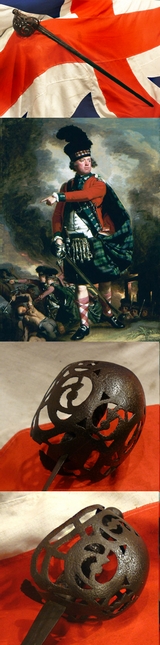
Original 18th Century Scottish Fencible Regimental Basket Hilted Broadsword
With distinctive two part centrally welded basket, in sheet iron, with scrolls and thistles there over. Interesting original regimental swords of the 18th century, from Scottish regiments are very much sought after throughout the entire world. Scottish Fencible Regiment's swords are now jolly rare indeed, and they are highly distinctive in their most unique form. Fancy carved replacement grip. Some ironwork separation on the basket by the forte of the blade, but overall in good sound condition. Overall natural age surface pitting. Made for the war with Revolutionary France in the 1790's. The total number of British fencible infantry regiments raised during the Seven Years' War and the American War of Independence was nine, of which six were Scottish, two were English and one was Manx. The regiments were raised during a time of great turbulence in Europe when there was a real fear that the French would either invade Great Britain or Ireland, or that radicals within Britain and Ireland would rebel against the established order. There was little to do in Britain other than garrison duties and some police actions, but in Ireland there was a French supported insurrection in 1798 and British fencible regiments were engaged in some pitched battles. Some regiments served outside Great Britain and Ireland. Several regiments performed garrison duties on the Channel Islands and Gibraltar. A detachment of the Dumbarton Fencibles Regiment escorted prisoners to Prussia, and the Ancient Irish Fencibles were sent to Egypt where they took part in the operations against the French in 1801.
When it became clear that the rebellion in Ireland had been defeated and that there would be peace between France and Britain in 1802 (The preliminaries of peace were signed in London on 1 October 1801) the Fencible regiments were disbanded.
The British cavalry and light dragoon regiments were raised to serve in any part of Great Britain and consisted of a force of between 14,000 and 15,000 men. Along with the two Irish regiments, those British regiments that volunteered for service in Ireland served there. Each regiment consisted of eighteen commissioned officers and troops of eighty privates per troop. The regiments were always fully manned as their terms of service were considered favourable. At the beginning of 1800 all of the regiments were disbanded read more
2750.00 GBP

A Spectacular & Beautiful 'Harvey' British Dragoon Basket Hilted Sword, Culloden Period, With Large King George's Crown & Cypher Engraved Blade Museum Grade Example
As used by the Scot's Dragoon's and the 7th Queens Dragoons, in fact all the British heavy dragoons in the 1740's up to 1790's. From the Battle of Culloden until the American Revolutionary War in the 1770's.
Likely made by the world famous English blade maker of his day, Samuel Harvey, and bearing the royal GR Cypher of King George. The Harvey surname was one of the marks of renown Birmingham maker, Samuel Harvey, 1718-1778, who supplied many basket hilted swords to the British Crown, mostly for use by Highland troops. This sword is marked with the surname alone, HARVEY below the Crown and Cypher the overlapping monogram of GR for King George. His more common mark was a running wolf, his other marks could be Harvey or S.Harvey. The fabulous basket hilt has the large oval ring insert, for the holding of the horses reins while gripping the sword when riding to battle, and part of the original buff hide basket liner. Wire bound fishskin grip, discoid pommel.
The British dragoon regiments were a decisive force in the Battle of Culloden for example; At the close of the battle the stand by the Royal Ecossais may have given Charles Edward Stuart the time to make his escape. At the time when the Macdonald regiments were crumbling and fleeing the field, Stuart seems to have been rallying Perth's and Glenbuchat's regiments when O'Sullivan rode up to Captain Shea who commanded Stuart's bodyguard: "Yu see all is going to pot. Yu can be of no great succor, so before a general deroute wch will soon be, Seize upon the Prince & take him off ". Shea then led Stuart from the field along with Perth's and Glenbuchat's regiments. From this point on the fleeing Jacobite forces were split into two groups: the Lowland regiments retired in order southwards, making their way to Ruthven Barracks; the Highland regiments however were cut off by the government cavalry, and forced to retreat down the road to Inverness. The result was that they were a perfect target for the government dragoons. Major-general Humphrey Bland led the charge against the fleeing Highlanders, giving "Quarter to None but about Fifty French Officers and Soldiers He picked up in his Pursuit". The basket hilted sword of this very form and character were used by British heavy dragoons for several decades, importantly in the American Revolutionary war. There is a near identical sword by Harvey, bearing the same form of maker mark and crown GR in a collection of American War of Independence weaponry featured in "Swords and Blades of the American Revolution" by George C. Neumann. Page 148 sword 261s
The shortage of cavalry in the Revolutionary War was a major drawback for the British. A strong cavalry presence at battles like Long Island and Brandywine could have enabled the British to encircle the Americans and prevent their retreat. It is possible that a strong cavalry force would have captured Washington's army entirely during the march south through New Jersey in 1776. This is the form of sword used by the Scot's Greys Dragoons in the 7 Years War against France, and by the 7th Queen's Dragoons. One of the earliest basket-hilted swords was recovered from the wreck of the Mary Rose, an English warship lost in 1545. Before the find, the earliest positive dating had been two swords from around the time of the English Civil War. At first the wire guard was a simple design but as time passed it became increasingly sculpted and ornate. During the 18th century, the fashion of duelling in Europe focused on the lighter smallsword, and fencing with the broadsword came to be seen as a speciality of Scotland. A number of fencing manuals teaching fencing with the Scottish broadsword were published throughout the 18th century. Portraits from the time show this very sword as worn. 35 3/4 inch blade length read more

Rare English Light Dragoon Officer's Sword 1773, of the American Revolutionary War, Used By Both American and British Dragoon Regiments.
One of the of the American Revolutionary War cavalry swords used by both protagonists. This superb sword was near identical {apart from the blade engraving} to one formerly in the world renown Tower of London collection, see it featured in photo plate 70, sword D, in "European Swords and Daggers in the Tower of London" by Arthur Richard Dufty, Master of the Armouries.
A beautifully engraved blade with King George's crest and family motto of the Hanovarian princes, 'Suscipere et Finire' trans. 'to support and finish', and another, on the other blade face, a loyalty motto 'for king and country', also in Latin, 'Pro Rege et Patria' This blade may well be an ancestral blade, as the regular blade would usually be flat sided without fuller. The Coat of Arms of HM King George III as King underwent a number of changes during his reign because the British Royal Arms are territorial and represent the main countries over which the Monarch rules rather than being personal. The Hanoverian Dynasty 'inherited' the Arms of the last Stuart Monarch, Queen Anne, and added a Quarter for their own territory, namely the then Electorate/Duchy of Brunswick and Lüneburg, commonly known as Hanover.
Although practised no longer by the Tower of London Executors, during the past two centuries, on just a very few occasions, the Tower of London has sold a few items by auction in order to facilitate an influx of funds for new acquisitions
A sword of particular fine elegance, yet this was designed to do a very specific task for an 18th century dragoon officer, and it did it well. Brass stirrup hilt now very finely and naturally heavily patinated, through age, and a very long clipped back blade. It has all its original ribbed carved horn grip. This English sword is most rarely seen, with very little known of it's design origins, the blade, and as very few remain in existence it rarely appears photographed in many reference books on British/American swords of the American Revolutionary War or War of Independence as it is also known.
Little or no documentation on its original ordnance order, made some 250 years ago, regarding its manufacture, exists. What is known however, is that it is estimated it was made from 1773, but possibly slightly earlier, and it was replaced by the more abundant 1788 pattern version. That replacement 1788 sword is far more well recorded, and fair number of that type survive. A very few examples of this sword are kept in just a few, select American museums, that contain the military collections of captured British weapons, and also those used by former American born British officers that moved over to serve in the new American Continental Army Light Dragoons under George Washington in the American Revolutionary War. We show two paintings of American Continental Dragoons using this pattern of sword. In our conversations in the 1980's with the eminent Howard Blackmore, Assistant Keeper of Weapons at the Tower of London, he believed these cavalry swords, when they surfaced, were possibly one of the most interesting of swords used in the Revolution in America, in that they were used by officers of both sides, but sadly so few survived the war itself that they are now considered to be one of the rarest swords of their type to exist. These swords were originally made for, and used by, the British Light Dragoon Regiments, including the infamous and well recorded through history 'Tarleton's Green Dragoons'. Banastre Tarleton was originally a young British officer of the 1st Dragoon Guards, who purchased his rank of cornet. He proved to be such a gifted horseman and leader of troops, due to his outstanding ability alone, he worked his way up through the ranks to Lieutenant Colonel without having to purchase any further commissions.
In December 1775, he sailed from Cork as a volunteer to North America where rebellion had recently broken out triggering the American War of Independence. Tarleton sailed with Lord Cornwallis as part of an expedition to capture the southern city of Charleston. After this failed, he joined the main British Army in New York under General Howe. His service during 1776 gained him the position of a brigade major of cavalry. After becoming the commander of the British Legion, a mixed force of cavalry and light infantry also called Tarleton's Raiders, he proceeded at the beginning of 1780 to South Carolina, rendering valuable services to Sir Henry Clinton in the operations which culminated in the capture of Charleston. This was part of the 'southern strategy' by which the British directed most of their efforts to that theater hoping to restore authority over the southern colonies where they believed there was more support for the crown. On 29 May 1780, Tarleton, with a force of 150 mounted soldiers, overtook a detachment of 350 to 380 Virginia Continentals led by Abraham Buford. Buford refused to surrender or even to stop his march. Only after sustaining heavy casualties did Buford order the surrender. What happened next is cause of heated debate. According to American accounts, Tarleton ignored the white flag and mercilessly massacred Buford's men. In the end, 113 Americans were killed and another 203 captured, 150 of whom were so badly wounded that they had to be left behind. Tarleton's casualties were 5 killed and 12 wounded.6 The British called the affair the Battle of Waxhaw Creek, while the Americans called it the "Buford Massacre" or the "Waxhaw Massacre." In recounting Tarleton's action at the scene, an American field surgeon named Robert Brownfield wrote that Col. Buford raised a white flag of surrender, "expecting the usual treatment sanctioned by civilized warfare". While Buford was calling for quarter, Tarleton's horse was struck by a musket ball and fell. This gave the loyalist cavalrymen the impression that the rebels had shot at their commander while asking for mercy. Enraged, the loyalist troops charged at the Virginians. According to Brownfield, the loyalists attacked, carrying out "indiscriminate carnage never surpassed by the most ruthless atrocities of the most barbarous savages." Tarleton's men stabbed the wounded where they lay. In Tarleton's own account, he virtually admits the massacre, stating that his horse had been shot from under him during the initial charge and his men, thinking him dead, engaged in "a vindictive asperity not easily restrained." However there are strange contraditions as to Tarleton's behaviour, for, contrary to his nature, as described by his conduct at Monticello, Thomas Jefferson himself later noted,
"I did not suffer by him. On the contrary he behaved very genteely with me. … He gave strict orders to Capt. Mcleod to suffer nothing to be injured." Tarleton materially helped Cornwallis to win the Battle of Camden in August 1780. He was completely victorious in an engagement with Thomas Sumter at Fishing Creek, aka "Catawba Fords", but was less successful when he encountered the same general at Blackstock's Farm in November 1780. Then in January 1781, Tarleton's forces were virtually destroyed by American Brigadier General Daniel Morgan at the Battle of Cowpens. Tarleton however managed to flee the battlefield with perhaps 250 men. Although Tarleton had a deservedly dastardly reputation, many other Light Dragoon forces were commanded by far more respected and gentlemanly officers, and the troops under their command fought in the most formative conflicts of both American and British history. A war that shaped the whole world that followed it, arguably more than any other war before it. Although in terms of casualties, fewer men perished in the whole war of Independence, that covered several years, than in a single day during the Battle of Gettysberg, less than 100 years later in the Civil War.
The carved ribbed horn grip is expansion cracked North to South. read more
2350.00 GBP
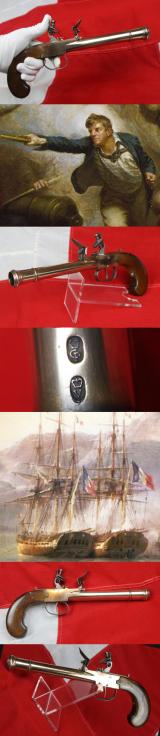
A Fabulous & Impressive 18th Century Ship Captain’s Beautiful & Large, Brass Barrel Naval Blunderbuss Flintlock Pistol, With Box-Lock Action.
6.5inch barrel with ring turned muzzle, nice action, sliding safety, bag-shaped wooden butt. Nicely proved barrel on the underside. This is truly a most beautiful piece.
The combination of polished bronze, walnut, horn, and steel make a most attractive pistol of colour and material contrasts. Finest walnut stock. Bronze cannon form blunderbuss barrel. Bronze blunderbuss barrel pistols were the weapon of choice for naval officers and ship's captains for use at sea. This is a superb example of its kind. The muzzle (and often the bore) was flared with the intent not only to increase the spread of the shot, but also to funnel powder and shot into the weapon, making it easier to reload in haste. The overtly flared muzzle is the defining feature of the blunderbuss. Ship's Captains found such impressive guns so desireable as they had two prime functions to clear the decks with one shot, and the knowledge to an assailant that the pistol hads the capability to achieve such a result. In the 18th and 19th century mutiny was a common fear for all commanders, and not a rare as one might imagine. The Capt. Could keep about his person or locked in his gun cabinet in his quarters a gun just as this. The barrel could be loaded with single ball or swan shot, ball twice as large as normal shot, that when discharged at close quarter could be devastating, and terrifyingly effective. Potentially taken out four or five assailants at once. The muzzle was swamped like a cannon for two reasons, the first for ease of rapid loading, the second for intimidation. There is a very persuasive psychological point to the size of this gun's muzzle, as any person or persons facing it could not fail to fear the consequences of it's discharge, and the act of surrender or retreat in the face of an well armed blunderbuss could be a happy and desirable result for all parties concerned. Action in excellent working order, recently fully serviced. 11 inches long overall. As with all our antique guns no license is required as they are all unrestricted antique collectables read more
2850.00 GBP
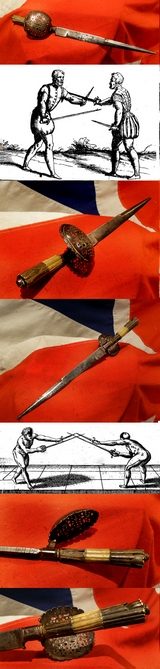
A Most Rare & Beautiful 16th-17th Century Italian Maine Gauche. A Renaissance Period Duellist's Parrying, Shell Guard Dagger
Long single edged blade with part false edge, and fine armourer's mark at the ricasso.
Triple section grip in horn and bone, bronze pommel cap. Beautifully pierced steel shell guard with scalloped edge. A most beautiful example of an early, Renaissance period 'main gauche' [left hand] duellist parrying dagger. When combined with a long swept or cup hilt rapier the pair make two formidable duo offensive and defensive duelling or combat weapons.
The parrying maine gauche dagger falls within the category of small hand-held weapons from the European late Middle Ages and early Renaissance. These weapons were used as off-hand weapons in conjunction with a single-handed sword. As the name implies they were designed to parry, or defend, more effectively than a simple dagger form, typically incorporating a wider guard, and often some other defensive features to better protect the hand, as well. The main-gauche is used mainly to assist in parrying incoming thrusts, while the dominant hand wields a rapier or similar longer weapon also intended for one-handed use.
It may also be used for attack if an opportunity arises. The general category includes two more specific kinds of weapon: sword breakers and trident daggers.
Its beautifully pierced shell guard was designed to be used as either, a hand protector, or, a sword blade catcher when reversed, depending of the swordsman's preference of his combat style.
The use of an off-hand weapon gradually fell out of favour as sword fighting evolved into the modern sport of fencing. The use of progressively lighter primary weapons such as the small sword, epee, and foil allowed for greater speed. Under these circumstances the use of just a primary weapon offered improvements in balance as well as a stance that offered a smaller target. read more
1750.00 GBP

A Very Rare American War of independence Era 1773-1780 British Light Dragoon Officer's Sword. Originally Purchased from The Tower of London Collection by A Private Collector Nearly 50 Years Ago
One of the rarest swords of the American Revolutionary War cavalry of both protagonists to exist today. This superb sword was formerly in the world renown Tower of London collection, [see photo plate 70 D in "European Swords and Daggers in the Tower of London" by Arthur Richard Dufty Master of the Armouries].
Although practised no longer by the Tower of London Executors, during the past two centuries, on just a very few occasions, the Tower of London has sold a few items by auction in order to facilitate an influx of funds for new acquisitions
Not a sword of particular elegance, for this was designed to do a very specific task for an 18th century cavalryman, and it did it well. Brass stirrup hilt now very finely and naturally heavily patinated, through age, and a very long clipped back blade. It has all its original fishskin bound grip. This English sword is most rarely seen, with very little known of it's design origins, although it does clearly have its ordnance crown inspection stamp on the blade, and as very few remain in existance it rarely appears photographed in many reference books on British/American swords of the American Revolutionary War or War of Independence as it is also known. This fine and rare example was sold from the 'Tower of London Collection' in 1973 at Christie's.
Little or no documentation on its original ordnance order, made some 250 years ago, regarding its manufacture, exists. What is known however, is that it is estimated it was made from 1773, but possibly slightly earlier, and it was replaced by the more abundant 1788 pattern version. That replacement 1788 sword is far more well recorded, and fair number of that type survive. A very few examples of this sword are kept in just a few, select American museums, that contain the military collections of captured British weapons, and also those used by former American born British officers that moved over to serve in the new American Continental Army Light Dragoons under George Washington in the American Revolutionary War. We show two paintings of American Continental Dragoons using this pattern of sword. In our conversations in the 1980's with the eminent Howard Blackmore, Assistant Keeper of Weapons at the Tower of London, he believed these cavalry swords, when they surfaced, were possibly one of the most interesting of swords used in the Revolution in America, in that they were used by officers of both sides, but sadly so few survived the war itself that they are now considered to be one of the rarest swords of their type to exist. These swords were originally made for, and used by, the British Light Dragoon Regiments, including the infamous and well recorded through history 'Tarleton's Green Dragoons'. Banastre Tarleton was originally a young British officer of the 1st Dragoon Guards, who purchased his rank of cornet. He proved to be such a gifted horseman and leader of troops, due to his outstanding ability alone, he worked his way up through the ranks to Lieutenant Colonel without having to purchase any further commissions.
In December 1775, he sailed from Cork as a volunteer to North America where rebellion had recently broken out triggering the American War of Independence. Tarleton sailed with Lord Cornwallis as part of an expedition to capture the southern city of Charleston. After this failed, he joined the main British Army in New York under General Howe. His service during 1776 gained him the position of a brigade major of cavalry. After becoming the commander of the British Legion, a mixed force of cavalry and light infantry also called Tarleton's Raiders, he proceeded at the beginning of 1780 to South Carolina, rendering valuable services to Sir Henry Clinton in the operations which culminated in the capture of Charleston. This was part of the 'southern strategy' by which the British directed most of their efforts to that theater hoping to restore authority over the southern colonies where they believed there was more support for the crown. On 29 May 1780, Tarleton, with a force of 150 mounted soldiers, overtook a detachment of 350 to 380 Virginia Continentals led by Abraham Buford. Buford refused to surrender or even to stop his march. Only after sustaining heavy casualties did Buford order the surrender. What happened next is cause of heated debate. According to American accounts, Tarleton ignored the white flag and mercilessly massacred Buford's men. In the end, 113 Americans were killed and another 203 captured, 150 of whom were so badly wounded that they had to be left behind. Tarleton's casualties were 5 killed and 12 wounded.6 The British called the affair the Battle of Waxhaw Creek, while the Americans called it the "Buford Massacre" or the "Waxhaw Massacre." In recounting Tarleton's action at the scene, an American field surgeon named Robert Brownfield wrote that Col. Buford raised a white flag of surrender, "expecting the usual treatment sanctioned by civilized warfare". While Buford was calling for quarter, Tarleton's horse was struck by a musket ball and fell. This gave the loyalist cavalrymen the impression that the rebels had shot at their commander while asking for mercy. Enraged, the loyalist troops charged at the Virginians. According to Brownfield, the loyalists attacked, carrying out "indiscriminate carnage never surpassed by the most ruthless atrocities of the most barbarous savages." Tarleton's men stabbed the wounded where they lay. In Tarleton's own account, he virtually admits the massacre, stating that his horse had been shot from under him during the initial charge and his men, thinking him dead, engaged in "a vindictive asperity not easily restrained." However there are strange contraditions as to Tarleton's behaviour, for, contrary to his nature, as described by his conduct at Monticello, Thomas Jefferson himself later noted,
"I did not suffer by him. On the contrary he behaved very genteely with me. … He gave strict orders to Capt. Mcleod to suffer nothing to be injured." Tarleton materially helped Cornwallis to win the Battle of Camden in August 1780. He was completely victorious in an engagement with Thomas Sumter at Fishing Creek, aka "Catawba Fords", but was less successful when he encountered the same general at Blackstock's Farm in November 1780. Then in January 1781, Tarleton's forces were virtually destroyed by American Brigadier General Daniel Morgan at the Battle of Cowpens. Tarleton however managed to flee the battlefield with perhaps 250 men. Although Tarleton had a deservedly dastardly reputation, many other Light Dragoon forces were commanded by far more respected and gentlemanly officers, and the troops under their command fought in the most formative conflicts of both American and British history. A war that shaped the whole world that followed it, arguably more than any other war before it. Although in terms of casualties, fewer men perished in the whole war of Independence, that covered several years, than in a single day during the Battle of Gettysberg, less than 100 years later in the Civil War. This sword has a 35 inch blade. No scabbard, for we have never even seen a surviving original scabbard for such a rare sword. This is probably only the second such surviving examples we have had in around 30 years. read more
3450.00 GBP

A Very Fine & Rare, Signally Beautiful, Anglo-American War of 1812, 'Eagle Head' & Scroll Fretted Hilt, American Officer's Sabre. In Great Condition.
It was quite extraordinary, but we acquired a pair of these fabulous and very rare American eagle head pommel and scroll fretted hilted sabres, that have been together since the war, possibly owned by brothers that served, but naturally, officer's swords were never sold as pairs, or indeed used as such, but, none the less, they have been together for almost 200 years. We are, however, selling them individually.
Eagle head pommel with fully feathered back strap, in brass, with scroll fretted knuckle guard, and carved bone grip. Almost all the deluxe grade American officer’s sabres had the expensive alternative option of a carved bone hilt, as opposed to carved ivory, as enjoyed by their British counterparts, as the new nation of America lost all its access to ivory after its split from being part of the British colonial forces. Another one of the long list of negative consequences resulting from the revolution of 1776. It has an engraved bright polished blade, and its original brass mounted leather scabbard, with both twin ring belt strap supports, and an alternative wear option of a frog mount stud. Overall in excellent condition, with usual aged blade etching surface wear.
Used in the War of 1812 period, and a very nice example of these very fine swords,For Canadians, historically, the War of 1812 was the successful defence of a small colony against attack by a much larger neighbour.
Canadians endured repeated invasions and occasional occupations, but each invasion ultimately ended with an American withdrawal. The Royal Navy and British Army supported by Canadian regulars, Canadian militia, and First Peoples warriors, successfully defended Canada. Isaac Brock, Charles de Salaberry, Laura Secord, and Tecumseh became, and remain, iconic Canadian figures. The successful defence of Canada allowed British North America to evolve into an independent transcontinental country.
The War of 1812 was fought between the United States of America and Great Britain and its colonies, Upper and Lower Canada and Nova Scotia, from 1812 to 1815 on land and sea. The Americans declared war on Britain on June 18, 1812, for a combination of reasons, outrage at the impressment (seizure) of thousands of American sailors, frustration at British restraints on neutral trade while Britain warred with France, and anger at British support for native attacks along the frontier which conflicted with American expansion and settlement into the Old Northwest. The war started poorly for the Americans as their attempts to invade Canada were repeatedly repulsed; later in the war, American land forces proved more effective. The Royal Navy lost some early single-ship battles but eventually their numbers told and the naval blockade of the eastern seaboard ruined American commerce, and led to extreme dissatisfaction in New England. Following the American raid and burning of York (now Toronto), the British raided the Chesapeake Bay area and burned parts of Washington D.C. but were repulsed at Baltimore and withdrew. The Americans gained naval control of Lake Erie and Lake Champlain, preventing the planned British invasion of New York. The Americans destroyed the power of the native people of the Northwest and Southeast. With the defeat of Napoleon in 1814, and the stalemate on the battlefields, both nations agreed to a peace that left the prewar boundaries intact. read more
1595.00 GBP